

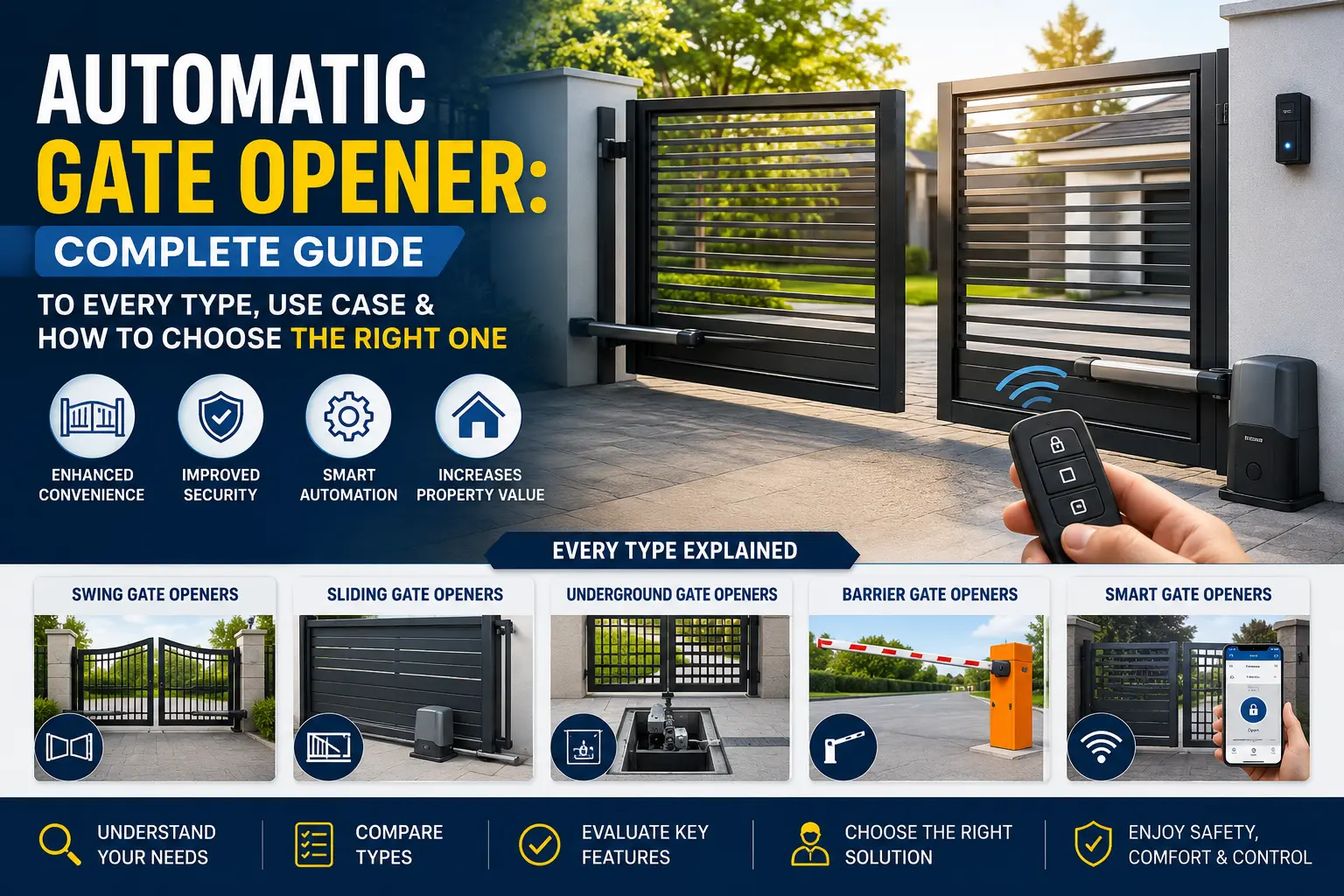
If you've ever typed "automatic gate opener" into a search bar, you already know the problem: the results tell you everything about remotes and nothing about what actually matters — gate weight, duty cycle, mounting type, power supply, and whether the operator you're looking at will still be running five years from now.
This guide cuts through that. It covers every type of automatic gate opener, the specifications that determine whether a system will perform under real conditions, and the application differences between residential driveways, commercial properties, and industrial facilities.
Key Takeaways
- An automatic gate opener is a motorized operator — the mechanism type (arm, rack-and-pinion, boom) is determined by how the gate moves, not by preference
- What separates a $400 residential kit from a $4,000 commercial operator is duty cycle, motor torque, UL 325 class, and the mounting system
- Gate type and operator type are not interchangeable — a swing arm operator on a sliding gate causes immediate mechanical failure
- UL 325 class is a legal compliance requirement — the wrong class at a commercial site is a code violation regardless of whether the gate functions
- A correctly sized, maintained automatic gate opener runs 10–15 years residential and 7–12 years commercial — undersizing destroys that lifespan in 18–36 months
The Direct Answer
An automatic gate opener is a motorized operator that opens and closes a gate automatically in response to a signal — remote, keypad, vehicle sensor, or access control system. The motor drives a mechanism matched to the gate type: an articulated arm for swing gates, a rack-and-pinion drive for sliding gates, or a boom pivot for barrier gates.
That's the definition. What actually separates a $400 residential kit from a $4,000 commercial operator is duty cycle, motor torque, UL 325 compliance class, and the mounting system — four things most buyers never compare before purchasing.
The Full Taxonomy of Automatic Gate Openers
Every automatic gate opener belongs to one of five mechanical categories. Getting this wrong — buying a swing arm operator for a gate that needs a sliding system, or vice versa — results in either installation failure or early motor burnout.
Operator Type
Gate Movement
Drive Mechanism
Typical Application
Cycle Speed
Side-Mounted Swing Operator
Hinged arc, inward or outward
Articulated or linear arm
Residential & light commercial swing gates
15–25 sec
Heavy-Duty Swing Operator
Hinged arc, high torque
Heavy arm or underground piston
Commercial & industrial swing gates
12–20 sec
Sliding/Roll Operator
Horizontal along track
Rack-and-pinion motor
Sloped driveways, high-security, tight spaces
8–15 sec
Floor/Underground Swing Operator
Hinged arc
Hydraulic/electromechanical piston in ground
Architectural, concealed installation
15–25 sec
High-Speed Barrier Gate
Boom arm pivot
Direct-drive pivot motor
Parking, toll, traffic control
1–3 sec
The gate's weight, width, daily cycle count, and site geometry determine which category applies — not the buyer's preference.
Category 1: Side-Mounted Swing Gate Operator
The side-mounted swing gate operator is the most widely installed automatic gate opener in the US residential and light commercial market. It mounts to the side of a gate post — above ground, visible — and drives a hinged gate through its arc using an articulated arm or linear arm attached to the gate panel.
Why it dominates residential installations: it's above-ground, which makes it accessible for service and adjustment without excavation. An experienced installer can have a single-gate system fully operational in three to four hours. The arm mechanism is mechanically transparent — you can see what's happening at every point in the cycle.
The arm types matter:
A linear arm extends and retracts in a straight line. It's the quieter, lower-maintenance option and handles gates up to around 16 feet wide at moderate weights. A articulated arm uses a pivot joint mid-arm, allowing the operator to be mounted closer to the hinge point — useful on gateposts where column geometry restricts the mounting position. Both are standard on BlackBear's side-mounted swing operator line.
Key specifications to evaluate:
- Leaf width capacity (typically 8–20 feet depending on model)
- Gate weight capacity (300 lb to 1,200 lb across residential to commercial grades)
- Duty cycle — residential: 15–25 cycles/hour; commercial: 60+ cycles/hour
- IP rating on the motor enclosure (IP54 minimum for outdoor exposure)
Category 2: Heavy-Duty Swing Operator
Where side-mounted operators handle residential and light commercial swing gates, heavy-duty swing operators are built for high-cycle commercial and industrial sites — warehouse yards, government facilities, logistics centers, gated communities with 24/7 throughput.
The motor torque ratings are dramatically higher. A residential-grade swing operator might produce 500–800 N of holding force. A commercial heavy-duty unit produces 1,500–3,000 N, and handles gates up to 30 feet wide and 2,000 lb per leaf without performance degradation over time.
Duty cycle is the critical distinction. A residential operator rated for 20 cycles per hour placed at a commercial entrance running 150 cycles per day will overheat, trigger thermal cut-out repeatedly, and fail within months. Heavy-duty operators are rated for continuous operation — some for 100+ cycles per hour indefinitely.
Category 3: Sliding Gate Operator (Rack-and-Pinion)
A sliding gate operator moves the gate panel horizontally along a ground track using a motor-driven pinion gear that meshes with a rack strip running along the gate's bottom rail. The gate rolls on wheels embedded in a channel or on a surface track.
Where sliding operators win over swing:
Sloped driveways are the clearest case. A swing gate on a sloped surface drags the ground as it arcs through the grade change, creating mechanical resistance that burns through motors. A sliding gate travels horizontally regardless of driveway grade — the slope is irrelevant to the gate's movement path.
The second case is space. A swing gate needs clearance equal to its own width to arc inward or outward. A sliding gate needs that same width as side clearance — but in many urban commercial and industrial sites, the side clearance exists where the driveway clearance doesn't.
Speed is the third factor. Rack-and-pinion sliding operators complete a full open cycle in 8–15 seconds versus 15–25 for swing. At 40–100+ daily cycles on a commercial site, that difference in throughput is real and measurable.
Category 4: Underground / Floor-Mounted Swing Operator
Underground operators — also called floor-mounted or buried piston operators — install beneath the gate's hinge line, concealed within a weatherproof housing set into the ground. The gate appears to open on its own with no visible mechanism.
This category exists primarily for architectural applications where the visual presence of an above-ground arm operator is unacceptable: heritage properties, luxury residential gates, high-end hospitality entrances, government buildings. The installation cost is substantially higher due to excavation and waterproofing requirements, but the result is a clean gate face with no surface hardware.
The maintenance reality: underground operators are harder to access for servicing. Drainage around the housing is critical — water ingress is the primary failure mode. These are not DIY installations and are not appropriate for high-cycle commercial applications.
Category 5: High-Speed Barrier Gate Operator
Barrier gate operators control a boom arm — typically 10–30 feet long — that lifts vertically to allow vehicle passage. They are not driveway gate openers. Their application is traffic control: parking facilities, toll plazas, loading docks, transit hubs, and any site requiring fast, high-volume vehicle throughput.
What makes them distinct from all other categories:
Cycle speed. A residential swing operator opens in 15–25 seconds. A commercial high-speed barrier gate opens in 1–3 seconds. At a parking facility processing 300–500 vehicles per day, a 20-second cycle time is operationally unacceptable. A 2-second cycle is not.
They also carry the highest duty cycle ratings in the category — some commercial barrier operators are rated for unlimited continuous cycling with no thermal rest requirement.
Automatic Gate Opener Specifications: What the Numbers Actually Mean
Most buyers look at motor wattage and maximum gate weight and stop there. Those two specs tell you less than you think. These are the numbers that actually predict performance and longevity.
Specification
What It Measures
Why It Matters
Duty Cycle (cycles/hour)
How many open-close cycles per hour before thermal cutout
A system regularly exceeding its duty cycle fails within 6–18 months
Holding Force (N or lb)
Force required to manually open the gate against the operator
Determines resistance to forced entry and wind load
IP/NEMA Rating
Ingress protection against dust and moisture
IP54 = dust-protected, splash-proof; IP65 = dust-tight, water jet-proof
UL 325 Class
Entrapment protection classification (I–IV)
Determines required safety device complement for code compliance
Torque (Nm)
Rotational force the motor produces
Higher torque handles heavier/wider gates without straining at end-of-travel
Operating Temp Range
Min and max ambient temperature for reliable operation
Critical for northern US climates and desert Southwest
Battery Backup Capacity
Cycles available during power outage
Determines operational continuity during outages
On UL 325: this is the US safety standard for gate operators. It classifies operators by application (Class I = residential, Class II = commercial/general access, Class III = industrial, Class IV = restricted access) and mandates specific entrapment protection for each class. A Class I operator installed at a commercial entrance with unrestricted public access is a code violation regardless of whether the gate physically functions. Always spec the correct UL 325 class for the installation context.
Residential vs. Commercial vs. Industrial: Choosing by Application
These three contexts aren't just marketing segments. They represent genuinely different performance requirements that map to genuinely different product specifications.
Residential: Single-family homes, private driveways, low-volume access. Gate weight typically under 600 lb per leaf, width under 16 feet, cycle count under 25/day. A residential-grade side-mounted swing operator or light sliding operator covers this application. Cost range: $500–$2,500 installed.
Commercial: Multi-tenant properties, gated communities, parking facilities, business campuses. Gate weight up to 1,500 lb per leaf, width up to 24 feet, cycle count 50–200+/day. Requires commercial-grade operators with higher duty cycles, UL 325 Class II compliance, and often integrated access control. Cost range: $2,000–$8,000 installed.
Industrial: Manufacturing facilities, logistics yards, government/military sites, utilities. Gate weight up to 3,000 lb per leaf, width up to 40 feet, cycle count 100–500+/day. Heavy-duty hydraulic or high-torque electromechanical operators, UL 325 Class III or IV, redundant safety systems, and hardened access control. Cost range: $5,000–$25,000+ installed.
Power Supply Options for Automatic Gate Openers
Power Type
Source
Outage Resilience
Best Application
AC Hardwired (120V/240V)
Main electrical panel
None without battery backup
Any site with reliable mains power
DC Battery + Solar
Solar panel charges sealed battery
Full operation through outage
Remote gates, off-grid locations
DC Battery + AC Trickle
AC charges battery as primary
Full operation through outage
Residential with mains access
Three-Phase (480V)
Commercial electrical service
None without UPS
Heavy industrial operators
For most commercial and industrial installations, AC hardwired with battery backup integrated into the control board is the standard. Battery-only solar systems are appropriate for residential applications at sites where trenching to run conduit is not practical.
Internal Links
→ Side-Mounted Swing Gate Operator: What It Is, How It Works & Who Needs It (/blog/side-mounted-swing-gate-operator)
→ Single Leaf vs Double Leaf Swing Gate Operator: The Installer's Decision Guide (/blog/single-leaf-vs-double-leaf-swing-gate-operator)
→ Heavy-Duty Automatic Gate Opener for Commercial & Industrial Sites (/blog/heavy-duty-automatic-gate-opener-commercial-industrial)
→ How to Choose the Right Automatic Gate Opener (/blog/how-to-choose-automatic-gate-opener)
→ Automatic Gate Opener Installation: What Installers Need to Know (/blog/automatic-gate-opener-installation-guide)
FAQs
What is the difference between a gate operator and a gate opener?
The terms are used interchangeably in the US market, but technically "gate operator" is the industry-standard term used in specifications, UL listings, and commercial contracts, while "gate opener" is the consumer-facing term used in retail and residential contexts. Both refer to the same product: a motorized system that automates gate movement. When specifying for commercial or industrial projects, use "gate operator" — it signals familiarity with the professional market and aligns with UL 325 classification language that matters to engineers and AHJs (Authorities Having Jurisdiction).
Can one automatic gate opener handle both swing and sliding gates?
No. The motor mechanism is entirely different between swing and sliding applications. A swing gate operator uses an arm that pushes or pulls a hinged panel through an arc. A sliding gate operator uses a rack-and-pinion system — a toothed gear running along a strip attached to the gate's bottom rail. The motors, mounting hardware, and control boards are specific to each application and are not transferable. Attempting to adapt a swing operator to drive a sliding gate — or vice versa — will result in mechanical failure, often immediate.
How many cycles per day is realistic for a residential automatic gate opener?
Most residential-grade automatic gate openers are rated for 15–25 open-close cycles per hour as a peak figure, but that rating assumes cool ambient temperatures and a gate well within the weight and width specifications. In practice, a typical residential household runs 8–20 gate cycles per day — well within the capacity of any properly specified residential operator. Problems arise when people install residential-grade operators at properties with high vehicle turnover: rental properties, home-based businesses, or shared driveways. If daily cycles regularly exceed 40–50, specify a commercial-grade operator from the start rather than replacing a residential unit every 2–3 years.
What does UL 325 compliance actually require for automatic gate openers?
UL 325 requires that all automatic gate operators include entrapment protection sufficient for their application class. For Class I (residential) operators, this means at least one of the following: inherent entrapment protection (the motor detects resistance and reverses), photo-eye sensors (infrared beam across the gate opening that halts the gate when broken), or edge pressure sensors (contact strips on the gate panel). For Class II through IV operators, the requirements escalate — typically requiring both inherent detection and external sensing devices. UL 325 also mandates a manual release mechanism on every compliant operator, allowing the gate to be pushed open by hand during power failure or operator malfunction.
How long does a properly maintained automatic gate opener last?
A correctly sized, properly installed automatic gate opener operating within its duty cycle rating and maintained annually should last 10–15 years in residential applications and 7–12 years in commercial applications with higher cycle counts. The motor and gearbox are typically the longest-lived components. What fails first is usually the control board (moisture and lightning are the primary causes), the battery backup module (lead-acid batteries need replacement every 3–5 years), or the mechanical arm/drive components (from deferred lubrication). Annual maintenance — lubricating drive components, testing battery backup, inspecting control board housing seals, and verifying sensor alignment — extends service life consistently toward the upper end of those ranges.
About the Author
Leo Chen is a gate automation specialist and technical content writer with hands-on experience across residential, commercial, and industrial automatic gate operator systems. He covers UL 325 compliance, swing and sliding operator selection, access control integration, and installation best practices for gate industry professionals across the US market. His work is used by distributors, system integrators, and facility managers to make better-informed specification decisions. When he is not writing about gate automation, Hasib works directly with installers and procurement teams to navigate product selection for complex commercial and industrial sites.