

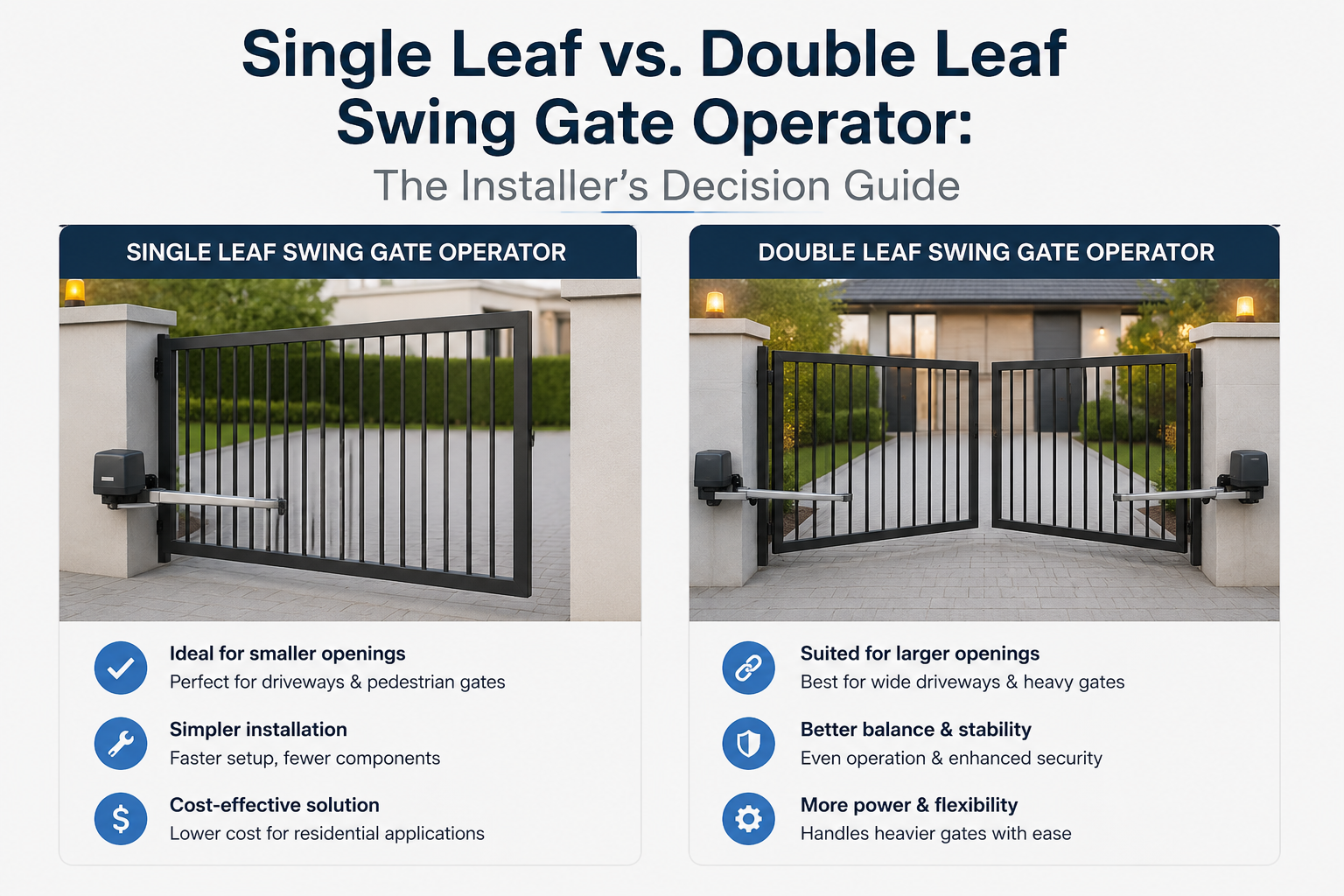
Every automatic swing gate installation starts with the same question: one leaf or two? It seems like a simple site geometry question, and often it is. But the choice of single leaf versus double leaf swing gate operator determines the operator kit, the control board architecture, the safety device count, the arm synchronization requirement, and the total installed cost. Getting it wrong on a commercial site means a callback before the concrete cures.
This guide is written for the people making that call: installers, integrators, and the agents and distributors supporting them.
Key Takeaways
- Single leaf operators are not just for small gates — they often outperform double leaf on security and mechanical simplicity at openings up to 14 feet
- Double leaf kits require a master-secondary synchronized control board — budget kits with fixed time-delay relays drift and cause leaf collision within months
- Gate weight must include infill, cladding, locks, and all mounted hardware — not just the frame — or the operator will be undersized from day one
- Articulated arms handle tighter post geometry; linear arms maintain synchronization tolerances better over a 10-year service life
- A residential swing gate arm operator at commercial cycle counts fails within 6–18 months — cycle count is the most frequently undersized specification in cross-segment sales
The Core Distinction
A single leaf swing gate operator drives one gate panel on one set of hinges. One motor, one arm, one control board. The gate opens in one direction — either inward or outward — and the full opening width is the width of that single panel.
A double leaf swing gate operator (also called a dual leaf or two-leaf operator) drives two gate panels simultaneously, one per leaf, with the leaves meeting at the center of the opening when closed. Each leaf has its own motor and arm. The critical addition is a synchronized control system — a master control board that coordinates both operators so they open and close in the correct sequence and don't collide mid-arc.
Same gate type. Completely different installation scope.
When Single Leaf Is the Right Answer
Single leaf configurations are not just for smaller openings. They're often the correct choice on wide openings too — when the geometry, site layout, or operational requirement favors one continuous panel over two meeting halves.
Clear cases for single leaf:
- Opening width under 14 feet: a single panel covers the opening with a standard residential or commercial operator, no synchronization complexity required
- Sites where one-sided clearance exists but not both sides: a single panel swings entirely to one side, requiring clearance only in that direction
- High-security applications requiring a single point of structural integrity at the closed position: two leaves meeting at center create a joint that is mechanically weaker under forced entry than a single continuous panel latching to a fixed stop
- Lower daily cycle count sites (under 40/day) where operational simplicity reduces service requirements
What single leaf looks like in the field:
One operator unit mounted on one post, one arm connected to the gate panel. The control board is typically integrated into the operator housing on residential-grade units, or mounted in a separate enclosure on commercial-grade installations. Photo-eye sensors mount at each post. One keypad or access reader. Clean, uncomplicated installation.
When Double Leaf Is the Right Answer
Double leaf configurations are required when the opening width, vehicle clearance requirements, or architectural intent make a single panel impractical.
Clear cases for double leaf:
- Opening widths above 14–16 feet: a single panel at this width and a typical gate height creates a weight and torque problem that residential-grade operators cannot handle cleanly — and commercial operators that can handle it are expensive enough that two lighter operators on split leaves often cost less
- Entrances requiring a center-opening visual symmetry: estate gates, architectural entrances, branded commercial facades
- Sites where clearance exists on both sides but limited gate depth prevents a single-panel swing arc from completing without hitting something
- Applications where one leaf can remain closed for pedestrian access while the other opens only for vehicles
Comparison Factor
Single Leaf
Double Leaf
Operators required
1
2 (one per leaf)
Control boards
1 (integrated or external)
1 master + 1 secondary (or 1 synchronized master governing both)
Safety devices (UL 325 Class I)
1 photo-eye set minimum
2 photo-eye sets (one per leaf opening arc)
Arm synchronization
Not applicable
Required — both arms must sequence correctly
Installation time
3–5 hours (residential)
5–9 hours (residential)
Total installed cost
Baseline
60–90% premium over single leaf
Forced entry resistance
Higher (single latch point)
Moderate (center joint is structural weakness)
Opening clearance needed
One-sided
Both sides
The Synchronization Question: Why It Matters More Than People Think
The synchronization problem is where most double leaf swing gate operator installations fail — not during commissioning, but six months later when one leaf starts opening before the other and the arms collide.
Here's what's happening mechanically: two separate motors driving two separate arms will never have identical cycle times in real-world conditions. Motor wear, arm pivot friction, gate weight distribution, and temperature all create small timing differences between the two leaves. Without active synchronization, those small differences accumulate. Within weeks or months, one leaf is consistently 2–3 seconds ahead of the other. The leading leaf swings into the trailing leaf's arc.
How quality double leaf kits solve this:
A properly designed double leaf swing gate operator kit uses a master-secondary control architecture. The master board governs the primary leaf's movement and simultaneously sends a synchronized start signal to the secondary board. Both boards share position feedback through a communication link — RS-485 or a dedicated sync cable — so timing corrections are applied in real time throughout every cycle.
Budget double leaf kits use a simple relay trigger: the master fires, then triggers the secondary with a fixed time delay. This works initially but drifts as components age. Specify master-secondary kits with active position synchronization for any commercial installation with more than 20 cycles per day.
Load Calculation: Getting the Operator Size Right
This is the step most commonly skipped in residential installations and most commonly over-simplified in light commercial ones. Sizing the operator to the gate's actual weight and wind load — not just the opening width — is what determines whether the system runs cleanly for 12 years or strains visibly for 3.
Gate weight calculation basics:
Gate weight is not just the panel's material weight. It's the panel material weight plus any cladding (timber boards, sheet metal infill, decorative ironwork), plus any attached hardware (locks, access control readers, intercom units). The hinges carry this weight statically. The operator carries it dynamically — it must overcome inertia to start the arc, maintain force through the mid-arc position, and decelerate cleanly at the stop.
Wind load:
A solid-panel gate in a high-wind environment becomes a sail. The holding force required to keep a closed solid gate from being pushed open by wind is directly proportional to the gate's area and the design wind speed for the site. Open-bar or picket gates reduce wind load significantly.
Gate Panel Type
Wind Load Factor
Holding Force Required at 80 mph
Solid infill (timber, sheet metal)
High
700–1,200 N (residential), 1,500–3,000 N (commercial)
Partial infill (50% open)
Medium
350–700 N
Open bar / picket
Low
200–450 N
Mesh infill
Low-Medium
300–600 N
When specifying a swing gate operator with arm for a solid-panel gate on an exposed site, the holding force specification matters as much as the weight rating. An operator with a 1,000 lb weight rating but only 400 N holding force will be pushed open by a strong storm regardless of the motor's gate capacity.
Residential vs. Commercial Swing Gate Arm Operator: The Spec Differences
The term residential swing gate arm operator appears specifically in contexts where buyers are distinguishing residential-grade products from commercial-grade. The distinction is real and the specifications are meaningfully different.
Specification
Residential Grade
Commercial Grade
Gate weight capacity
Up to 600 lb
600–2,000 lb
Duty cycle
15–20 cycles/hr
40–100 cycles/hr
Control board memory
2–8 remotes
50–1,000 access credentials
Safety device integration
Photo-eye (basic)
Photo-eye + edge sensor + monitored inputs
Access control inputs
Remote/keypad
Remote, keypad, card reader, intercom, loop detector, BMS
Housing rating
IP44
IP54–IP65
Warranty
1–2 years
3–5 years
Service interval
Annual lubrication
6-month inspection + annual service
A residential swing gate arm operator placed at a commercial property — a light industrial unit, a rental complex, a small business entrance — will run outside its duty cycle and fail early. The gate may be the right weight and width for the residential-grade product, but the daily cycle count is not. Cycle count is the most frequently undersized specification in cross-segment sales.
Articulated Arm vs. Linear Arm for Double Leaf Gates
For double leaf installations specifically, arm type choice carries additional weight beyond single leaf considerations.
Articulated arm advantages on double leaf:
The elbow joint in an articulated arm accommodates closer mounting to the hinge line, which is often necessary when two operators need to be positioned on adjacent faces of a center pillar or pair of close posts. The folding geometry also produces more consistent force delivery through the second half of the gate's opening arc — the phase where the gate is swinging perpendicular to the operator housing and a linear arm's force vector is least efficient.
Linear arm advantages on double leaf:
Linear arms are quieter, have fewer lubrication points, and maintain their synchronization tolerances better over time because there are fewer mechanical joints to develop play. On wide double leaf gates with adequate standoff between the posts, linear arms are the lower-maintenance choice over a 10-year service horizon.
Recommendation: On double leaf gates where post geometry allows adequate arm standoff, specify linear arms. On gates where post geometry forces the operators close to the hinge line, specify articulated arms. Do not mix arm types between the two leaves of a double leaf installation — arm geometry affects cycle timing, and mismatched arms on the same gate create exactly the synchronization drift described above.
Internal Links
→ Automatic Gate Opener: Complete Guide to Every Type (/blog/automatic-gate-opener-complete-guide)
→ Side-Mounted Swing Gate Operator: What It Is, How It Works & Who Needs It (/blog/side-mounted-swing-gate-operator)
→ Heavy-Duty Automatic Gate Opener for Commercial & Industrial Sites (/blog/heavy-duty-automatic-gate-opener-commercial-industrial)
→ How to Choose the Right Automatic Gate Opener (/blog/how-to-choose-automatic-gate-opener)
→ Automatic Gate Opener Installation: What Installers Need to Know (/blog/automatic-gate-opener-installation-guide)
FAQs
Can I add a second operator later to convert a single leaf installation to double leaf?
Technically yes, but it's not as simple as bolting on a second unit. The original operator's control board must support a secondary input — specifically, a synchronized master-secondary communication protocol — for the two units to operate safely together. Many residential-grade single leaf control boards do not include this capability. Adding a second operator to a board that doesn't support synchronization produces two independently cycling leaves that will eventually collide. Before purchasing a single leaf kit for an opening that might later become double leaf, confirm that the control board includes secondary operator synchronization capability. Specifying a dual-ready board from the start costs very little more and eliminates a future upgrade problem.
How do I calculate the correct arm length for a swing gate operator on a specific post and gate geometry?
Arm length is derived from the mounting geometry diagram published in the operator's installation manual — not a universal formula. The key measurements are: distance from the hinge centerline to the operator mounting point on the post, height of the operator pivot above the hinge height, and the point on the gate face where the arm bracket attaches. These three measurements define a geometry that the manufacturer has tested and certified for correct arm travel, correct force delivery, and correct limit switch behavior. Deviation from the published geometry — particularly placing the arm bracket higher or lower on the gate face than specified — changes the force vectors and can cause the motor to work against its optimal mechanical advantage throughout the cycle. Always start from the installation manual's geometry diagram for a given product.
What happens if one leaf of a double leaf gate operator fails during operation?
The behavior depends on the control board's fault handling. A quality synchronized control board detects the loss of position feedback from the secondary operator and halts the master leaf as well — preventing the working leaf from completing its arc while the failed leaf remains stationary. Budget systems with simple relay triggers have no failure detection: the working leaf continues its cycle, and if the failed leaf is in a partially open position, the result ranges from the leaves colliding to the working leaf completing its arc and creating a partially blocked opening. For any commercial double leaf installation, specify a system with active fault monitoring and fail-safe behavior on secondary operator loss.
Is a residential swing gate arm operator suitable for a shared driveway serving multiple units?
It depends on the daily cycle count, not the number of units. If three households share a driveway and collectively run the gate 30 times per day, a residential-grade arm operator running within its duty cycle handles that load without issue. If ten units share a driveway and the gate runs 150 times per day, a residential-grade operator will overheat repeatedly, trigger thermal protection repeatedly, and fail within a year. Count the realistic daily cycles for the shared access scenario first. If they exceed 40–50/day reliably, spec a commercial-grade swing gate operator from the start.
About the Author
Leo Chen is a gate automation specialist and technical content writer with hands-on experience across residential, commercial, and industrial automatic gate operator systems. He covers UL 325 compliance, swing and sliding operator selection, access control integration, and installation best practices for gate industry professionals across the US market. His work is used by distributors, system integrators, and facility managers to make better-informed specification decisions. When he is not writing about gate automation, Hasib works directly with installers and procurement teams to navigate product selection for complex commercial and industrial sites.