
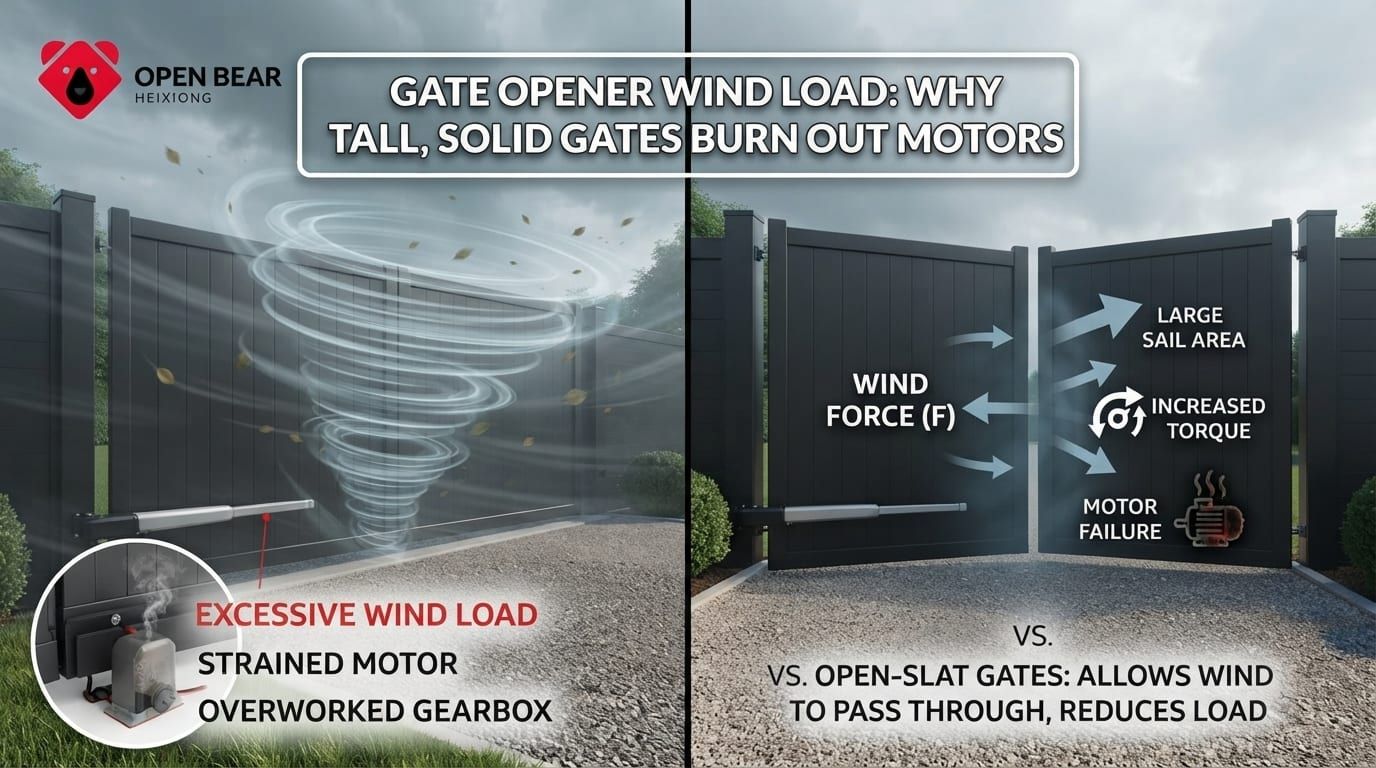
Two gates can weigh exactly the same and behave completely differently in the wind. One is open bars, the other is a solid panel. On a still day, either opens fine. On a gusty day, the solid one hits the motor with hundreds of kilograms of wind pressure the bar gate never feels. Wind load is the force that catalogues leave out and storms reveal, and it is one of the most common causes of premature motor failure. This guide explains how wind load works, why solid and tall gates suffer most, and how much extra motor capacity to allow so your opener survives the wind instead of dying to it.
What wind load actually is
Wind load is the force moving air exerts on the gate's face. When the wind blows against a gate, the panel behaves like a sail. The motor then has to overcome two things at once: the gate's weight and the wind pressure pushing on its surface. On a calm day only the weight matters. In wind, the second force can dwarf the first.
The pressure is highest when the wind hits the gate square on, perpendicular to the panel. As the gate swings open, the angle changes and the pressure eases, the same way a sail depowers when it turns into the wind. The worst moment for a swing gate is usually the start of the open cycle and the final push to close, when the panel is broadside to the wind.
Closing against the wind is the hardest job of all. The motor has to drive the gate to full closure and latch it while the wind fights back the whole way. Undersize the opener and this is where it stalls.
Why solid gates suffer and open gates don't
The single biggest factor in wind load is how much air the gate blocks. This is the infill: the proportion of the gate's face that is solid material rather than gaps.
A solid gate, full timber boarding, sheet steel, or close privacy panels, blocks nearly all the air. It catches the full wind pressure across its whole surface and acts like a wall. This is the highest-load design there is.
An open gate, tubular bars, pickets, or wide-spaced slats, lets most of the air pass straight through. The same size gate in an open design might feel a fraction of the wind force a solid one does. Between the two sit partial-infill options: mesh, louvres, and angled slats that give privacy while letting some air through and cutting the sail effect.
If privacy is the reason you want a solid gate, louvres or angled slats are the compromise that keeps the wind load manageable. Going fully solid on a wide, exposed gate is a structural decision, not just a style one.
Height and width multiply the force
Wind load scales with the area of the gate exposed to the wind, so both height and width matter directly. A taller gate has more surface for the wind to push on. A wider gate has more still, and on a swing gate that extra width also sits further from the hinge, so the wind's leverage against the motor grows too.
This is why wide estate gates are where wind quietly wrecks installations. A three-metre gate rarely gives trouble. A five or six-metre solid gate on an exposed ridge puts far more force through the posts, hinges, and motor than most owners expect. On the widest openings a sliding gate has a real advantage, because it is never presented broadside to the wind while it moves. If you are still choosing between types, our sliding vs swing gate guide covers that decision.
What undersized wind reserve looks like
When the motor cannot handle the wind load, the symptoms are consistent. The gate slows or stops midway through a cycle. It rebounds or reverses for no obvious reason, because the control board reads the wind resistance as an obstruction and triggers a safety stop. Current draw climbs as the motor strains, which raises heat and risks overload. Over months, the extra stress wears hinges, brackets, and the drive faster than normal.
Some of these look like faults but are really sizing problems. If your gate misbehaves mainly on windy days, wind load is the first thing to suspect. Our troubleshooting guide covers how to tell a wind issue apart from a genuine fault.
How much to derate for wind
Here is the practical part most guides skip. Start from the reserve rule for weight: size the motor for 1.5 to 2 times the gate's actual weight, which we explain in the gate opener sizing guide. Then adjust that reserve up based on infill and exposure.
Use these bands as a working guide:
Gate infill | Exposure | Reserve to allow |
Open bars/pickets (under 30% solid) | Sheltered | Standard 1.5x reserve is fine |
Partial infill (30 to 60% solid) | Average | Move toward 2x reserve |
Solid infill (over 60% solid) | Average | Use 2x reserve as the minimum |
Solid infill | Exposed/coastal/ridge | 2x reserve plus, and consider sliding |
Tall gate (over 2 m) or wide (over 5 m) | Any | Treat as one band higher than above |
The logic is simple: the more air the gate blocks and the more exposed the site, the more headroom the motor needs to hold the leaf against a gust rather than just move it on a calm day. A motor sized only for weight on a solid, exposed gate is the classic setup that fails in the first storm.
Material and design choices that help
You can lower the wind load at the design stage. Open frames in tubular steel or wrought iron cut wind resistance sharply against a solid panel of the same size. Where you need privacy, louvres and angled slats break up the airflow without turning the gate into a full sail. Aluminium is lighter than steel for the same panel, so the motor manages it more easily in wind, and rounded rather than sharp panel edges reduce turbulence.
On the motor side, choose an opener with enough torque headroom to hold the gate against gusts, and set the obstruction sensitivity so it can tell wind resistance apart from a real obstacle without becoming unsafe. An electric gate lock adds holding force that keeps a closed gate from being pushed open by the wind, taking continuous strain off the opener arms. Our electric gate lock guide covers when one is worth fitting.
Specify for wind at the survey
The through-line on every exposed gate is that wind is either designed for at the survey or discovered in the first storm, and the second is far more expensive. Before you buy, note your gate's infill percentage, its height and width, and how exposed the site is, then size the motor with the reserve those three demand. You can match that reserve to a specific model across our product range, and our engineers will review an exposed or wide gate on a free site check.
Frequently asked questions
Why does my gate stop or reverse in the wind?
Wind pushes on the gate's face and adds load the motor has to overcome. The control board often reads that resistance as an obstruction and triggers a safety stop or reversal. It usually means the opener has too little reserve for the gate's wind load, so it cannot push through a gust without tripping.
Do solid gates need a more powerful motor than open gates?
Yes. A solid gate blocks nearly all the air and catches the full wind pressure across its face, while an open bar or picket gate lets most air through. Two gates of the same weight can present very different wind loads, so a solid gate needs more motor reserve than an open one.
How does gate height affect wind load?
Wind load scales with the area exposed to the wind, so a taller gate catches more force. A gate over about two metres tall should be treated as needing more reserve than a shorter gate of the same width, especially if it has solid infill or sits on an exposed site.
How much extra motor capacity should I allow for wind?
Start with 1.5 to 2 times the gate's weight, then raise the reserve based on infill and exposure. An open gate in a sheltered spot is fine at the lower end, while a solid gate on an exposed site needs 2x reserve as a minimum, and tall or very wide gates need a band more.
Are sliding gates better than swing gates in high wind?
On wide, exposed openings, often yes. A sliding gate is never presented broadside to the wind while it operates, so it avoids the worst of the sail effect that hits a swing gate at the start and end of its cycle. For the widest estate gates this is a real advantage.
Can I reduce wind load without changing the whole gate?
Yes. Partial-infill options like mesh, louvres, or angled slats let air pass while keeping privacy, cutting the sail effect against a fully solid panel. Open frames in tube or wrought iron also lower wind resistance sharply compared with solid boarding of the same size.

Frequently Asked Questions
Key engineering and selection answers regarding this topic
Wind pushes on the gate's face and adds load the motor has to overcome. The control board often reads that resistance as an obstruction and triggers a safety stop or reversal. It usually means the opener has too little reserve for the gate's wind load, so it cannot push through a gust without tripping.
Yes. A solid gate blocks nearly all the air and catches the full wind pressure across its face, while an open bar or picket gate lets most air through. Two gates of the same weight can present very different wind loads, so a solid gate needs more motor reserve than an open one.
Wind load scales with the area exposed to the wind, so a taller gate catches more force. A gate over about two metres tall should be treated as needing more reserve than a shorter gate of the same width, especially if it has solid infill or sits on an exposed site.
Start with 1.5 to 2 times the gate's weight, then raise the reserve based on infill and exposure. An open gate in a sheltered spot is fine at the lower end, while a solid gate on an exposed site needs 2x reserve as a minimum, and tall or very wide gates need a band more.
On wide, exposed openings, often yes. A sliding gate is never presented broadside to the wind while it operates, so it avoids the worst of the sail effect that hits a swing gate at the start and end of its cycle. For the widest estate gates this is a real advantage.
Yes. Partial-infill options like mesh, louvres, or angled slats let air pass while keeping privacy, cutting the sail effect against a fully solid panel. Open frames in tube or wrought iron also lower wind resistance sharply compared with solid boarding of the same size.
Explore Related Automation Systems
Looking for motors, hardware, or installation systems mentioned in this guide? Discover our factory-direct gate opener range:
All Gate Openers
Browse DC24V sliding, swing & barrier operators with full factory warranty.
Explore Products →Residential Gate Operators
Ultra-quiet, solar-ready sliding & swing gate motors for homes and villas.
Residential Solutions →Commercial Gate Systems
Continuous-duty operators for gated communities, business parks & parking.
Commercial Solutions →Industrial Heavy-Duty
High-torque motors engineered for gates up to 4,000 kg and logistics hubs.
Industrial Solutions →