
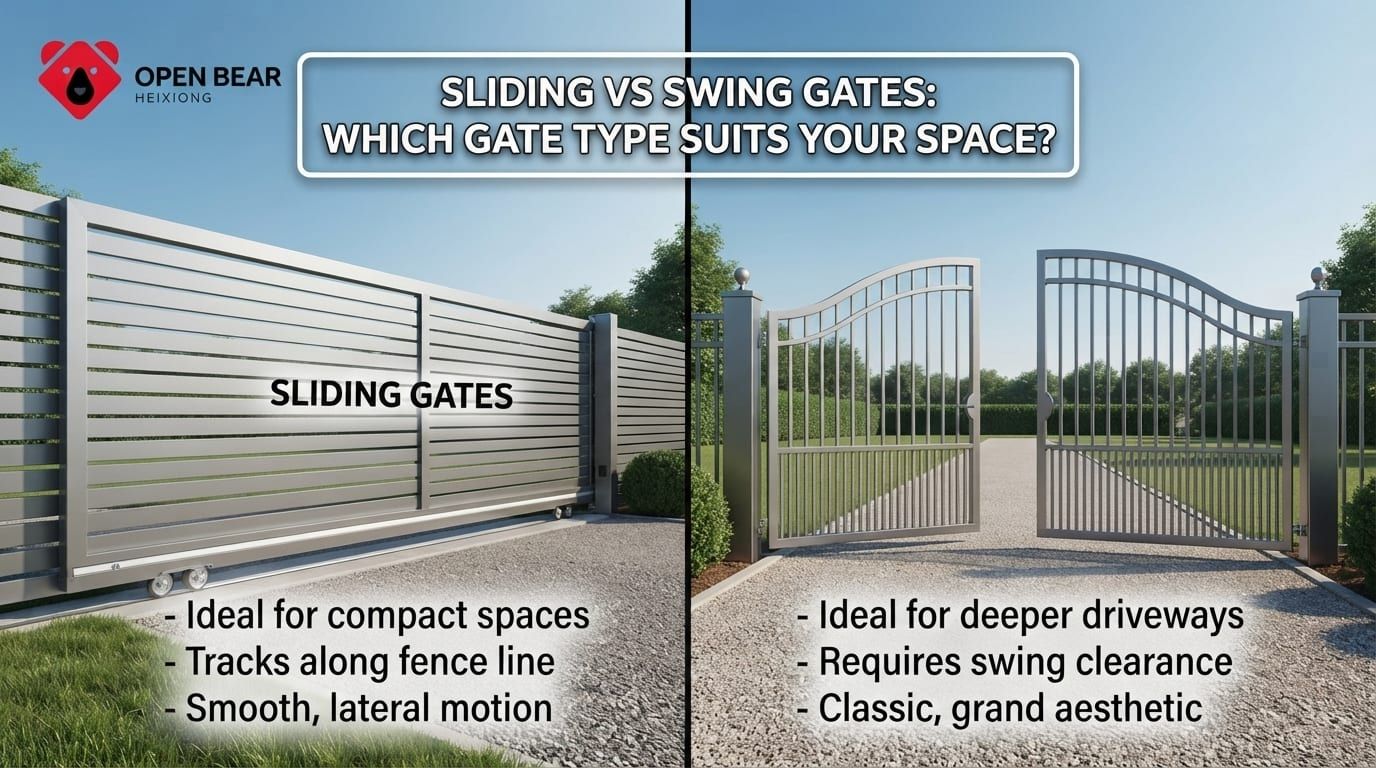
The sliding versus swing decision is not really about looks or budget. It is about where you have room to move the gate. A swing gate needs a clear arc in front of or behind the opening. A sliding gate needs a clear run to the side. Pick the one that fits the space you actually have, and the gate disappears into daily life. Pick the wrong one and you fight it every day. This guide walks through the factors that decide it, then gives you a scenario table so you can match your own driveway to the right type.
The core difference: where the gate goes
A swing gate works like a door. It pivots on hinges and arcs open, either inward or outward, as a single leaf or a pair that meets in the middle. It needs empty space along that arc.
A sliding gate moves sideways, parallel to the fence line. It either rolls on a ground track or hangs as a cantilever with no track touching the ground. It needs empty space to the side to retract into.
That single difference drives almost every other point below. The question to ask standing at your entrance is simple: do you have more clear space in front of the opening, or to the side of it?
Space and clearance
Swing gates demand depth. A single swing leaf needs a clear arc equal to its full width. A 4 m single leaf sweeps a 4 m arc, and anything in that path, a parked car, a wall, a planter, blocks it. This is the most common reason a swing gate fails to suit a property.
Splitting the gate into two leaves cuts the problem in half. A 4 m dual swing gate needs only about 2 m of arc per side, since each leaf is half the width. If you like the look of a swing gate but are tight on depth, a dual leaf setup is often what makes it fit.
Sliding gates ask for side room instead. A tracked sliding gate needs roughly the width of the opening plus extra run-back along the fence, usually about 50 percent more than the opening width, plus space for the motor. A cantilever needs even more run-back, around 1.5 times the opening width, because its counterbalanced tail extends past the opening. If a wall or landscaping sits right beside your driveway, that side room is often what rules a slide gate in or out.
The practical takeaway: short driveways with a wall or fence to the side favour sliding. Open, deep frontage with nothing in the arc favours swing.
Slope and ground level
Ground level often settles the argument on its own. A swing gate has to clear the ground through its whole arc. On a driveway that rises away from the street, an inward swinging gate catches on the rising grade and jams before it fully opens. Once the slope in the gate's path passes roughly 10 percent, a swing gate usually will not work at all.
A sliding gate moves horizontally along a relatively level line and is far less affected by a sloped driveway. If your entrance slopes, a sliding gate is normally the practical choice. This is one of the few points where the decision is close to non-negotiable rather than a matter of preference.
Driveway width
Very wide openings shift the balance too. Spanning a wide entrance with a single swing leaf puts enormous leverage on one hinge and post, and long single leaves sag over time. Wide openings are better served by a dual swing gate, which shares the load across two posts, or by a sliding gate, which handles width without the hinge strain. The wider the gap, the more a sliding gate or a dual leaf starts to make sense.
Cost and maintenance
Swing gates usually cost less upfront. They are mechanically simpler, with fewer moving parts and no track or roller system, so both the gate and its operator tend to be cheaper. Sliding gates carry the added cost of a track or cantilever structure, rollers, and a heavier operator.
Maintenance follows the same logic. A swing gate has fewer parts to service and no ground track to collect leaves, grit, or snow. A tracked sliding gate needs its track kept clear, since debris in the track is a leading cause of sliding gate faults. In regions with heavy rain, snow, or falling leaves, a swing gate or a trackless cantilever avoids that particular headache. Whatever you choose, both types last far longer with routine care, which we cover in the gate opener maintenance guide.
Security and traffic
Sliding gates have a mild security edge. There is no swing arc to lever against, they resist being forced open, and solid cantilever designs are hard to breach. They also handle high-traffic entrances well, with fast, consistent cycling that suits apartment blocks and business gates where the gate rarely rests. If your gate will cycle heavily all day, match it to the right duty rating using our guide on how to size a gate opener.
Swing gates suit lower-traffic residential entrances and carry the classic, welcoming look many homeowners want. For a modest household gate on flat, open ground, a swing gate is often the simpler and cheaper answer.
Quick decision table
Match your situation to the type that fits:
Your situation | Better fit | Why |
Short driveway, car parks close to gate | Sliding | No arc needed in front |
Deep, open frontage, flat ground | Swing | Room to arc, lower cost |
Driveway slopes up from the street | Sliding | Swing catches on the rise |
Very wide opening | Sliding or dual swing | Avoids single-hinge strain |
Tight on depth but want a swing look | Dual swing | Halves the arc per leaf |
Snowy or leafy site | Swing or cantilever | No ground track to clog |
High-traffic, all-day cycling | Sliding | Fast, consistent, secure |
Tight budget, simple residential gate | Swing | Cheaper to buy and maintain |
Making the final call
Stand at your entrance and check three things in order: is the ground level or sloped, do you have more room in front or to the side, and how wide is the opening. Slope and clearance usually narrow it to one type before cost or looks even enter the conversation. Once you know the type, you can match it to a specific operator across our full product range, and if you are still unsure, our engineers will review your layout on a free site check.
Frequently asked questions
Is a sliding or swing gate better for a small driveway?
A sliding gate usually suits a small or short driveway because it needs no clear arc in front of the opening. It slides sideways along the fence line, so you can park a car close to the gate. A swing gate needs depth to open into, which short driveways rarely have.
Which gate type is best for a sloped driveway?
A sliding gate is the practical choice for a sloped driveway. A swing gate has to clear the ground through its whole arc, so a driveway that rises away from the street blocks it once the slope passes about 10 percent. A sliding gate moves level along the fence and avoids the problem.
Are sliding gates more expensive than swing gates?
Usually yes. Sliding gates need a track or cantilever structure, rollers, and a heavier operator, which raises the upfront cost. Swing gates are mechanically simpler and cost less to buy and install, though slope and space can still make a sliding gate the only option that physically works.
Do swing gates need less maintenance than sliding gates?
Swing gates generally have fewer moving parts and no ground track, so there is less to service and nothing to clog with leaves or snow. A tracked sliding gate needs its track kept clear. A trackless cantilever sliding gate avoids the track issue while keeping the sliding motion.
Can I fit a swing gate on a wide driveway?
A single swing leaf on a wide opening strains one hinge and post and tends to sag over time. A dual swing gate spreads the load across two posts and suits wider openings, or a sliding gate handles the width without hinge strain. The wider the gap, the more a dual leaf or sliding gate makes sense.
How much side space does a sliding gate need?
A tracked sliding gate needs roughly the opening width plus about 50 percent more run-back along the fence, plus room for the motor. A cantilever needs around 1.5 times the opening width of clear run-back for its tail. If a wall or landscaping sits beside the driveway, that side room often decides whether a sliding gate fits.

Frequently Asked Questions
Key engineering and selection answers regarding this topic
A sliding gate usually suits a small or short driveway because it needs no clear arc in front of the opening. It slides sideways along the fence line, so you can park a car close to the gate. A swing gate needs depth to open into, which short driveways rarely have.
A sliding gate is the practical choice for a sloped driveway. A swing gate has to clear the ground through its whole arc, so a driveway that rises away from the street blocks it once the slope passes about 10 percent. A sliding gate moves level along the fence and avoids the problem.
Usually yes. Sliding gates need a track or cantilever structure, rollers, and a heavier operator, which raises the upfront cost. Swing gates are mechanically simpler and cost less to buy and install, though slope and space can still make a sliding gate the only option that physically works.
Swing gates generally have fewer moving parts and no ground track, so there is less to service and nothing to clog with leaves or snow. A tracked sliding gate needs its track kept clear. A trackless cantilever sliding gate avoids the track issue while keeping the sliding motion.
A single swing leaf on a wide opening strains one hinge and post and tends to sag over time. A dual swing gate spreads the load across two posts and suits wider openings, or a sliding gate handles the width without hinge strain. The wider the gap, the more a dual leaf or sliding gate makes sense.
A tracked sliding gate needs roughly the opening width plus about 50 percent more run-back along the fence, plus room for the motor. A cantilever needs around 1.5 times the opening width of clear run-back for its tail. If a wall or landscaping sits beside the driveway, that side room often decides whether a sliding gate fits.
Explore Related Automation Systems
Looking for motors, hardware, or installation systems mentioned in this guide? Discover our factory-direct gate opener range:
All Gate Openers
Browse DC24V sliding, swing & barrier operators with full factory warranty.
Explore Products →Residential Gate Operators
Ultra-quiet, solar-ready sliding & swing gate motors for homes and villas.
Residential Solutions →Commercial Gate Systems
Continuous-duty operators for gated communities, business parks & parking.
Commercial Solutions →Industrial Heavy-Duty
High-torque motors engineered for gates up to 4,000 kg and logistics hubs.
Industrial Solutions →