
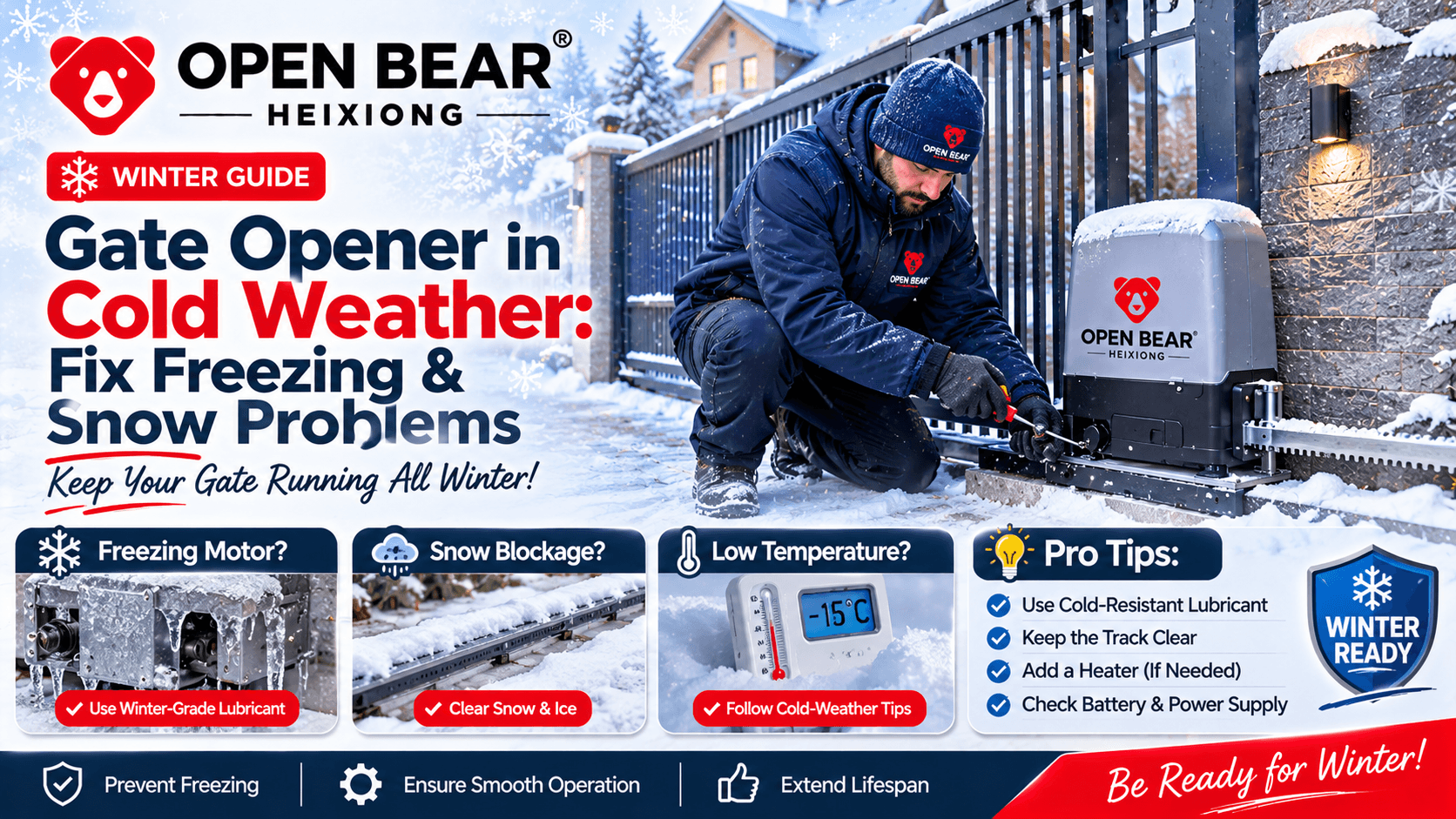
The Morning the Gate Wouldn’t Budge
You walk out to the driveway at 6 a.m. The frost is thick, your breath is showing, and the gate just sits there. You press the remote. Nothing. You press it again, harder, as if that helps. If this sounds familiar, you already know how a gate opener in cold weather can turn a normal morning into a standoff.
The good news is that most winter failures follow a handful of patterns. Once you know them, you can fix the current problem and stop the next one before it starts. This guide covers what freezes, what snow does to your track and arms, and what to do before and after the first hard frost.
What Cold Actually Does to the Machine
Cold doesn’t break an opener out of spite. It changes the physical behavior of the parts inside it.
Grease thickens. Fresh lubricant that glides at 20°C turns to something close to cold butter at -15°C, and the motor has to push through it. Metal contracts slightly, which can throw off limit settings. Moisture that crept in during a damp autumn turns to ice inside gearboxes, hinges, and control boxes. Plastic and rubber seals get stiff and sometimes crack.
Put those together and you get the classic complaint: the gate struggles, grinds, stops halfway, or does nothing at all. Every automatic gate opener on the market deals with these forces, but the ones that cope best are sealed well, lubricated with the right grade of grease, and powered by healthy batteries.
Common Gate Opener Freezing Problems and Where They Hide
When people search for help with gate opener freezing problems, the cause usually sits in one of four places.
The control board and wiring box. Condensation forms overnight, freezes, then thaws into a drip across the circuit board. Look for a damp or frosted enclosure and corroded terminals.
The gearbox. Water that got past a worn seal turns the gear oil sluggish or slushy. You’ll hear a groan or feel the motor strain before it gives up.
The hinges, rollers, and track. A frozen hinge pin or a roller stuck in an iced groove makes the gate harder to move than the motor was sized for.
The sensors. Photo-eyes fog up or collect frost, and the opener reads that as an obstruction. The gate may start to close and then reverse for no obvious reason.
If you’re dealing with a gate opener not working in cold weather, check these four spots before you call anyone. About half the time, the fix is simple.
A Frozen Gate Opener Fix That Won’t Damage Anything
Here’s the order we’d follow, starting with the least invasive step.
First, cut power to the opener. Never work on a stuck gate with the motor live.
Second, release the gate from the motor using the manual release key or lever, then push the gate by hand. If it moves freely, the gate itself is fine and the problem sits in the operator. If it resists, you have an ice or hinge problem.
Third, clear visible ice and snow from the track, hinges, and arm joints. Use a plastic scraper or a stiff brush. Skip metal tools and skip boiling water, which refreezes within minutes and can crack cold components.
Fourth, wipe the photo-eyes clean with a soft cloth.
Finally, restore power and run a few cycles. A real frozen gate opener fix often comes down to clearing the path and giving the motor a few gentle passes to warm up.
If the gate still won’t move after all that, stop forcing it. A strained motor can burn out in one bad morning, and that’s a much bigger bill than a service call.
Gate Opener Battery Cold Weather Care
Batteries are the quiet culprit in a lot of winter breakdowns. A lead-acid battery loses a large share of its usable capacity as the temperature falls, so a unit that worked fine in October may barely turn the motor in January.
Gate opener battery cold weather problems show up as slow movement, gates that stop partway, or an opener that works for a day and then dies. Remote fobs suffer too, since a weak coin cell loses range in the cold.
A few habits help. Test battery voltage before winter and replace anything that’s three or four years old. Keep terminals clean and tight. If your system uses solar charging, brush snow off the panel regularly, because a covered panel can’t top up the battery during the shortest, darkest days. And keep a spare fob battery in the glovebox, not the kitchen drawer.
Sliding Gates and Swing Gates Fail Differently
Not every gate suffers in the same way, so it’s worth knowing which type you own.
Sliding gates. Snow and ice pile up in the track, and the rollers can’t ride over them. Regular sliding gate snow removal is the single best defense. Clear the track after every storm, and if you can, add a small shield or cover to keep drifts out. A good sliding gate opener with a robust drive and a high duty rating tolerates extra resistance far better than a light residential unit.
Swing gates. The main enemy is ice buildup at the base of the leaf and around the hinges. A swing gate opener ice problem often appears when an arm or ram freezes at its pivot, or when a gate drags on a frozen patch of driveway. Check the ground clearance, and think about how drainage works around the gate. Water that pools under a leaf will freeze there.
Preparing a Gate Opener in Cold Weather Before the First Freeze
Prevention beats repair every time. Spend an hour in autumn and you’ll avoid most of the trouble.
- Switch to a lubricant rated for low temperatures on hinges, rollers, and chains.
- Reseal cable entries, junction boxes, and control enclosures. A dab of silicone and a fresh gasket go a long way.
- Check that drain holes in the gearbox housing and track aren’t blocked.
- Test all safety sensors and clean the lenses.
- Adjust the travel limits and force settings so the motor isn’t working at its ceiling.
- Check the manual release works smoothly, because you’ll want it on the worst day.
For a more complete routine, this gate opener maintenance tips checklist walks through each part step by step. Good gate opener maintenance winter habits also include a quick weekly look: clear the path, wipe the sensors, and listen for strange sounds.
When Heavy Use Meets Hard Winters
Busy sites feel the cold more. A warehouse gate that opens hundreds of times a day can’t afford a slow morning, and a light-duty unit stretched across that many cycles in freezing air will wear out early.
If your property sees constant traffic, Industrial Gate Openers are built with bigger motors, sealed housings, and cooling that holds up under load. And if you’re shopping for a snow winter gate opener for a new build or an upgrade, ask about operating temperature range, ingress protection ratings, and low-temperature battery options before you compare prices.
Remote access helps in winter too. A WiFi gate opener lets you check whether the gate is open, closed, or stuck without trudging out in the cold, and some systems send an alert if a cycle fails.
Get Your Gate Ready Before the Next Storm
A gate that fights you every frosty morning is a sign something needs attention, whether that’s grease, a battery, or a motor that was never right for your site. You don’t have to guess which one.
Send us your gate type, size, and the problems you’re seeing. We’ll help you work out whether you need a repair, a few small upgrades, or a new operator built for hard winters. Get a quote today, or request a factory-direct quote if you’re planning a larger project.

Frequently Asked Questions
Key engineering and selection answers regarding this topic
Yes. Low temperatures thicken grease, weaken batteries, and let moisture freeze inside the housing. Well-sealed, properly maintained units handle it much better.
Usually it’s frozen hinges or tracks, a weak battery, or frost on the sensors. Cut power, release the gate manually, and clear the ice before trying again.
Use cold-rated lubricant, seal the control box, keep drains clear, and remove snow from the track after each storm. Do the checks before winter starts.
It can, as long as the track, hinges, and sensors stay clear. A gate opener in cold weather performs best when it’s sized for the gate and rated for low temperatures.
Cold slows the chemical reaction inside the battery, so it delivers less power. Older batteries fail first. Test it early and replace it if it’s aging.
Explore Related Automation Systems
Looking for motors, hardware, or installation systems mentioned in this guide? Discover our factory-direct gate opener range:
All Gate Openers
Browse DC24V sliding, swing & barrier operators with full factory warranty.
Explore Products →Residential Gate Operators
Ultra-quiet, solar-ready sliding & swing gate motors for homes and villas.
Residential Solutions →Commercial Gate Systems
Continuous-duty operators for gated communities, business parks & parking.
Commercial Solutions →Industrial Heavy-Duty
High-torque motors engineered for gates up to 4,000 kg and logistics hubs.
Industrial Solutions →