
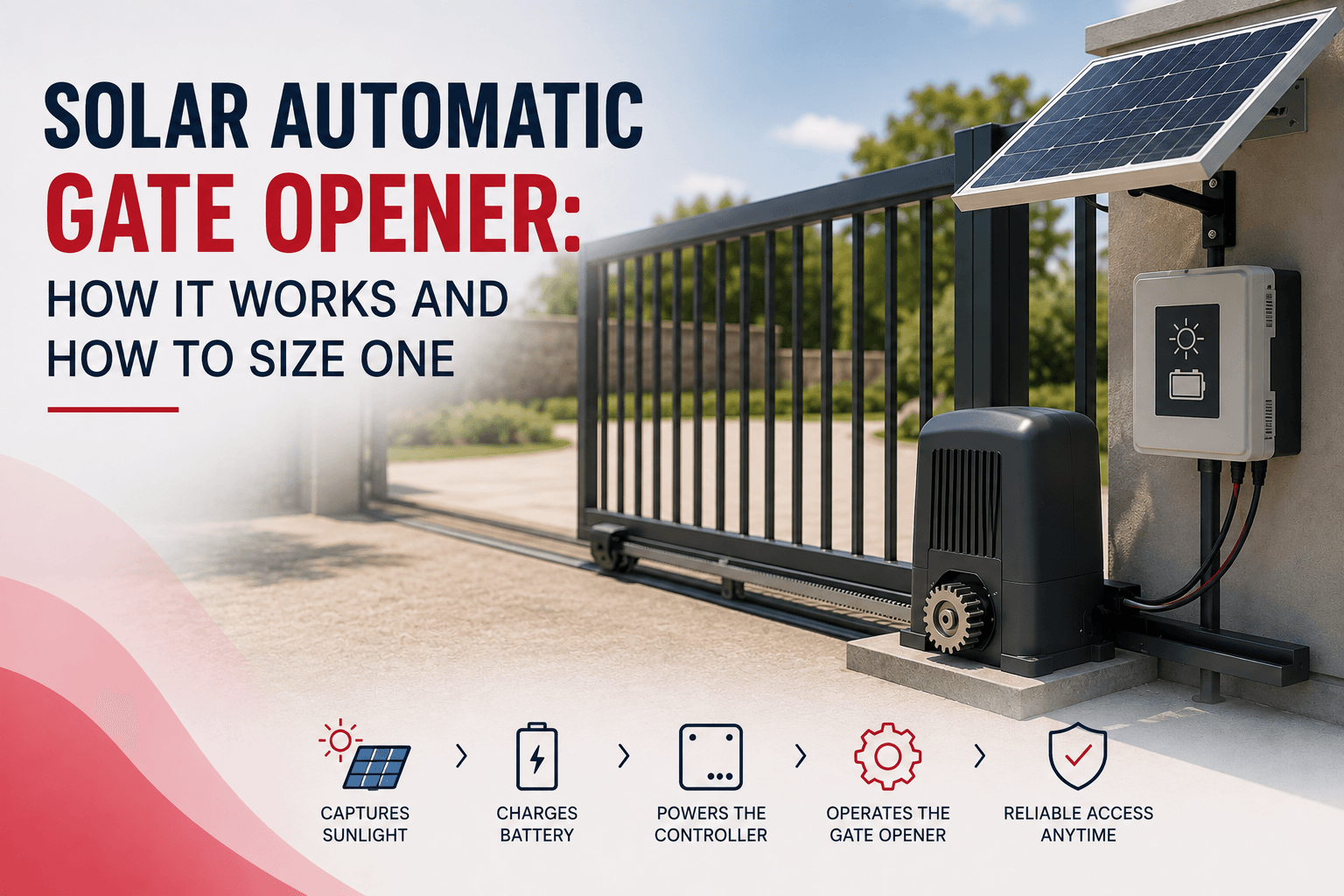
A solar automatic gate opener runs a low-draw DC motor from a battery, and a solar panel keeps that battery charged. The gate itself is powered by the battery, not directly by the sun, which is the detail that decides whether solar will work on a given gate. If the panel can replace the charge each day's cycles use up, the gate runs indefinitely with no mains supply. If the gate cycles more often than the panel can keep up with, the battery slowly drains and the gate stops, usually on a short winter day. Get the sizing right for the real traffic and solar is an excellent fit for gates far from power. Get it wrong and it becomes a seasonal problem.
This guide explains how these systems work, where they make sense, and how to size the panel and battery so the gate keeps running through the worst part of the year, not just the best.
How a solar gate opener actually works
A solar gate operator has four parts working together: a DC operator, a rechargeable battery, a solar panel, and a charge controller that manages the panel's output into the battery. On many kits the charge controller is built into the control board.
The important idea is the order of power flow. The battery drives the motor every time the gate moves. The panel does not power the motor directly; it trickle-charges the battery between cycles and during daylight, replacing what the gate used. So the battery has to be big enough to cover the busiest realistic day plus some reserve for cloudy spells, and the panel has to be big enough to put back roughly what a day of use takes out. When people picture the sun opening the gate, they have it slightly wrong, and that misunderstanding is behind most undersized systems.
Because the battery is central, solar operators use DC motors, typically 12V or 24V, chosen for low current draw. A heavy mains-style AC operator is a poor match for solar, which is why solar-ready units are designed from the motor outward to sip power rather than pull it.
When solar is the right choice
Solar suits gates where two things are true: mains power is inconvenient or expensive to reach, and the traffic is light to moderate.
That describes a lot of rural sites. A farm or ranch entrance, a field gate, a long private driveway, or a remote property boundary often sits hundreds of feet from the nearest power, where trenching a cable is a real cost. A solar automatic gate opener removes that cost entirely. These are also usually low-cycle gates, opened a handful of times a day, which is exactly the load a modest panel and battery can sustain. This is why solar automatic farm gate openers are a common and reliable choice.
Solar is a weaker fit where the gate cycles heavily. A busy shared entrance that opens hundreds of times a day can pull the battery down faster than a reasonably sized panel replaces it, and at that point mains power or a much larger solar package is the honest answer. Traffic volume, not gate size alone, is the deciding factor.
Swing or sliding on solar
Both swing and sliding gates can run on solar, and the choice between them follows the same site logic as any gate rather than anything unique to solar. A solar power automatic swing gate opener is common on level rural driveways with room to swing, and single or dual swing kits are widely available in solar form. Sliding gates can also run on solar where the site is sloped or short on depth, though a heavier sliding gate draws more per cycle and needs the panel and battery sized accordingly.
The power draw difference matters more than the gate type. A light gate on a quiet driveway is undemanding whichever way it moves. A heavy gate, a windy exposed site, or frequent use all raise the daily energy the panel has to replace, and that is what you size around. For help choosing the gate type itself, our guide on sliding versus swing operators covers the site factors in full.
Sizing the panel and battery
Sizing is where a solar gate opener succeeds or fails. You are balancing three things: how much energy the gate uses per day, how much the panel can generate, and how much reserve the battery holds for days with little sun.
Work through it in this order:
- Estimate daily cycles. Count the realistic peak number of open-and-close cycles per day, not the average. A gate that normally opens ten times but hits forty on a busy day has to be sized for the forty.
- Account for standby draw. The control board, receiver, and any keypad draw a small current around the clock. On a low-traffic gate this standby draw can use as much energy as the cycles themselves, so it is not optional to include.
- Match the panel to the load and the location. The panel's wattage has to replace the daily energy use in the sunlight hours your location actually gets in winter, when days are short and light is weak. A panel sized for summer will fall behind in December.
- Size the battery for autonomy. The battery should hold enough charge to run the gate through several overcast days without full charging. More reserve means the gate keeps working through a cloudy week.
The most common mistake is sizing for a bright day in a mild month. Size for the worst realistic conditions, which usually means a short, overcast winter day, and the gate will run all year. Manufacturers publish panel and battery guidance for their operators against expected cycle counts, so use those figures as the starting point and add margin for exposed or northern sites.
Placement and seasonal reality
A solar panel only performs if it is sited well. Mount it where it gets direct sun for as much of the day as possible, angled and oriented for your latitude, and clear of shade from trees, buildings, or the gate posts. Partial shade across a panel cuts its output far more than its size suggests, so a smaller panel in full sun often beats a larger one that spends the afternoon shaded.
Two seasonal facts are worth planning for. Short winter days give the panel fewer hours to charge, and cold weather reduces the usable capacity of most batteries. Both pull in the same direction, which is why winter is when undersized systems fail. Keeping the panel clean and clear of snow, and specifying with winter in mind, avoids the classic "it worked fine until December" call.
The battery is a wear part
The battery is the component that will need replacing during the operator's life. Rechargeable batteries lose capacity with age and cycling, and a solar gate that has run reliably for a few years and then starts stalling on cloudy days usually needs a fresh battery rather than any deeper repair. Plan for that replacement as normal maintenance, keep the correct battery type and rating on hand, and treat a gate that suddenly weakens in cold weather as a battery check first.
Specifying or sourcing a solar kit
If you are buying or reselling a solar automatic gate opener kit, confirm these before you order:
- The operator is a DC unit rated for the gate's weight and length.
- The panel wattage and battery capacity are matched to the expected daily cycles, with winter margin.
- The charge controller is included and suited to the battery type.
- The safety devices required for the installation market are part of the kit or specified alongside it.
- Replacement batteries and other spare parts are available after the sale.
The completeness of that package is what separates a solar kit that runs for years from one that arrives missing the parts that make it work. What belongs in a complete kit, solar or mains, is covered in our gate opener kit buyer's guide, and the DC, low-draw operators that suit off-grid rural entrances sit within our residential gate solutions.
FAQs
How does a solar automatic gate opener work?
A solar panel charges a battery, and the battery powers a low-draw DC motor each time the gate moves. The gate runs on the battery; the panel replaces the charge that the day's cycles use. As long as the panel keeps up with the daily use, the gate needs no mains supply.
Is a solar gate opener powerful enough for a heavy gate?
Yes, if it is sized for it. Solar operators come in ratings for different gate weights and lengths, and a heavier gate simply draws more per cycle, so it needs a DC operator rated for the load and a panel and battery sized to match. The limit is usually daily traffic, not gate weight.
Will a solar gate opener work in winter?
It will if it was sized for winter. Short days and cold reduce charging and battery capacity, so a system sized only for summer can fall behind. Sizing the panel and battery for the worst realistic winter conditions, and keeping the panel clear and unshaded, keeps it running year round.
How many times a day can a solar gate open?
That depends on the panel, battery, and operator, and on your location's sunlight. Solar suits low to moderate traffic well; very high-cycle gates can drain the battery faster than the panel recharges it, which points to a larger solar package or mains power.
Do solar gate openers need much maintenance?
Little, beyond keeping the panel clean and unshaded and replacing the battery when it ages. A reliable solar gate that starts stalling on cloudy days usually needs a new battery rather than any major repair.
Choosing solar with confidence
A solar automatic gate opener is a reliable, low-running-cost way to automate a gate that sits far from power, as long as the panel and battery are sized for the real traffic and the worst part of the year rather than the best. Start from the honest daily cycle count, include the standby draw, size for winter, and place the panel in genuine full sun, and an off-grid rural entrance will open on demand without a metre of trenched cable.
To match a solar operator and power package to a specific gate and site, or to source solar-ready kits for the rural and off-grid customers you supply, browse our gate operators and accessories or contact our team with the gate details and expected daily use.

Explore Related Automation Systems
Looking for motors, hardware, or installation systems mentioned in this guide? Discover our factory-direct gate opener range:
All Gate Openers
Browse DC24V sliding, swing & barrier operators with full factory warranty.
Explore Products →Residential Gate Operators
Ultra-quiet, solar-ready sliding & swing gate motors for homes and villas.
Residential Solutions →Commercial Gate Systems
Continuous-duty operators for gated communities, business parks & parking.
Commercial Solutions →Industrial Heavy-Duty
High-torque motors engineered for gates up to 4,000 kg and logistics hubs.
Industrial Solutions →