
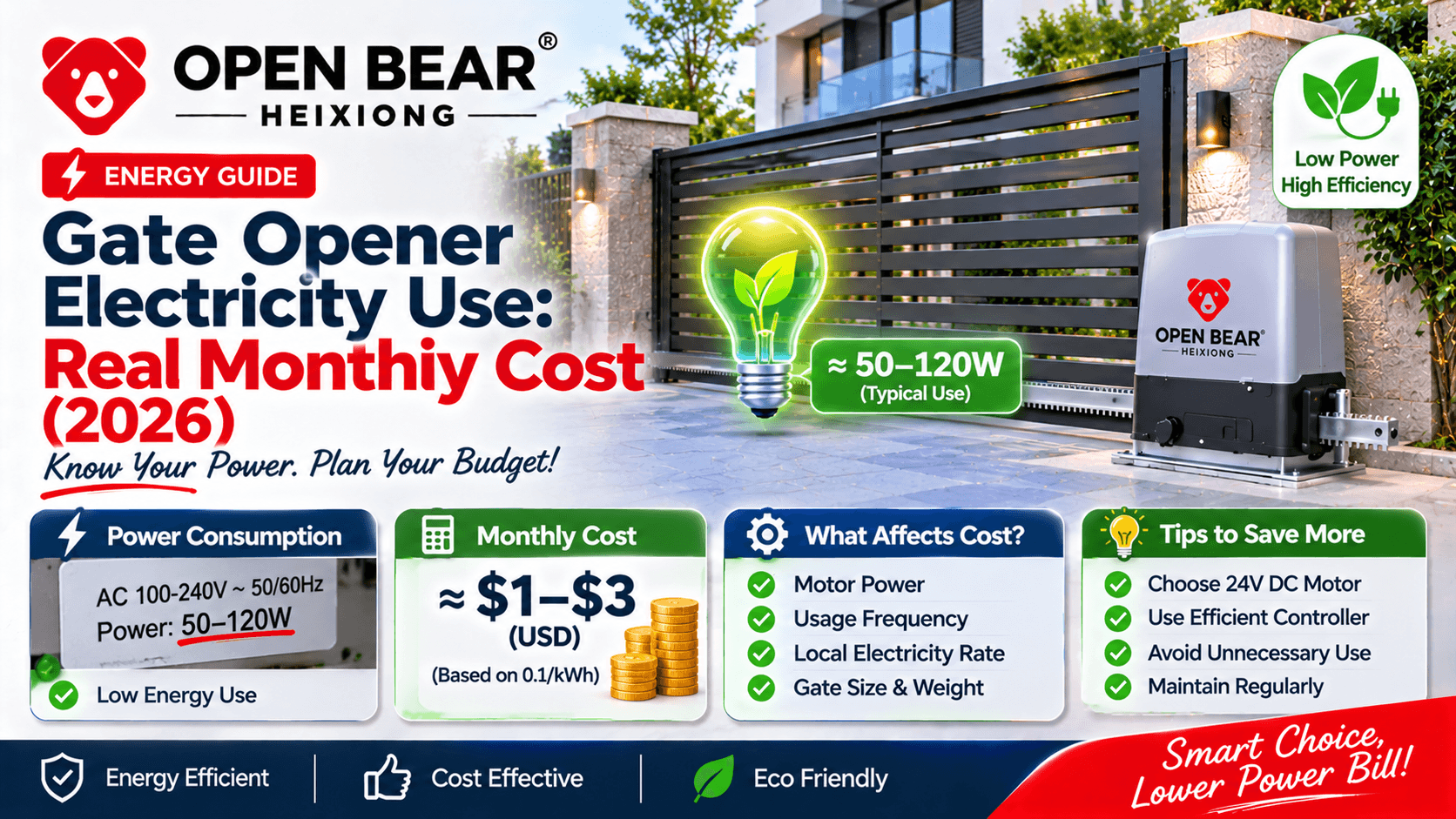
People usually ask this right before buying a gate opener, or right after a power bill makes them suspicious of anything with a motor in it. So here's the straight answer: a typical residential gate opener uses a few kWh a month. On most bills, that's somewhere between 50 cents and a couple of dollars.
The surprising part is where that power goes. The motor isn't the big spender. The control board, quietly waiting for you to press a button all day and all night, usually uses more than the motor does. Below we'll walk through the maths so you can check your own gate.
One note first. The wattages in our examples are round figures picked so the sums are easy to follow. Your operator's real numbers are on its nameplate or spec sheet, and we'll show you exactly where to plug them in.
The short answer
For a home driveway gate that opens around 10 times a day, expect roughly 4 kWh a month. Add a few accessories and it's closer to 8. A busy commercial entrance with 200 cycles a day lands around 15 kWh. At typical power prices, none of those will change your bill in a way you'd notice.
If your gate seems to be costing you more than that, the cause is almost always a fault, not the design. We'll cover that further down.
What actually uses power in a gate opener
Four things draw electricity:
- The motor. It only runs while the gate is moving, usually 15 to 30 seconds each way.
- The control board. It's awake around the clock, listening for the remote, the keypad and the safety sensors.
- The transformer or power supply. It converts mains voltage down to what the motor and board need. Some energy is lost as heat, even when the gate is idle.
- Accessories. Photocells, keypads, WiFi modules and gate lights each pull a little, all the time.
Only the first one is related to how often you use the gate. The other three run whether the gate moves once a day or never.
Running power vs standby power
This is the part most guides skip, and it's the key to understanding gate opener power consumption.
A motor might draw 100 watts, which sounds like a lot. But it only runs for under a minute per open-and-close cycle. Do that 10 times a day and the motor is on for less than 10 minutes in total.
The control board might draw only 5 watts. That sounds like nothing. But it does it for 24 hours a day. Over a month, that small, steady draw adds up to more energy than the motor used.
That's why the number of times you open the gate matters less than people expect, and why gate opener standby power is the figure worth checking first.
How to calculate your own gate opener power consumption
The formula is the same for every appliance:
Watts x hours of use / 1,000 = kWh
Then multiply the kWh by your electricity rate to get the cost. Here's how to do it for a gate:
- Find the motor's running watts. Check the nameplate or spec sheet. Some list amps and volts instead. Multiply them to get watts.
- Work out run time per cycle. One cycle is one open and one close. If each move takes 25 seconds, a cycle is 50 seconds of motor time.
- Multiply by cycles per day and by 30. That gives you motor energy for the month.
- Find the standby watts. Multiply by 24 hours and 30 days, then divide by 1,000.
- Add accessories. Do the same sum for each one.
- Add it all up and multiply by your rate in cost per kWh.
Check the rate on your own power bill, since it varies a lot from place to place.
Worked example: monthly kWh and cost
Here are the assumptions we used. They're simple on purpose.
Item | Assumption |
|---|---|
Motor running power | 100 W |
Time to open or close | 25 seconds |
Control board standby | 5 W, on 24 hours a day |
Accessories (photocells, keypad, WiFi) | 5 W combined, on 24 hours a day |
Days per month | 30 |
One cycle uses 100 W for 50 seconds, which is about 0.0014 kWh. That's tiny. Standby is where the real energy goes: 5 W for 720 hours comes to 3.6 kWh a month.
Here's how that plays out in three common situations:
Scenario | kWh per month | At $0.12/kWh | At $0.20/kWh | At $0.30/kWh |
|---|---|---|---|---|
Home gate, 10 cycles a day, no extras | about 4.0 | $0.48 | $0.80 | $1.21 |
Home gate, 10 cycles a day, with accessories | about 7.6 | $0.91 | $1.52 | $2.29 |
Busy commercial gate, 200 cycles a day, with accessories | about 15.5 | $1.86 | $3.11 | $4.66 |
Look at the first row. In a month, the motor itself accounts for about 0.4 kWh out of 4.0. The rest is the board sitting there waiting.
Heavier gates need bigger motors, and a bigger motor draws more watts while it runs. Swap in your own wattage and the table above will still work. The structure doesn't change.
Accessories add up quietly
Individually, accessories look harmless. Together they can double your standby draw.
- Photocells are on all the time, because they have to be. That's a safety feature, so don't switch them off.
- Keypads and readers usually draw very little, but check any with backlights.
- WiFi or GSM modules stay connected around the clock.
- Gate lights and warning lamps are the big ones. A light left on at night can use more than everything else combined.
In our second row above, 5 W of accessories added about 3.6 kWh a month, nearly doubling the total. If you're trying to reduce gate opener electricity use, this is the first place to look.
Does 24V DC change the numbers?
Sometimes people assume a 24V DC motor must be far cheaper to run than a mains AC one. It's not that simple. What matters more is how hard the motor works, how efficient the power supply is, and how much the control board draws while idle. DC systems can be efficient, and they're popular for good reasons like soft start and battery backup, but the voltage alone doesn't set your bill.
If you're weighing the two types, our guide to 24V DC vs AC gate motors goes through the differences in more detail.
When your bill is higher than it should be
If the numbers above are well below what you see, something is making the motor work harder or run longer. The usual suspects:
- A sagging or binding gate. If the gate drags, the motor draws more and runs longer on every move. Check the hinges and wheels first.
- Poor lubrication. Dry hinges, tracks or chains add friction.
- Wind load. A tall solid gate in a strong wind makes the motor fight harder.
- A failing battery. A tired backup battery can keep the charger working hard. If you use battery backup, our guide to gate opener battery sizing explains what to look for.
- Accessories left on. Check lights and anything that was added later and forgotten.
A gate that suddenly uses more power than before is usually telling you it needs a service.
Ways to lower your gate opener electricity use
You can't reduce it much below the standby floor, but you can trim the extras:
- Fit a gate light with a timer or a light sensor, so it isn't on all night.
- Remove accessories you don't actually use.
- Keep the gate moving freely. Lubricate and align it twice a year.
- Don't oversize the motor. A motor far bigger than the job needs can cost more to run and to buy.
- Consider solar if the gate is far from the house. Running cable to a remote gate often costs more than the power ever will, and our solar vs electric gate opener comparison covers when each option makes sense.
How to measure your real number
If you want an exact figure instead of an estimate, measure it.
For a plug-in power supply, use a plug-in energy meter. Leave it connected for a few days and read the kWh it records. Then divide to get a monthly figure.
If your operator is hard-wired to the mains, don't open anything up yourself. Ask a qualified electrician to measure the load, or check the nameplate and spec sheet for watts and use the formula above.
If you have one of our operators, send us the model number and we'll give you the running and standby figures so you don't have to guess.
Final thoughts
Gate opener electricity use is smaller than most people fear. For a typical home, you're looking at a few kWh a month, and the bulk of it is the control board waiting for the next button press. If your gate costs more than the examples here, the first thing to check is friction and accessories, not the motor.
Want exact figures for your gate? get a quote, along with your gate weight and leaf length, and our team will help you estimate the running load before you order. You can also browse our automatic driveway gate range for home use..

Frequently Asked Questions
Key engineering and selection answers regarding this topic
Most residential gate openers use roughly 4 to 8 kWh a month, depending on accessories. Busy commercial gates may reach 15 kWh or more. Most of that comes from the control board's standby draw, not the motor, so the number of daily openings changes the total less than people expect.
Yes. The control board, transformer and accessories stay on all the time to listen for the remote and keep the safety sensors active. This standby power is often larger than the energy the motor uses, because it runs 24 hours a day.
Not automatically. Running cost depends on motor load, power supply efficiency and standby draw, not just voltage. DC openers have other advantages, such as soft start and easy battery backup, but the difference in electricity cost is usually small for a single gate.
Not automatically. Running cost depends on motor load, power supply efficiency and standby draw, not just voltage. DC openers have other advantages, such as soft start and easy battery backup, but the difference in electricity cost is usually small for a single gate.
Yes. Each one draws a small amount around the clock. Together they can double a gate's standby power. Gate lights are usually the biggest extra, so putting them on a timer or light sensor is the easiest saving.
Explore Related Automation Systems
Looking for motors, hardware, or installation systems mentioned in this guide? Discover our factory-direct gate opener range:
All Gate Openers
Browse DC24V sliding, swing & barrier operators with full factory warranty.
Explore Products →Residential Gate Operators
Ultra-quiet, solar-ready sliding & swing gate motors for homes and villas.
Residential Solutions →Commercial Gate Systems
Continuous-duty operators for gated communities, business parks & parking.
Commercial Solutions →Industrial Heavy-Duty
High-torque motors engineered for gates up to 4,000 kg and logistics hubs.
Industrial Solutions →