Power goes out at six in the evening. You’re sitting in the car, the gate’s shut, and the opener just clicks or does nothing at all. Nine times out of ten the motor is fine. The battery is the problem, because nobody sized it properly when the gate went in.
That’s what automatic gate opener battery sizing is really about. Not fancy engineering. Just a bit of arithmetic and an honest answer to “how often does this gate actually move?” Get those two things right and the battery stops being something you think about.
Automatic Gate Opener Battery Sizing Starts With Three Numbers
Before you look at a single battery, write down three things: the system voltage, how many amps the motor pulls, and how many cycles the gate runs in a day.
Voltage and amps are printed on the operator’s label or in the manual. Cycles are on you, and people lie to themselves here. A quiet family driveway might see ten cycles a day. A yard with deliveries can hit three hundred. Those two sites need completely different batteries, even with the same motor.
Automatic Gate Opener Battery Requirements Depend on Voltage
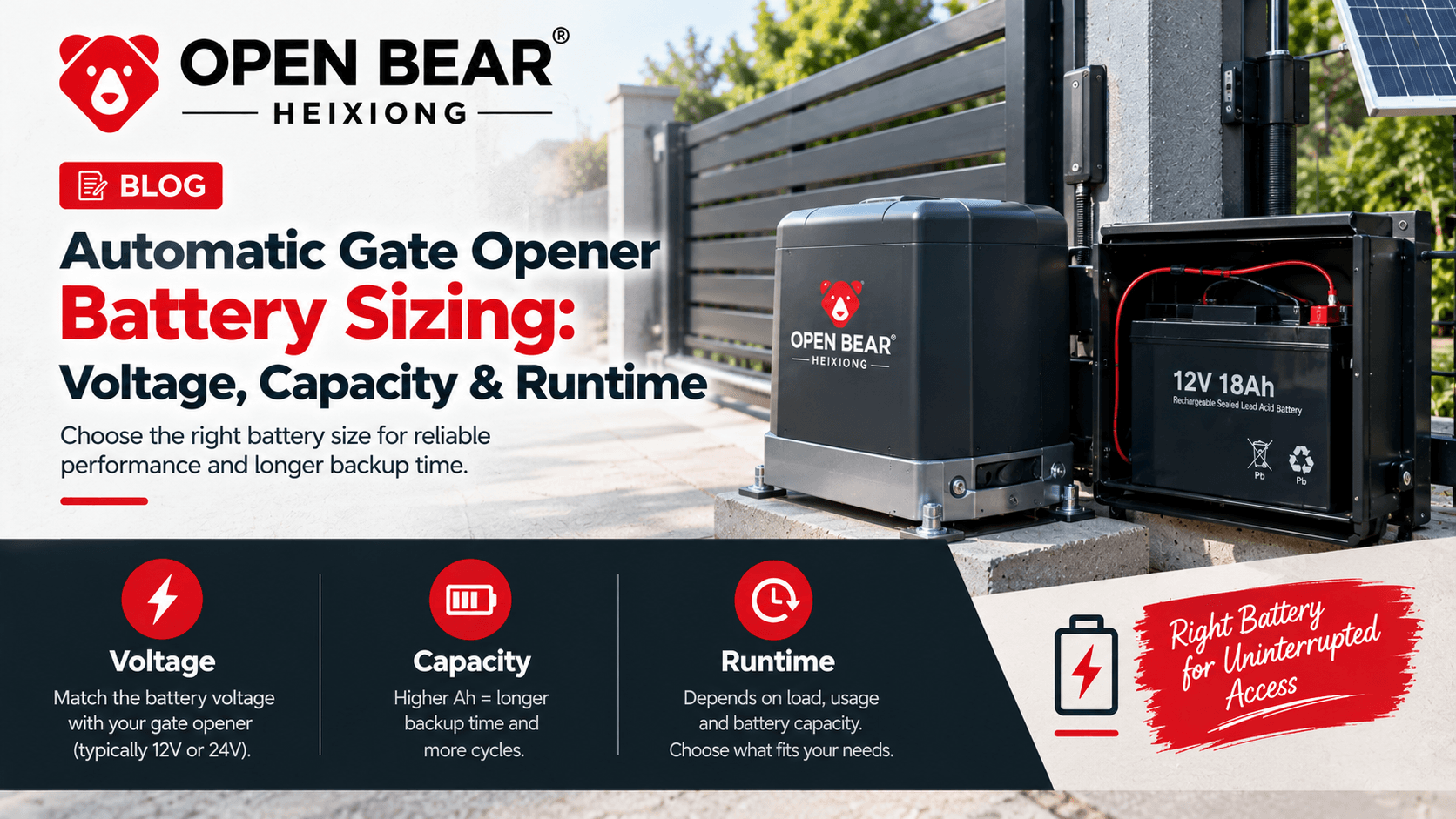
Most home and light commercial openers run on 12V or 24V DC. Small, light gate? 12V is usually fine. Heavier gate? You’ll often see 24V, which is just two 12V batteries wired in series. The higher voltage moves the same power with less current, so wires run cooler and the motor works easier.
One rule you can’t bend: the battery voltage has to match the control board. A 24V board won’t run off one 12V battery. And wiring the wrong voltage in can kill the board. Read the label first, shop second.
Where Gate Opener Power Consumption Really Goes
People count the gate moving and forget everything else. Gate opener power consumption has two sides.
When the gate moves, a typical swing operator pulls somewhere around 3 to 10 amps for maybe 15 to 30 seconds. That’s short. But the board, the receiver and the sensors never switch off. They sip current all day and all night, often 0.1 to 0.5 amps. Add it up over 24 hours and that quiet drain can beat a dozen gate cycles.
Every accessory adds to it. Keypad, loop detector, intercom, light. Write each one down with its current draw and add the lot. That total matters more than most people expect.
Working Out a Gate Motor Backup Battery in Amp-Hours
A gate motor backup battery is rated in amp-hours, or Ah. One Ah means the battery can give one amp for one hour. To size it, do this:
- Motor amps times seconds per cycle, divided by 3,600. That’s Ah per cycle.
- Multiply by the number of cycles you want during an outage.
- Add standby amps times the hours you want covered.
- Multiply the result by 1.5 to 2 for a safety margin.
Say the motor draws 6 amps for 25 seconds. That’s about 0.04 Ah a cycle, so 50 cycles need 2 Ah. Standby at 0.3 amps for 24 hours adds 7.2 Ah. Total 9.2 Ah. Apply the 1.5 margin and you’re near 14 Ah. A 12 Ah battery would be cutting it fine, so go for 18 Ah.
Two things shift the answer. Lead-acid batteries hate being drained below about half, so don’t count the bottom half as usable. And cold weather steals capacity, sometimes a fifth or more. If your winters are rough, go one size up.
How Long Gate Opener Battery Runtime Actually Lasts
Gate opener battery runtime depends on capacity, cycles, standby load and how old the battery is. Take that 18 Ah battery. At 50 percent usable, you’ve got about 9 Ah to spend. That covers roughly a day of standby plus a decent number of cycles, and a lot more cycles if nobody’s using the gate overnight.
A farm gate opened twice a day can run for days. A busy commercial entrance can empty the same battery in an afternoon.
Don’t just trust the maths, though. After install, cut the mains and count how many cycles you really get. Real numbers beat any formula.
Why Gate Opener Battery Charging Time Matters
A big battery that never fills back up is just a heavy paperweight. Gate opener battery charging time comes down to the charger’s output and how flat the battery was. A 1 amp charger takes around 12 to 18 hours to refill a half-empty 12 Ah battery. A 4 amp charger does it in a few hours.
If outages are frequent where you are, check the charger can recover the battery between them. Off-grid sites rely on solar panels, and the panel has to cover daily use with room to spare. If you’re torn between the two setups, this breakdown of solar vs. electric gate openers helps you pick.
Picking a Battery Type That Fits the Gate
Sealed lead-acid, usually called AGM, is the default for good reason. It’s cheap, handles float charging and needs no upkeep. Gel copes a bit better with deep discharge and heat. Lithium iron phosphate weighs less and lasts much longer, but costs more and needs a charger built for it.
Mains-powered driveway with the odd outage? AGM does the job. Solar or heavy daily use? Gel or lithium earns its price back.
It also helps to buy from a factory direct gate opener supplier. The maker knows which battery each operator was tested with, so you’re not guessing from a spec sheet.
Sizing Mistakes That Kill Gates Early
Most dead gates come back to the same handful of slips:
- Counting gate movements, ignoring standby draw
- Draining lead-acid below half
- Skipping the safety margin
- Forgetting the cold
- Mixing an old battery with a new one in a 24V bank
- Using a charger that’s too small
Swap batteries every three to five years, sooner if runtime drops. Test twice a year and wipe the terminals down. Treat this page as a rough automatic gate battery sizing guide, and keep your own numbers next to it.
Get the Right Battery Without the Guesswork
Don’t fancy the maths? Send us your gate’s weight, length and daily traffic. Get a quote and we’ll match an operator and battery to your site. Or browse our full product range and compare operators, batteries and solar kits side by side.

Frequently Asked Questions
Key engineering and selection answers regarding this topic
Multiply motor amps by seconds per cycle, divide by 3,600, then multiply by your planned cycles. Add standby draw for the outage period and apply a 1.5 to 2 margin.
Most run on 12V or 24V DC. Check the controller label, since the battery must match. A 24V system uses two 12V batteries in series.
One charge usually gives several hours to a few days, depending on cycles and standby load. The battery itself tends to last three to five years.
Light residential gates often manage on 7 to 12 Ah. Heavier or busier gates need 18 to 35 Ah or more. Work it out from your own numbers.
AGM suits most mains-powered gates. Gel or lithium suits solar and heavy use. Go with what your operator’s manufacturer recommends.
Explore Related Automation Systems
Looking for motors, hardware, or installation systems mentioned in this guide? Discover our factory-direct gate opener range:
All Gate Openers
Browse DC24V sliding, swing & barrier operators with full factory warranty.
Explore Products →Residential Gate Operators
Ultra-quiet, solar-ready sliding & swing gate motors for homes and villas.
Residential Solutions →Commercial Gate Systems
Continuous-duty operators for gated communities, business parks & parking.
Commercial Solutions →Industrial Heavy-Duty
High-torque motors engineered for gates up to 4,000 kg and logistics hubs.
Industrial Solutions →