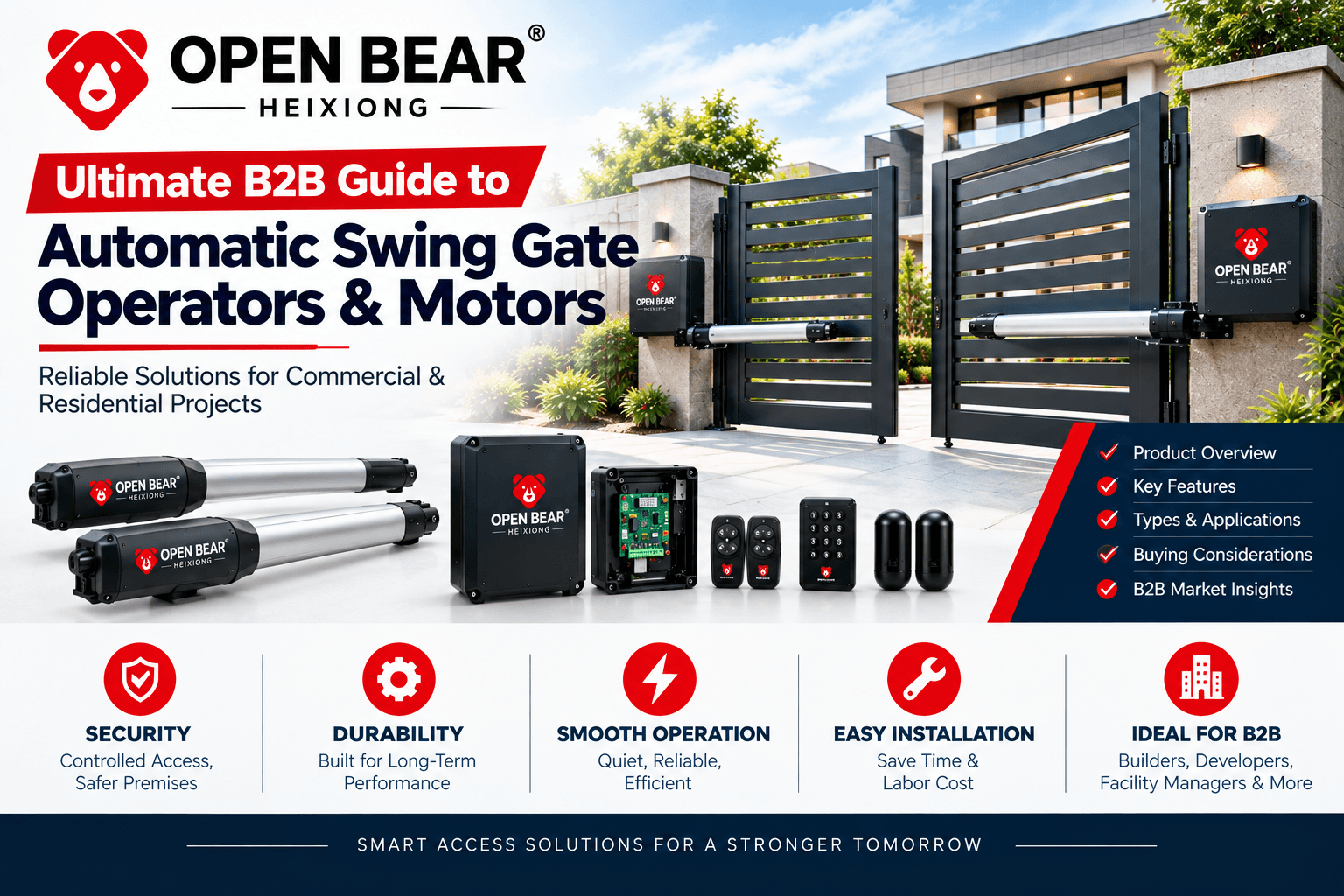
Buying a Swing Gate Opener for a Commercial Property Is Not the Same as Buying One for a Driveway
Most purchasing guides online were written for homeowners. Light gates, low cycle counts, mild conditions, one-time installation. That is not the world B2B buyers operate in.
If you are sourcing automatic swing gate operators & motors for a commercial facility, a residential development, an industrial yard, or a client project, the decisions involved are different in almost every way. Gate weights run heavier. Daily cycles run higher. Downtime costs real money. And the wrong specification does not just cause inconvenience, it causes failures that interrupt operations and generate emergency repair costs that dwarf the original equipment price.
This guide was written for that buyer. Not the homeowner automating a timber driveway gate over a weekend, the procurement manager, the developer, the contractor, or the facility operator who needs to get the specification right the first time and cannot afford to learn through expensive mistakes.
🔧 Before getting into operators and motors, it is worth knowing where the mechanism actually mounts. Our side mounted swing gate opener guide covers the installation differences between side, top, and underground configurations, worth reading before finalizing any specification.
What Separates a Commercial Automatic Swing Gate Opener From a Residential One?
The product category shares a name but not much else.
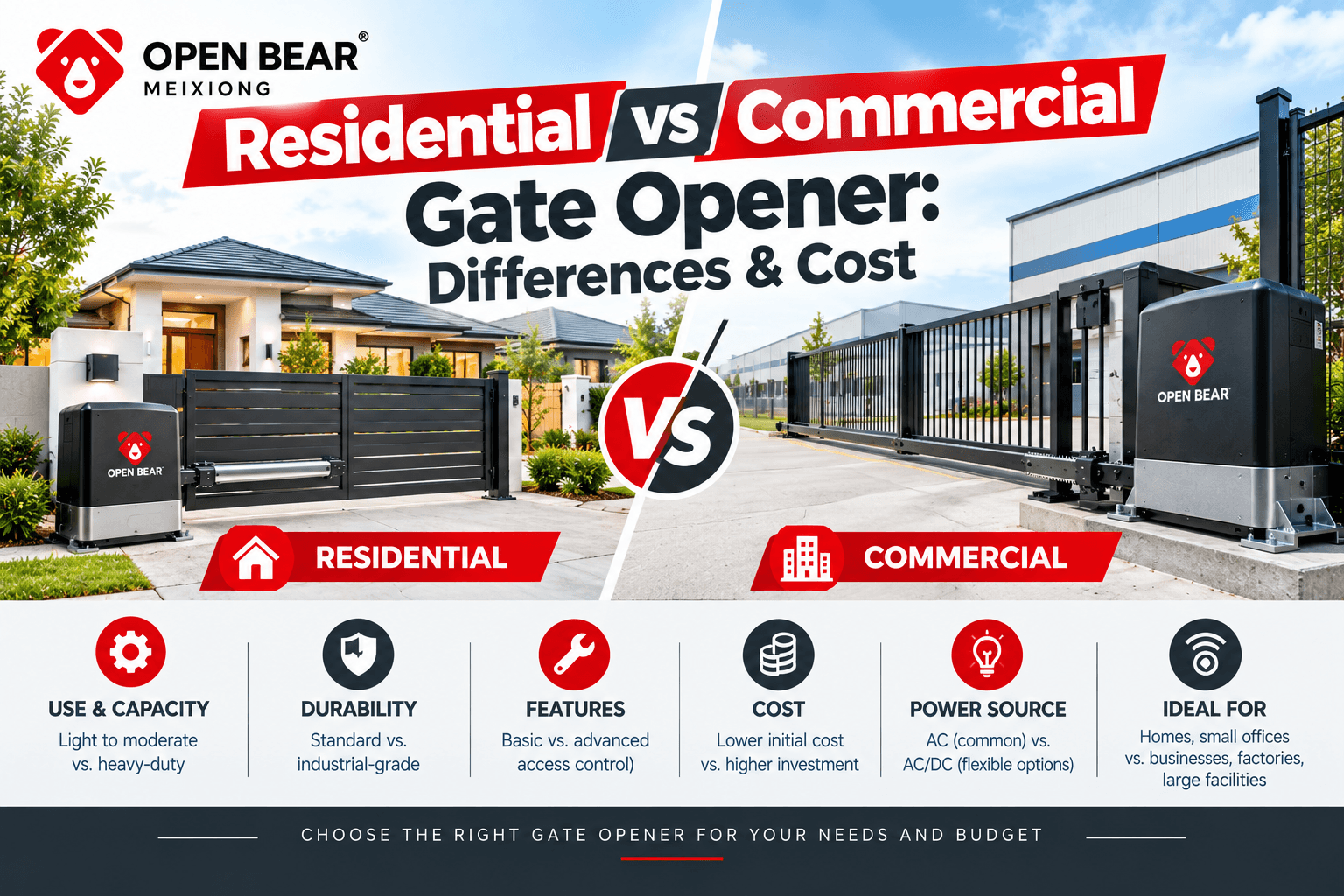
A residential automatic swing gate operators is sized for a light gate, a handful of daily cycles, and a forgiving environment. The motor runs cool because it rarely works hard. The gearbox lasts because it rarely faces real load. The housing survives because it sits in a suburban driveway, not an industrial yard.
A commercial operator lives in a different world. The gate might weigh 500 kilograms. The cycle count might hit 400 before noon. The environment might involve coastal salt air, construction dust, or temperature swings of 60 degrees between seasons. The operator that handles all of that without breaking down is a fundamentally different piece of engineering, heavier motor, thicker gears, sealed bearings, higher duty cycle rating, and housing built to take impacts rather than just weather.
The duty cycle number is where most undersized specifications show up. Residential operators commonly carry a 30 or 50 percent duty cycle, meaning for every minute they run, they need proportional rest time. A commercial gate running 400 daily cycles cannot work within those limits. A proper commercial operator runs at 100 percent continuous duty cycle. It does not need rest periods. It runs when the gate needs to run.
That single spec difference explains more gate operator failures in commercial applications than any other factor.
How Do You Choose the Right Swing Gate Operator Manufacturer for a B2B Project?
This question matters more than most buyers give it credit for before the project starts and more than they can stop thinking about after something goes wrong.
A swing gate operator manufacturer with serious commercial credentials brings things to the table that a residential-grade supplier simply cannot. Type-tested products with verified load ratings. Control boards that accept standard access control wiring without custom workarounds. Spare parts programs that mean components are available years after installation. Technical support that understands commercial installation requirements rather than redirecting you to a consumer FAQ.
When evaluating manufacturers for a B2B project, the questions worth asking directly:
What is the tested gate weight limit and how was that figure verified, by internal testing or independent certification?
What duty cycle does the product carry and is that rating for the motor alone or the complete operator assembly?
How long has the product line been in production and what is the parts availability commitment?
Does the manufacturer maintain a certified installer network and what does certification actually require?
What access control protocols does the control board natively support and what requires additional hardware?
Manufacturers who answer these questions clearly and with documented evidence are the ones worth specifying. Manufacturers who respond with marketing language and redirect to brochures are the ones to be cautious about regardless of how attractive the pricing looks.
When Does a Project Need a Dual Swing Gate Opener?
Single leaf gates work well for openings up to around four or five meters. Beyond that, a single leaf becomes impractical, too heavy for a single operator, too much wind load on the hinge, too much structural demand on the gate post.
A dual swing gate opener uses two operators, one on each leaf, controlled by a single panel that sequences their movement. The leaves open in a coordinated arc and close with adjustable timing to ensure the secondary leaf closes before the primary one, preventing collision.
For B2B projects this configuration comes up frequently:
Gated residential developments where the entrance width needs to accommodate two vehicles passing simultaneously.
Commercial facilities where the gate opening needs to span a full access road width of six meters or more.
Institutional properties, hospitals, universities, government facilities, where the entrance gates are as much about visual presence as they are about access control.
Industrial yards where the opening needs to accommodate wide-load vehicles.
The specification considerations for dual swing gates go beyond simply ordering two operators. The control panel sequencing, the safety sensor coverage across the full opening width, the loop detector positioning for vehicle detection, and the mechanical synchronization between leaves all need to be planned as a system rather than as two independent gates that happen to be adjacent.
🔍 Deciding between a concealed underground motor and a visible above-ground operator for your dual gate setup? The Underground vs Above-Ground Gate Openers comparison covers the cost, installation, and maintenance differences that actually matter at project specification stage.
What Does a Heavy Duty Swing Gate Motor Actually Need to Deliver?
The term heavy duty gets used loosely enough that it has almost lost meaning. So here is the concrete version.
A heavy duty swing gate opener for genuine commercial application needs to deliver consistent torque output at the rated gate weight, not peak torque under ideal conditions but consistent torque through the full arc of travel, in operating temperatures that range from freezing to extreme heat, after thousands of cycles without a service visit.
Torque figures on spec sheets are worth checking against the actual gate weight with a margin built in. A motor rated at maximum torque for a 500 kilogram gate that you then install on a 480 kilogram gate is running near its limit every cycle. A motor rated for 800 kilograms on that same gate runs comfortably and lasts significantly longer as a result.
Thermal management matters for heavy duty applications in a way that does not show up on spec sheets. How the motor dissipates heat through sustained heavy use determines whether it maintains output or gradually degrades across a long operating day. Manufacturers who engineer heat management into the housing design rather than relying on thermal cutoffs as the primary protection mechanism build products that perform more consistently over time.
The gearbox specification matters as much as the motor itself. Hardened steel gears with adequate lubrication capacity handle high-cycle commercial applications without the progressive wear that cheaper gearboxes show within the first year of demanding use. When evaluating heavy duty operators, asking specifically about gearbox material and lubrication system is worth the conversation.
What Access Control Integration Should B2B Buyers Expect?
An automatic swing gate opener in a B2B context is almost never a standalone product. It is one component in an access control infrastructure that includes entry management, visitor processing, security monitoring, and sometimes fleet management.
The control board is where that integration either works cleanly or creates ongoing headaches.
Standard relay outputs for triggering from keypads, card readers, and intercoms are baseline expectation, any commercial-grade operator should support these without additional hardware. Beyond that, the questions that matter for B2B specification are:
Does the board support loop detector inputs for vehicle presence detection? This is essential for anti-crushing protection and for open-on-approach functionality in high-traffic facilities.
Does the board accept inputs from safety edges and photocells from multiple manufacturers or is it limited to the gate operator brand's own accessories?
Does the system support remote monitoring and fault reporting, either natively or through a compatible controller?
Can the board be configured for different operating modes, automatic closing after a set interval, held open during business hours, restricted to manual operation during maintenance, without requiring a technician visit for each change?
Operators whose control boards answer yes to all of these questions are the ones that work cleanly in complex commercial access control environments. Those that answer yes to two out of four create integration compromises that facility managers deal with for the life of the installation.
What Are the Real Costs of Getting the Specification Wrong?
This is the section that changes how procurement decisions get made once someone has lived through a specification mistake.
The equipment cost of a commercial automatic swing gate opener is a fraction of the total cost of a failed installation. When the wrong operator goes on a heavy commercial gate, the sequence usually looks something like this:
The motor overheats within the first high-cycle period, typically a busy morning rush. Performance degrades. Cycles slow. The gate starts behaving inconsistently.
A service call gets booked. The technician identifies that the operator is running beyond its rated capacity. A replacement is recommended.
Meanwhile the facility has been operating with an unreliable gate for weeks or months. Security has been compromised on the days it failed open. Operations have been disrupted on the days it failed closed.
The replacement cost, the service call costs, and the operational disruption costs together typically run three to five times the price difference between the correct specification and the undersized one that was chosen to save money upfront.
The business case for correct specification is not complicated. It just requires someone to do the full cost calculation rather than comparing line-item equipment prices.
Floor-Level and Specialty Configurations Worth Knowing About
Not every swing gate installation follows the standard above-ground operator arm configuration. B2B projects regularly involve situations where the standard approach either does not work aesthetically or structurally.
Underground operators mount below the hinge point inside a sealed housing set into the ground. They leave no visible hardware on the gate post and are the preferred solution for high-end residential developments and institutional properties where the entrance aesthetics are part of the design brief.
Above-ground operators with side mounting configurations work for gates where underground installation is not practical, high water table areas, existing concrete that cannot be broken up, or installations where future service access needs to be straightforward.
For pedestrian access points and commercial doorways, a different category of product applies entirely.
🚪 Specifying powered access for commercial doorways alongside your gate project? The Floor Swing Door Opener Guide covers the specific requirements for floor-mounted commercial door operators, different product category, different compliance requirements, worth understanding separately.
Final Thoughts
Getting the specification right on an automatic swing gate operators & motors for a commercial project is not complicated once the right questions are being asked. Duty cycle, gate weight margin, access control integration, manufacturer support infrastructure, and total cost of ownership rather than equipment price alone, these are the factors that determine whether the installation runs reliably for fifteen years or generates service calls and operational headaches from the first busy week.
The brands worth specifying are the ones that answer technical questions directly, back their products with documented certifications, and maintain the support infrastructure that commercial facilities actually need after the installer leaves.
Work with a certified commercial gate installer, specify to your real requirements with margin built in, and treat the gate operator as the infrastructure investment it is, not a commodity line item where the cheapest option wins.

Frequently Asked Questions
Key engineering and selection answers regarding this topic
Duty cycle matters most, confirm the operator carries a 100 percent continuous duty cycle rating for any application running more than 50 cycles daily, verified for the complete assembly not just the motor alone.
A dual swing gate opener uses a single control panel that sequences both operators, managing opening order, travel timing, and closing sequence to prevent leaf collision based on the gate geometry and access requirements.
A genuine heavy duty swing gate motor delivers consistent torque through the full arc of travel under sustained high-cycle use, with hardened gearbox components and rated capacity well above the actual gate weight.
Ask for type-tested load certifications, duty cycle documentation, parts availability commitments, and native access control protocol support, manufacturers who answer with documented evidence rather than marketing language are worth specifying.
At minimum, relay outputs for keypad and card reader triggers, loop detector inputs for vehicle detection, third-party photocell compatibility, and configurable operating modes adjustable without a technician visit.
Explore Related Automation Systems
Looking for motors, hardware, or installation systems mentioned in this guide? Discover our factory-direct gate opener range:
All Gate Openers
Browse DC24V sliding, swing & barrier operators with full factory warranty.
Explore Products →Residential Gate Operators
Ultra-quiet, solar-ready sliding & swing gate motors for homes and villas.
Residential Solutions →Commercial Gate Systems
Continuous-duty operators for gated communities, business parks & parking.
Commercial Solutions →Industrial Heavy-Duty
High-torque motors engineered for gates up to 4,000 kg and logistics hubs.
Industrial Solutions →