
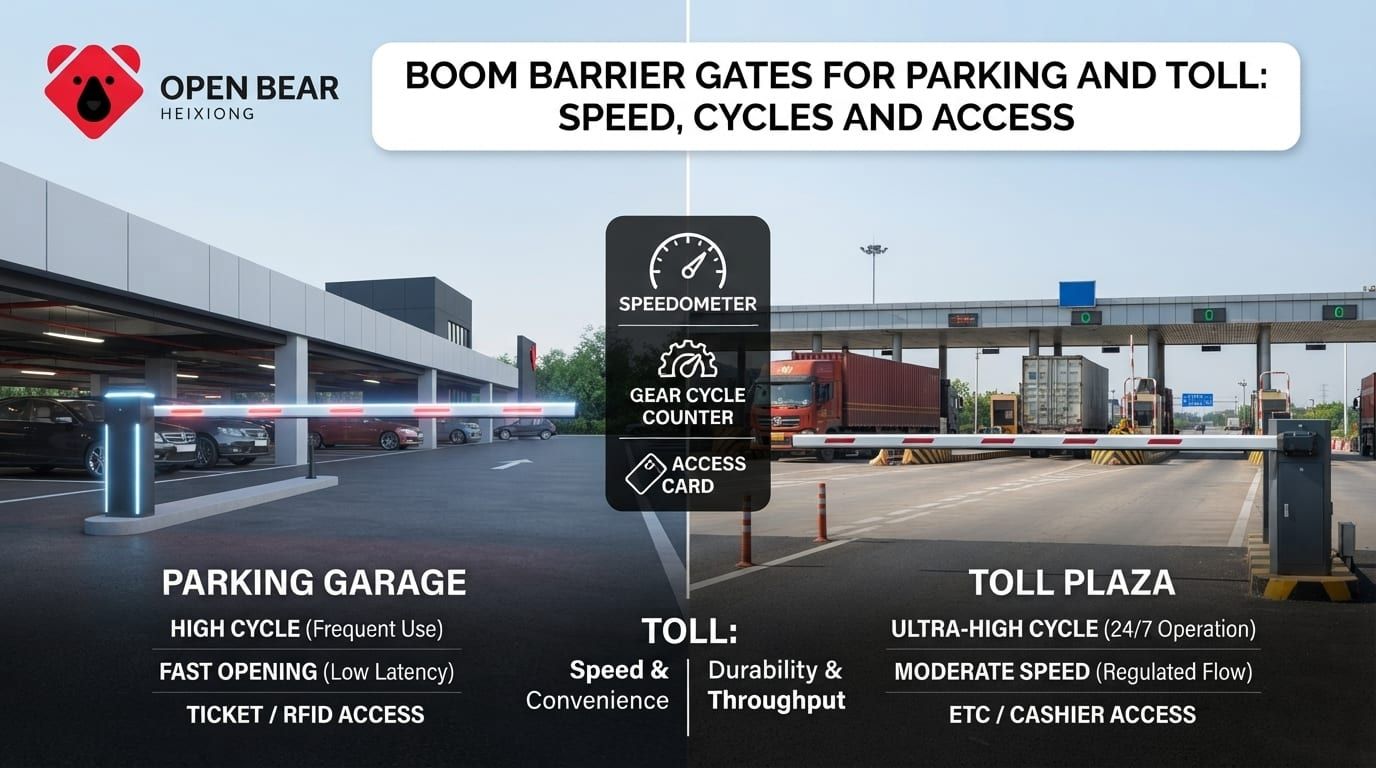
A boom barrier lives a completely different life from a driveway gate. It might lift and lower a thousand times a day, every day, for years, in a lane where a slow arm means a queue and a failed arm means chaos. Speed and endurance are not nice-to-haves here, they are the whole specification. This guide covers what actually matters when you spec a barrier for a car park or toll lane: how fast the arm needs to move, how the cycle and reliability ratings work, which motor type survives high-frequency duty, and how the barrier ties into loop detectors and plate recognition so the lane runs itself.
What a boom barrier has to do
A boom barrier is a horizontal arm that raises to let a vehicle through and lowers behind it. In a car park or toll lane, its job is throughput: move as many vehicles through the lane as possible without letting anyone through who has not paid or been authorised.
That splits into three demands. The arm has to move fast, so vehicles are not waiting. It has to survive an enormous number of cycles, because it never really rests. And it has to talk to the access system, so it only lifts for the right vehicle at the right moment. A barrier that does one well but not the others creates a bottleneck. This is a different problem from general perimeter gates, which we cover in the heavy-duty industrial gate guide.
Opening speed: the number drivers feel
Opening speed is the spec drivers notice, because it decides how long each car waits at the arm. It is usually given as the time for the arm to rise from horizontal to vertical.
For a busy lane, faster is better, within reason. A quality barrier offers an adjustable trip time, and the Open Bear barrier runs from as fast as 0.7 seconds up to 6 seconds, so you can tune it to the lane. A 0.7 second rise suits a high-volume car park exit where every second of delay builds a queue. A slower setting suits a wider arm or a site where a gentler motion is safer.
Arm length affects the achievable speed. A longer arm has more mass to accelerate and swing, so the fastest trip times apply to shorter arms, and a 6 metre arm sits toward the slower end of the range. Match the arm to your lane width first, then set the speed the arm can handle.
Cycles and MCBF: how endurance is measured
This is where barrier specs separate real high-duty equipment from gate motors wearing a barrier arm. Two numbers matter.
The cycle rating is the total number of open-close operations the barrier is built to perform over its life. A high-duty barrier is rated in the millions. The Open Bear barrier carries a 10,000,000-cycle rating. To put that in context, a lane running 1,000 vehicles a day would take about 27 years to reach that figure, and at 500 a day, over 50 years. The rating outlasts most of the facilities these barriers go into.
The MCBF, mean cycles between failures, tells you how many cycles the barrier averages between faults. It is the barrier equivalent of MTBF (mean time between failures), but counted in cycles rather than hours, which fits a machine measured by operations rather than runtime. The Open Bear barrier is rated at 2,000,000 MCBF. A high MCBF is what keeps a lane running without constant service calls, and for a car park operator that reliability is the difference between a barrier you forget about and one that generates tickets every month.
When you compare barriers, read both numbers together. A high headline cycle rating with a low MCBF means the barrier reaches a big lifetime total but faults often along the way.
Servo vs induction motors
The motor type underneath drives both speed and endurance. Two broad options exist.
An induction (AC) motor is the older, cheaper approach. It works, but it runs hotter under heavy repetition, offers less precise speed control, and typically wears faster in high-frequency duty. For a light-traffic barrier it can be adequate.
A servo motor is the choice for demanding lanes. It gives precise control over acceleration and deceleration, so the arm starts and stops smoothly instead of slamming, which reduces mechanical wear at both ends of every cycle. It handles high-frequency duty with less heat and holds position accurately. The Open Bear barrier uses a 300W DC servo, which is also why it can absorb up to three times its rated load without cutting out, so a gust or a knock does not stop the lane. For a car park or toll application cycling all day, a servo barrier is worth the difference.
Loop detectors: the barrier's eyes
A barrier needs to know when a vehicle is present, and the standard tool is the inductive loop detector, a wire loop cut into the road surface that senses the metal mass of a vehicle over it.
Loops do several jobs in a lane. A safety loop under the arm stops it lowering onto a vehicle and holds it up until the car clears, the same protection principle as the sensors in our gate safety sensor guide. An arming or exit loop can trigger the arm automatically for free-flow exits. A closing loop drops the arm promptly once the vehicle has passed, so no one tailgates through. Together they let the lane run without an attendant.
Access integration: LPR, cards and remotes
The barrier only earns its place when it lifts for the right vehicle automatically. Modern lanes tie the barrier to an access layer.
LPR or ANPR (licence plate or automatic number plate recognition) reads a vehicle's plate with a camera and lifts the arm for registered vehicles, no ticket or card needed. This suits resident car parks, staff lots, and toll lanes with account holders. Alongside it, barriers accept the familiar methods: IC cards for staff and members, remotes for regular users, and push-button control for a staffed booth. The Open Bear barrier supports several of these access methods through one controller, so a single lane can serve plate-recognised residents and card-holding staff at once. Ticket-based pay-on-exit systems connect the same way.
The goal is a lane where the right vehicle triggers the arm, the safety loop protects it, and the closing loop resets it, with no one in the booth.
Specifying a barrier: a short checklist
Pull it together before you buy. Match the arm length to your lane width. Set the opening speed to your traffic volume, faster for high-throughput exits, using an adjustable barrier so you are not locked in. Read both the cycle rating and the MCBF, and favour a servo motor for any lane cycling heavily all day. Plan your loops, at least a safety loop, plus arming and closing loops for unattended lanes. Choose the access method your site needs, whether that is LPR, cards, remotes, or a mix.
You can match these requirements to the Open Bear barrier specifications, and our engineers will help you spec a full lane on the contact page.
Frequently asked questions
How fast should a boom barrier open for a car park?
For a busy lane, an arm that rises in around 0.7 to 1.5 seconds keeps vehicles from queuing at the exit. A good barrier offers an adjustable trip time so you can tune speed to traffic. Longer arms move slower, so match the arm to the lane width first, then set the fastest speed the arm handles safely.
What does MCBF mean on a barrier gate?
MCBF is mean cycles between failures, the average number of open-close operations the barrier performs between faults. It is the cycle-based version of MTBF (mean time between failures), which suits a machine measured by operations rather than hours. A high MCBF, such as 2,000,000, means fewer service calls in a busy lane.
How many cycles does a boom barrier last?
High-duty barriers are rated in the millions of cycles. A 10,000,000-cycle barrier running 1,000 vehicles a day would take roughly 27 years to reach that total. Always read the cycle rating alongside the MCBF, since lifetime total and reliability between faults are two different measures.
Should I choose a servo or induction motor barrier?
For a car park or toll lane cycling heavily all day, a servo motor is the better choice. It controls acceleration and deceleration precisely, runs cooler under high-frequency duty, and wears more slowly than an induction motor. Induction motors are cheaper and can suit light-traffic barriers, but they run hotter under constant repetition.
What are loop detectors used for on a barrier?
Inductive loop detectors sense a vehicle over a wire loop in the road. A safety loop stops the arm lowering onto a car, an arming loop can trigger the arm for exits, and a closing loop drops it once the vehicle passes so no one tailgates. Together they let a lane run without an attendant.
Can a boom barrier read licence plates automatically?
Yes. With LPR or ANPR, a camera reads the plate and lifts the arm for registered vehicles without a ticket or card, which suits resident and staff car parks and account-based toll lanes. Barriers also accept IC cards, remotes, and push-button control, often through one controller, so a lane can serve several access methods at once.

Frequently Asked Questions
Key engineering and selection answers regarding this topic
For a busy lane, an arm that rises in around 0.7 to 1.5 seconds keeps vehicles from queuing at the exit. A good barrier offers an adjustable trip time so you can tune speed to traffic. Longer arms move slower, so match the arm to the lane width first, then set the fastest speed the arm handles safely.
MCBF is mean cycles between failures, the average number of open-close operations the barrier performs between faults. It is the cycle-based version of MTBF (mean time between failures), which suits a machine measured by operations rather than hours. A high MCBF, such as 2,000,000, means fewer service calls in a busy lane.
High-duty barriers are rated in the millions of cycles. A 10,000,000-cycle barrier running 1,000 vehicles a day would take roughly 27 years to reach that total. Always read the cycle rating alongside the MCBF, since lifetime total and reliability between faults are two different measures.
For a car park or toll lane cycling heavily all day, a servo motor is the better choice. It controls acceleration and deceleration precisely, runs cooler under high-frequency duty, and wears more slowly than an induction motor. Induction motors are cheaper and can suit light-traffic barriers, but they run hotter under constant repetition.
Inductive loop detectors sense a vehicle over a wire loop in the road. A safety loop stops the arm lowering onto a car, an arming loop can trigger the arm for exits, and a closing loop drops it once the vehicle passes so no one tailgates. Together they let a lane run without an attendant.
Yes. With LPR or ANPR, a camera reads the plate and lifts the arm for registered vehicles without a ticket or card, which suits resident and staff car parks and account-based toll lanes. Barriers also accept IC cards, remotes, and push-button control, often through one controller, so a lane can serve several access methods at once.
Explore Related Automation Systems
Looking for motors, hardware, or installation systems mentioned in this guide? Discover our factory-direct gate opener range:
All Gate Openers
Browse DC24V sliding, swing & barrier operators with full factory warranty.
Explore Products →Residential Gate Operators
Ultra-quiet, solar-ready sliding & swing gate motors for homes and villas.
Residential Solutions →Commercial Gate Systems
Continuous-duty operators for gated communities, business parks & parking.
Commercial Solutions →Industrial Heavy-Duty
High-torque motors engineered for gates up to 4,000 kg and logistics hubs.
Industrial Solutions →