

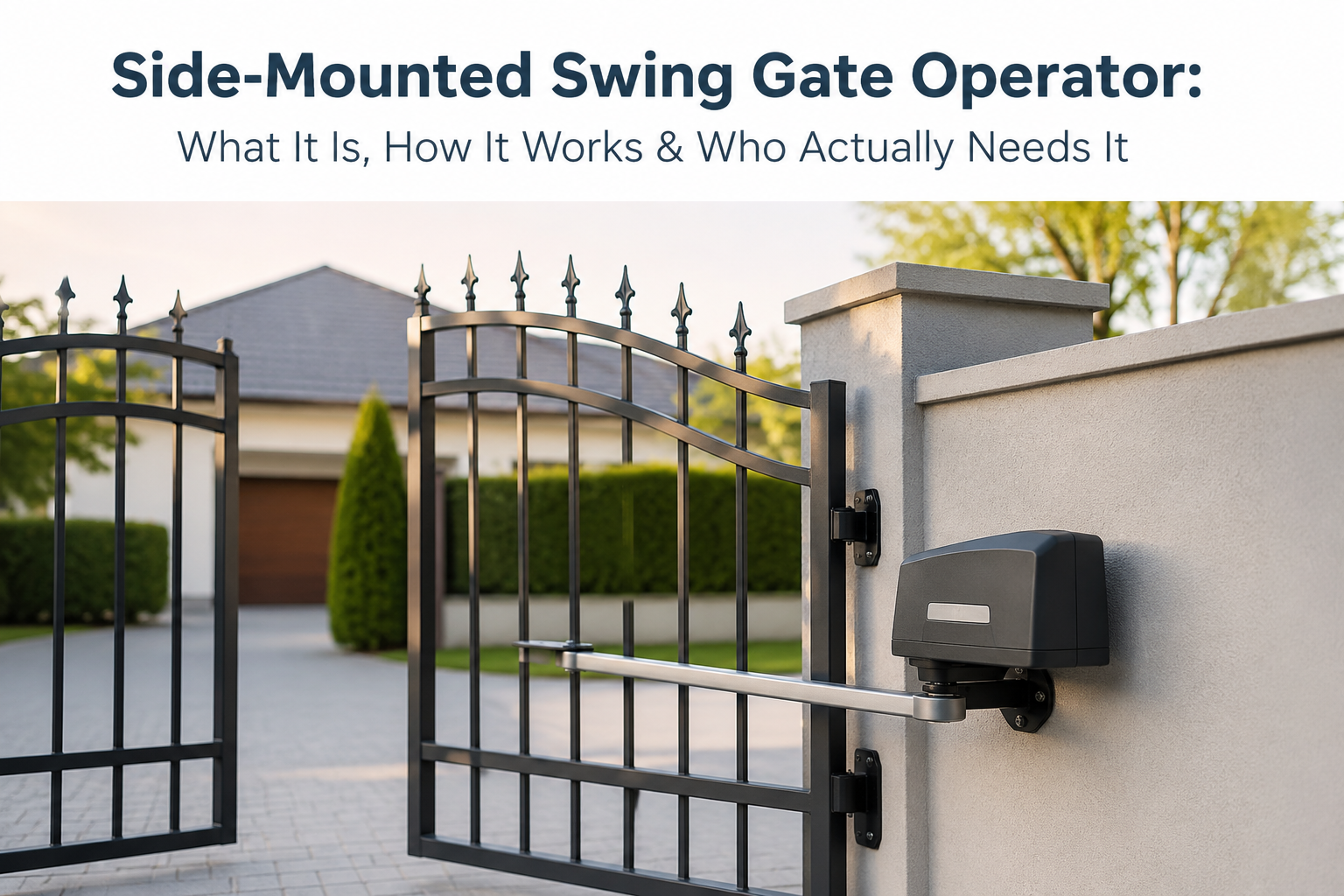
Pull up any distributor's catalog for swing gate automation and you'll see more naming variations than should be legal: side-mounted, column-mounted, post-mounted, above-ground, arm operator, linear arm, articulated arm. They all point at the same product category — but the distinctions between them are real, and specifying the wrong variant for a site causes installation problems that look like product failures.
This guide defines the side-mounted swing gate operator precisely, explains how each arm variant works mechanically, and maps the product to the applications where it performs best.
Key Takeaways
- A side-mounted swing gate operator mounts above ground on the gate post — making it serviceable without excavation, unlike underground operators
- Linear arms are quieter and lower-maintenance; articulated arms solve tight-mounting-geometry problems that linear arms cannot
- "Column mount," "post mount," and "surface mount" describe the bracket kit — the motor unit is identical across all three
- Duty cycle is the most commonly undersized specification: a 15-cycle/hr residential unit on a site running 80+ cycles/day fails within 6–18 months
- The holding force specification matters as much as weight capacity on exposed sites — a gate in a high-wind location requires 700–1,200 N holding force regardless of gate weight
What a Side-Mounted Swing Gate Operator Is
A side-mounted swing gate operator is an electromechanical gate drive unit that mounts above ground on the side face of a gate post or pillar — hence "side-mounted" — and uses a mechanical arm to push or pull a hinged gate panel through its opening arc.
The key word is above-ground. This is what separates side-mounted swing operators from underground (floor-mounted) operators, which install in a buried housing beneath the hinge line. The side-mounted configuration is visible, accessible, and serviceable without excavation. That accessibility is not an aesthetic compromise — it's a maintenance advantage that translates directly to lower total cost of ownership over a 10–15 year service life.
What "swing gate operator" means in spec language: the gate it drives swings on a vertical axis — like a door. It does not roll, slide, or fold. The arm transfers motor force to the gate face, and the gate arcs through a clearance zone either inward toward the property or outward toward the road.
The Two Arm Types: Linear vs. Articulated
The arm is the mechanical heart of a side-mounted swing operator, and there are two fundamentally different arm geometries. Choosing incorrectly for the mounting geometry of a specific site causes chronic alignment problems.
Linear Arm (Straight Arm)
A linear arm extends and retracts in a straight line — like a piston. The motor drives a lead screw or rack inside the arm housing, pushing the arm's extension rod outward or retracting it inward. This extension force, applied to the gate face at a fixed bracket point, pushes or pulls the gate through its arc.
Where linear arms work best: sites where the gate post allows the operator to be mounted perpendicular to the gate face with adequate standoff distance. The geometry requires clear space for the arm to extend at its maximum travel without the housing fouling the post or column.
Performance characteristics:
- Quieter than articulated arms due to fewer pivot points
- Lower maintenance requirements (fewer wear surfaces)
- Best suited for gates up to 16 feet wide in the residential and light commercial range
- Opening speed: 15–20 seconds for a standard residential cycle
Articulated Arm (Folding Arm)
An articulated arm uses a pivot joint at the arm's midpoint, creating a two-segment "folding" geometry. As the motor drives the arm, the elbow joint flexes — allowing the operator housing to be mounted closer to the hinge point without the arm geometry creating mechanical interference.
Where articulated arms solve problems: column-mounted installations where the pillar geometry restricts how far from the hinge the operator can sit. The elbow joint compensates for the compressed mounting geometry.
Performance characteristics:
- Handles wider gates than linear arms at comparable motor torques
- More mechanical joints = more periodic lubrication required
- Better force geometry for heavy gates through the mid-arc position
- Commonly used on dual-leaf (double) gate configurations where two operators work simultaneously
Mounting Variants: Column, Post, and Surface
The "side-mounted" label covers several distinct mounting configurations, each suited to a different gate post construction.
Mounting Type
Post Construction
Typical Use
Installation Notes
Column mount
Brick, stone, or concrete pillar
Residential estate, commercial entrance
Requires anchor bolts in masonry; drilling depth critical
Post mount
Steel square or round hollow section
Residential, agricultural, light commercial
Weld plate or bolt-through bracket; most DIY-friendly
Surface mount
Any flat vertical face
Retrofit on existing structures
Quickest to install; bracket alignment is the critical step
Integrated frame mount
Purpose-built operator post
New construction commercial
Cleanest installation; operator housing is part of the post
The differences are in the bracket hardware and the drilling or welding requirement — the operator unit itself is identical across mounting variants. When agents or distributors specify a "column mount swing gate operator" or "post mount swing gate operator," they're specifying the bracket kit, not a different motor.
How the Side-Mounted Swing Operator Works: The Full Cycle
Understanding the operational sequence helps installers diagnose problems and helps buyers understand what they're actually paying for when they compare products at different price points.
Open cycle, step by step:
- An access signal arrives at the control board — from a remote, keypad, vehicle loop detector, or access control system
- The control board validates the signal and sends a start command to the motor driver
- The motor engages, driving the arm mechanism — extending a linear arm or flexing an articulated arm outward
- The arm pushes the gate panel away from the closed stop, and the gate begins its arc
- A position sensor (limit switch or shaft encoder) monitors gate travel and signals the control board when the gate reaches the programmed full-open position
- The motor stops precisely at the open limit; the arm holds the gate stationary against wind load
- The timer-to-close countdown begins if auto-close is active, or the system waits for a close command
Safety device integration during the cycle:
Photo-eye sensors mounted at bumper height across the gate opening monitor for obstructions throughout the close cycle. Any beam interruption stops the gate and reverses it to full open. UL 325 Class I compliance (residential) requires at least one entrapment protection device active during the close cycle. Class II (commercial) requires two independent devices.
Specifications That Actually Differentiate Products
When comparing side-mounted swing gate operators across manufacturers, these specifications separate operators that will perform under the stated duty cycle from those that won't.
Spec
Entry Level
Mid-Range Commercial
Heavy-Duty
Gate weight capacity
Up to 500 lb
500–1,000 lb
1,000–2,000 lb
Leaf width capacity
Up to 12 ft
Up to 18 ft
Up to 24 ft
Duty cycle
15 cycles/hr
40 cycles/hr
80–100 cycles/hr
Motor type
AC induction
DC brushless
DC brushless / hydraulic
IP rating
IP44
IP54
IP65
UL 325 class
Class I
Class I–II
Class II–III
Operating temp
14°F to 131°F
-4°F to 140°F
-22°F to 158°F
Holding force
300–500 N
700–1,000 N
1,200–2,500 N
Battery backup
Optional add-on
Integrated
Integrated + UPS option
The duty cycle number is the most commonly undersized specification. A distributor sourcing operators for a gated community entrance running 80+ cycles per day needs to match that real-world demand against the operator's hourly rating — not just the gate weight and width specs, which are easier to find on the product page.
Application Mapping: Where Side-Mounted Swing Operators Are Right
Not every gate site is a swing gate site, and not every swing gate site should use a side-mounted operator. This mapping identifies where the product fits correctly.
Strong fit:
- Residential driveways on level or near-level ground with 10+ feet of inward clearance
- Light commercial entrances: office parks, small warehouses, gated parking areas under 80 cycles/day
- Agricultural gates: farms, equestrian properties, rural properties with wide single-leaf gates
- Retrofit automation: existing manual swing gates in sound structural condition
- Any site where above-ground access for maintenance is valued over concealed aesthetics
Weak fit or wrong product:
- Driveways with more than 8–10% grade at the gate line (sliding operator required)
- Sites where the gate swings outward onto a public road or pavement (safety and regulatory issue)
- Applications requiring cycle times under 10 seconds (sliding or barrier operators)
- Gates exceeding 30 feet wide per leaf (hydraulic or linear actuator systems)
- Installations where no visible surface hardware is acceptable (underground operator)
Above-Ground Swing Gate Motor: Why the Terminology Matters for SEO and Spec Documents
Buyers searching for "above ground swing gate motor" are specifically distinguishing their need from underground operators — they want the surface-mounted, visible, accessible configuration. This is the correct product. The term is particularly common among agricultural buyers and distributors sourcing for rural US markets where underground installation is impractical due to soil conditions, frost depth, or drainage.
When writing specifications or sourcing documentation, "above ground swing gate motor" and "side mounted swing gate operator" refer to the same physical product category. Using the buyer's preferred terminology in both spec sheets and product pages helps match the product to the search behavior of the specific buyer segment.
Internal Links
→ Automatic Gate Opener: Complete Guide to Every Type (/blog/automatic-gate-opener-complete-guide)
→ Single Leaf vs Double Leaf Swing Gate Operator: The Installer's Decision Guide (/blog/single-leaf-vs-double-leaf-swing-gate-operator)
→ How to Choose the Right Automatic Gate Opener (/blog/how-to-choose-automatic-gate-opener)
→ Automatic Gate Opener Installation: What Installers Need to Know (/blog/automatic-gate-opener-installation-guide)
→ Heavy-Duty Automatic Gate Opener for Commercial & Industrial Sites (/blog/heavy-duty-automatic-gate-opener-commercial-industrial)
FAQs
What is the difference between a side-mounted swing gate operator and an underground swing gate operator?
A side-mounted swing gate operator mounts above ground on the face of the gate post, with the motor housing and arm mechanism visible and accessible. An underground operator installs in a weatherproof housing buried beneath the gate's hinge line, with no visible surface hardware. The operational result is the same — a hinged gate that opens automatically — but the installation requirements, maintenance access, cost, and aesthetic outcome are completely different. Underground operators require excavation, precise waterproofing of the buried housing, and are significantly harder to service. Side-mounted operators are accessible from the surface, can be inspected and maintained without tools in many cases, and cost substantially less to install and service over their lifetime. For the overwhelming majority of commercial and residential swing gate applications, a side-mounted operator is the correct choice.
Can a side-mounted swing gate operator handle a double-leaf gate?
Yes, with a two-operator kit — one operator per leaf. Dual-gate kits include a master control board that synchronizes the two operators, ensuring both leaves open and close in coordinated sequence. This is critical because independently operating leaves can collide mid-arc if their cycle timing diverges. Most reputable side-mounted swing operator manufacturers offer paired kits with a single control board governing both units. The gate weight capacity and arm geometry specifications must be evaluated for each leaf independently — the operator on each side handles only its own leaf's load. Do not assume that a single operator rated for 1,000 lb can be used to drive a double gate simply by centering it.
What is the maximum gate width a side-mounted arm swing gate operator can handle?
This depends on the specific product line, but as a general specification boundary: residential-grade side-mounted operators handle gate leaves up to 12–14 feet wide. Commercial-grade operators extend to 18–20 feet. Heavy-duty commercial units reach 24 feet per leaf in some configurations. Beyond 24 feet per leaf, the arm geometry becomes mechanically unfavorable — the force vectors at full travel work against the motor rather than with it — and hydraulic linear actuators or underground operators are typically the better engineering choice. Always verify the manufacturer's maximum leaf width specification against the actual gate dimensions, not just the weight rating.
How do I specify the correct mounting bracket for a column-mounted swing gate operator?
The bracket selection depends on four parameters: the column face material (brick, stone, concrete, steel), the column face width at the mounting height, the required standoff distance between the operator housing and the column face, and whether the installation requires surface-mount adhesive anchors or through-bolted connections. For masonry columns, the anchor bolt specification (diameter, embedment depth, spacing) should be confirmed against the operator's published pull-out load requirements — particularly on older brick columns where mortar condition affects anchor capacity. Column-mount operators with adjustable standoff brackets accommodate a range of column widths without requiring custom fabrication. Provide the column face dimensions and material when sourcing a bracket kit.
Does a side-mounted swing gate operator work with existing access control systems?
Yes, and compatibility here is determined by the control board's input terminals, not the motor mechanism. Most modern side-mounted swing gate operator control boards include dry contact inputs (typically labeled "Open," "Close," "Stop," and "Pedestrian") that accept a signal from any access control system capable of producing a switched output — which includes virtually every keypad, card reader, intercom, and vehicle loop detector on the market. Advanced commercial operators also include RS-485 or Wiegand communication ports for integration with building management systems and fleet access platforms. Verify the specific input terminal types on the control board against your access control system's output specifications before committing to a product.
About the Author
Leo Chen is a gate automation specialist and technical content writer with hands-on experience across residential, commercial, and industrial automatic gate operator systems. He covers UL 325 compliance, swing and sliding operator selection, access control integration, and installation best practices for gate industry professionals across the US market. His work is used by distributors, system integrators, and facility managers to make better-informed specification decisions. When he is not writing about gate automation, Hasib works directly with installers and procurement teams to navigate product selection for complex commercial and industrial sites.