Heavy Gates Deserve Better Than a Hand Push
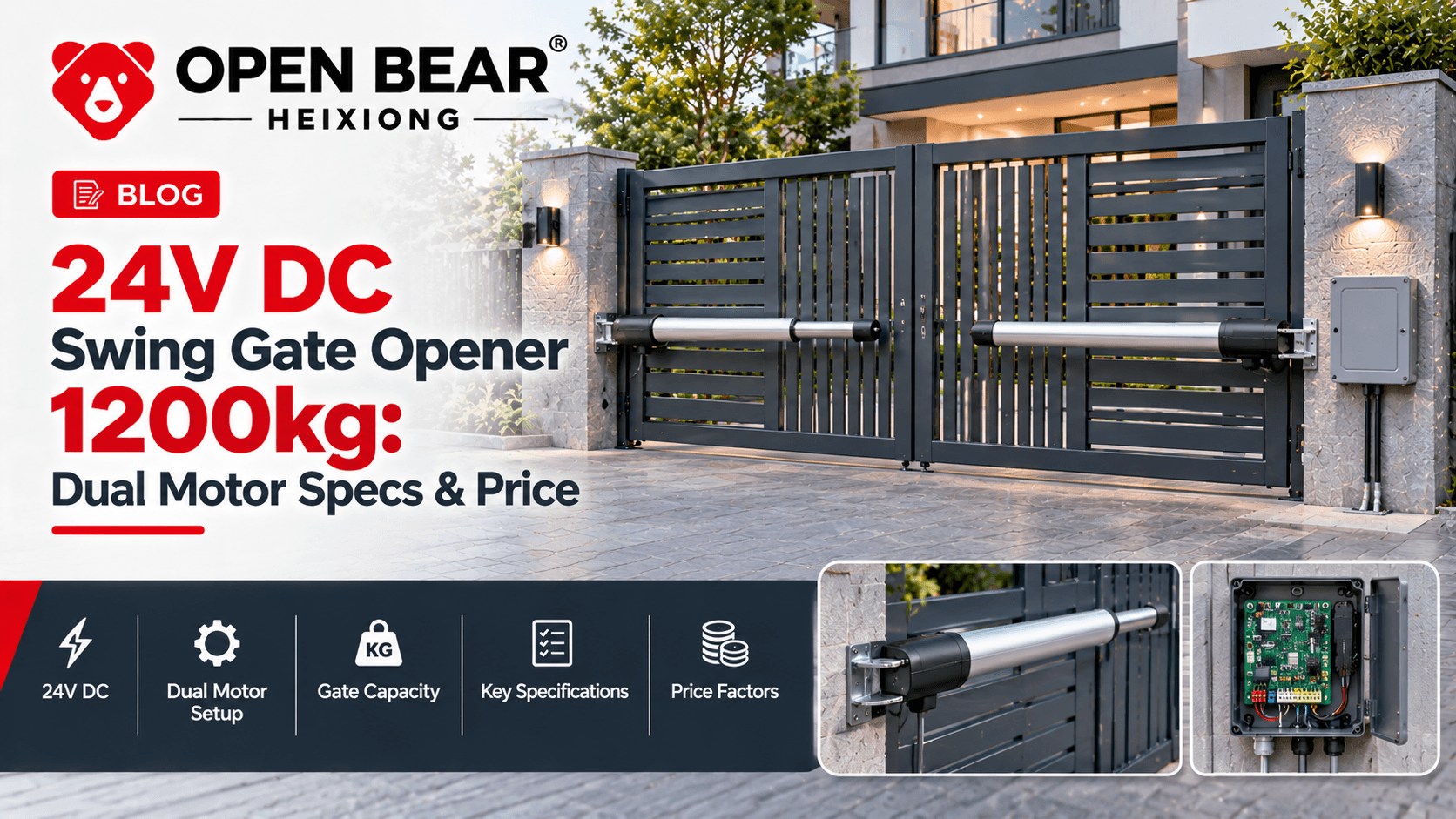
We’ve all dragged a heavy steel gate open in the rain at some point. It’s slow, it’s annoying, and half the time the gate swings back into your shins. If that sounds familiar, this 24v dc swing gate opener 1200kg guide is for you. I’ll explain what a dual motor setup can really lift, what it needs to run, and why prices vary so much from one quote to the next.
Short version: it’s not complicated. But a few details trip people up, so let’s walk through them.
What the 1200kg Rating Really Means?
That number is for the whole gate. Two motors share the job, so each one handles roughly half. A dual swing gate opener 1200kg kit is really a swing gate opener 600kg per leaf system, and that’s the figure you should check first.
Weight isn’t the only limit, though. Leaf length matters just as much. A wide, light gate catches the wind like a sail and pushes back on the motor harder than a short, heavy one. So read both numbers on the spec sheet. I’ve seen 500kg leaves fail simply because they were a meter wider than the opener allowed.
If your gate falls in this range, our dual swing gate opener is built for exactly that kind of daily use.
Why the 24V DC Swing Gate Motor Wins on Smoothness?
Mains voltage motors tend to start hard and stop hard. A 24v dc swing gate motor eases into each move and slows down near the end of travel. Your hinges, posts, and welds feel the difference after a few years. It’s gentler on everything.
Low voltage is also easier to wire safely, and it fits batteries naturally, since batteries already store DC power. That’s why most solar and backup setups are built around 24V.
Most of these motors are linear actuators. A small motor turns a screw, the screw pushes an arm, and the arm swings the leaf. Compare sealing, gear material, and duty rating between brands. Wattage alone tells you very little.
Running Without Mains: Solar Swing Gate Opener 24V Setups
Plenty of gates sit a long way from the house. Digging a trench for cable across a paddock or driveway can cost more than the opener itself. A solar swing gate opener 24v kit skips that job completely. A panel charges a battery, and the battery drives the motors.
Some things I’d get right on day one. Put the panel where the sun hits it for most of the day, not behind a tree. Size the battery for your busiest week, because a cloudy stretch will come. And pick a control board that sips power in standby, otherwise it quietly drains the battery overnight.
A family opening the gate ten times a day gets by with a small panel. A depot with constant traffic needs a bigger one.
When the Power Drops Out?
Storms knock out power at the worst moments. A swing gate opener with battery backup keeps working through them, and since the motors already run on 24V, adding batteries is easy. You won’t be fumbling for the release key with a torch in your mouth.
Backup time depends on gate weight and battery size. Two standard batteries might give you a few dozen cycles. If you run a clinic, a farm, or any site where people must get in and out, ask for the larger battery option.
What Actually Changes the Price?
Everyone wants one number, and I get it. But the price depends on what you put around the motors.
Motor quality comes first. Cheap units use softer gears and thinner seals, and they show it after two winters. Next comes the control board: obstacle detection and adjustable force cost extra but they’re worth having. Then the power system, since mains-only is the cheapest and solar plus batteries adds to the total. Accessories like remotes, keypads, and photo sensors are often sold separately. And installation varies with the state of your gate and posts.
My advice is to ask for an itemised quote. A low headline price that leaves out sensors and batteries won’t stay low for long.
Before You Buy, Check the Gate Itself
A strong motor can’t fix a bad gate. If a hinge sticks or a post leans, the opener will fight it every single cycle and lose eventually. Swing the gate by hand first. It should move freely with one finger. Check the posts, too. They take a lot of push.
Also look at the space the gate sweeps. Walls, slopes, and parked cars all get in the way.
If part of your property needs a different style, our sliding gate openers page shows some layouts worth a look. And when you’d rather leave the fitting to someone else, contact us for installation and send photos with your gate measurements. It speeds up the quote a lot.
Matching the Setup to Your Property
A two-car driveway doesn’t need what a loading yard needs. Roughly speaking, a home driveway does well with a standard dual kit, remotes, and photo sensors. Farm entrances call for solar, battery backup, and a long-range remote. Commercial sites want a high duty rating, keypad or card access, and plenty of battery reserve.
You can browse more options across our automatic gate openers range, or read about our company to see who’s behind the products.
Ready to Size Your Gate?
Send us your gate weight, leaf length, and power situation. We’ll suggest a setup that fits, with no padding and no unneeded extras. Get a quote today and have your gate opening by itself within days.

Frequently Asked Questions
Key engineering and selection answers regarding this topic
It covers a double gate of up to about 600kg per leaf, within the stated leaf length. Check both weight and width before you order.
Yes. Most good kits include remotes and a key release, so you can still open the gate by hand if something fails.
Yes. Look for a weatherproof box, battery backup, and long-range remotes, since farm gates sit far from the house.
It does when the battery is sized properly. A good battery carries the gate through several grey days.
It does when the battery is sized properly. A good battery carries the gate through several grey days.
For most people 24V wins. It’s safer, quieter, and works with solar and batteries. 220V suits sites with steady mains and simple needs.
Weigh each leaf and pick a motor rated well above it. Leave a 20 to 30 percent margin for wind and wear.
You fix one bracket to the post and one to the gate, mount the actuator between them, wire the board, then set the travel limits.
Explore Related Automation Systems
Looking for motors, hardware, or installation systems mentioned in this guide? Discover our factory-direct gate opener range:
All Gate Openers
Browse DC24V sliding, swing & barrier operators with full factory warranty.
Explore Products →Residential Gate Operators
Ultra-quiet, solar-ready sliding & swing gate motors for homes and villas.
Residential Solutions →Commercial Gate Systems
Continuous-duty operators for gated communities, business parks & parking.
Commercial Solutions →Industrial Heavy-Duty
High-torque motors engineered for gates up to 4,000 kg and logistics hubs.
Industrial Solutions →