
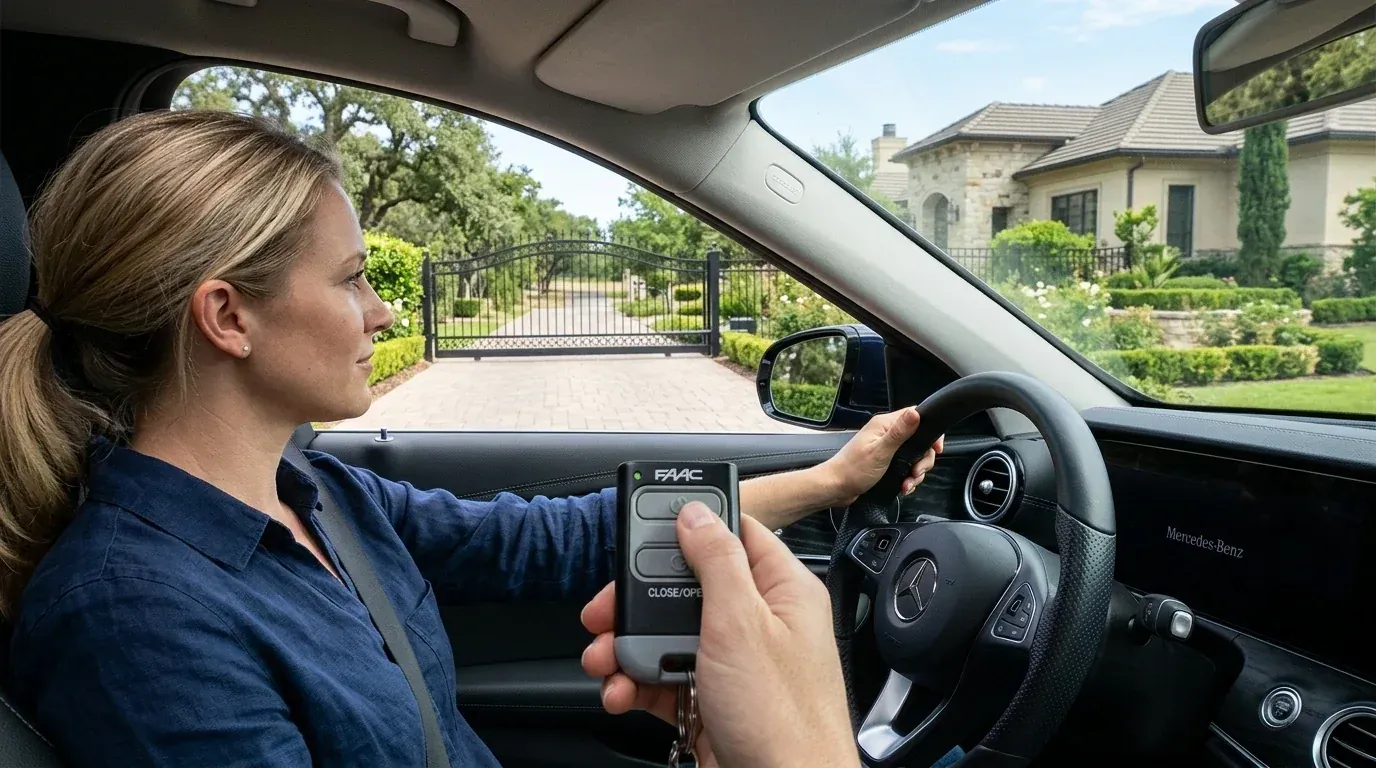
A gate remote not working from a distance is one of the most common complaints owners have about an automatic gate. If you have to roll up to the gate and press the button twice before anything happens, the opener is usually fine. The radio link between your remote and the receiver is what has weakened. Range loss is gradual, which is why most people only notice it once they are almost touching the gate.
This guide explains what controls range, the common reasons it drops, and the order to work through them. Most cases come down to a battery, an antenna, or something metal in the way.
How Far Should a Gate Remote Work?
A gate remote is a low-power radio transmitter. The receiver in the opener listens on one frequency and only acts on a signal it recognizes.
Gate remote range is quoted in open air, with nothing blocking the path. Real driveways are different. Walls, steel gates, parked cars, wet trees, and sloped ground all cut the distance. A system that worked at the end of the drive in summer may struggle in winter when the hedge is wet and heavy.
Two points are worth knowing before you start:
- Range almost never drops to zero at once. It shrinks over weeks or months.
- The transmitter and the receiver both matter. A new remote will not fix a receiver problem.
Start With a Baseline Test
Before changing anything, find out what the current range actually is.
- Stand outside the car, in clear line of sight to the opener.
- Press the remote and walk backward until the gate stops responding.
- Note the distance.
- Repeat from inside the car, in your usual spot.
If the range is much shorter from inside the car, the car is part of the problem. Heated or metallic window film blocks radio signals well. Holding the remote out of the window, or up against the windshield, often adds distance right away.
If range is short everywhere, work through the causes below.
Seven Causes of Poor Range
1. A Weak Battery
This is the most common reason for a gate remote not working from a distance. A battery does not fail all at once. As voltage drops, the transmitter sends a weaker signal, so the LED still lights while the range keeps shrinking.
Fix: replace the battery, even if the LED looks normal. Most gate remotes use a coin cell such as a CR2032 or a small 12V battery such as an A23. Match the type printed on the old battery. Replacing remote batteries once a year keeps this from creeping back.
2. Antenna Problems
The gate remote antenna on the receiver side does most of the work. It is usually a single wire, or a short whip, connected to a terminal on the control board.
A poor gate remote antenna setup causes more range complaints than any other single item. Common faults:
- The wire is coiled up inside the control box
- The wire has been cut short during installation
- The terminal connection is loose or corroded
- The antenna sits low, behind the steel gate frame
Fix: open the control box with the power off and check the antenna terminal. Uncoil the wire and run it upward, outside the box, as straight and as vertical as the manual allows. Do not cut it to length. If the housing is metal, the antenna must sit outside it.
An external antenna on a short mast, mounted above the gate frame and facing the approach road, is the single biggest upgrade for a long driveway.
3. Metal and Site Layout
Radio signals pass through wood, plastic, and glass far better than through metal and concrete.
A receiver mounted low behind a solid steel gate is shielded from the road. A control box inside a masonry pillar is worse. Even a parked van between you and the gate can cut range noticeably.
Fix: move the antenna rather than the whole opener. Run the antenna cable up to a bracket above the gate, on the approach side. Keep it clear of the gate leaf so it does not move with the gate. Keep at least a hand's width between the antenna and any large metal surface.
4. Interference
Nearby electronics transmit noise on the same band, which drowns out a weak signal. Common sources include:
- LED floodlights and cheap LED drivers
- Solar charge controllers and inverters
- Phone chargers and outdoor Bluetooth speakers
- Alarm systems, weather stations, and other remotes
- Neighboring gate or garage systems
Fix: test by switching things off. Turn off the LED lights near the gate and test the range again. Unplug a suspect charger or inverter and repeat. Interference often follows a pattern, so note whether the problem is worse at night when lights are on. Moving the antenna a meter away from the noisy device is often enough.
5. A Damaged or Worn Remote
Remotes live in pockets, cars, and toolboxes. Over time, the case cracks, the battery contacts corrode, and moisture gets in.
Fix: open the remote and look at the board. Green or white deposits on the contacts mean corrosion. Clean the contacts with a cotton swab and isopropyl alcohol, or replace the remote. Test a second remote if you have one. If one remote reaches the gate from the road and another only works up close, the second remote is the problem.
6. Receiver Faults and Weak Power
Less often, the fault sits in the receiver. Voltage drop on a long supply cable, a failing receiver module, or water inside the housing all reduce sensitivity.
Fix: look for moisture, insect nests, and corrosion inside the control box. Check the supply voltage at the board. If every remote gives short range even with a fresh antenna, a replacement receiver module may be needed. Our guide to automatic gate opener parts explains how the receiver sits in the system.
7. Frequency and Compatibility Mismatch
A replacement remote bought online may be close to the right model but not exact. Slight frequency differences can leave you with a remote that pairs at arm's length and fails further out.
Fix: check the frequency printed on the remote, the receiver, or in the manual. Many openers sold internationally use 433.92 MHz, while many North American brands use the 300 to 390 MHz range. Buy the manufacturer's own remote when you can.
Work Through It in This Order
Changing several things at once makes it hard to know what worked. Most remote control range problems clear in the first few steps, so follow the sequence.
Step | Action | Time | Custo |
|---|---|---|---|
1 | Replace the remote battery | 2 minutos | Baixo |
2 | Teste fora do carro e de diferentes ângulos | 5 minutos | None |
3 | Verificar e desembaraçar a antena receptora | 15 minutos | None |
4 | Mover a antena para cima e para fora do metal | 30 minutos | Baixo |
5 | Desligue as luzes e carregadores LED nas proximidades para testar | 15 minutos | None |
6 | Testar um segundo comando | 5 minutos | None |
7 | Encaixe um kit de antena externa | 1 hora | Medium |
8 | Substituir o módulo receptor ou remoto | 1 hora | Medium |
A maioria dos problemas de controle remoto são resolvidos pelos passos 1 a 4. Se você alcançar o passo 8 com um controle remoto do abridor de portão não funcionando melhor, o receptor é a falha provável.
Quando o alcance não é o verdadeiro problema
Algumas falhas parecem perda de alcance, mas não são.
- O portal responde apenas às vezes, a qualquer distância. Isso aponta para uma falha de emparelhamento ou receptor, não intervalo. Um controle remoto do abridor de portas que não funciona a cada distância é um problema diferente.
- Um segundo controle remoto comporta-se da mesma forma em cada ponto. Novamente, isso é um problema de receptor ou emparelhamento em vez de intervalo.
- Nada funciona, mesmo de perto. Verifique a potência, o fusível e a libertação manual. O nosso guia sobrepor que um portão automático não abre ou fechacobre estes casos.
- O portão começa e pára a meio caminho. Isso é um problema mecânico ou de segurança, não um problema de rádio.
Alternativas que valem a pena adicionar
Se sua entrada é longa ou o portão é fortemente protegido, métodos de controle extra ajudam mais do que perseguir o alcance de rádio.
- Teclado no portão para visitantes e entregas
- Aplicativo de telefone através de WiFi, que usa sua rede em vez do rádio do remoto
- Detector de laço para que o portão se abra automaticamente para veículos que saem
- Intercomunicador para entrada de hóspedes
Nossoguia de controle de acessocompara estas opções. Você também pode ver módulos de controle inteligente, sensores e controles remotos em nossosacessórios para portasalcance.
Manter o alcance confiável
Substituir baterias remotas anualmente. Mantenha a antena reta, vertical e limpa de metal, já que o alcance remoto da porta depende mais dela do que do próprio controle remoto. Verifique a caixa de controle para obter umidade em cada serviço. Quando você adicionar iluminação ao ar livre ou equipamento solar perto do portão, teste o controle remoto depois para que você capture interferência cedo.
Cada abertura deFábrica do abridor de portasnavios com manuais em inglês e diagramas de fiação que mostram o layout do terminal e do receptor da antena. Se o seu problema de alcance não limpar após os passos acima,contactar a nossa equipacom o seu modelo e uma descrição do site, e vamos ajudá-lo a resolver a causa.

Frequently Asked Questions
Key engineering and selection answers regarding this topic
R: As causas habituais são uma bateria fraca, uma antena receptora enrolada ou danificada, ou o metal que protege o receptor. Substituir a bateria primeiro, em seguida, verifique se a antena funciona reta, vertical e fora da caixa de controle.
R: Sim. Filme de janela metálico ou aquecido reflete sinais de rádio. Se o controle remoto funcionar melhor fora do carro, segure-o perto de uma janela aberta ou do pára-brisas, ou adicione um teclado ou controle de aplicativo para uso diário.
R: Só se o antigo comando estiver defeituoso. Se um segundo controle remoto mostra o mesmo alcance curto, o problema está no lado receptor, geralmente a antena, sua posição, ou interferência de eletrônicos próximos.
R: Pode. Chuva pesada, folhagem molhada e neve na antena absorvem o sinal. Damp dentro da caixa de controle também reduz a sensibilidade. Gama que cai apenas no tempo molhado aponta para umidade no alojamento.
R: Tão alto quanto o cabo e manual permitem, acima do quadro do portão e claro de grandes superfícies metálicas, com o fio vertical. Montar em um suporte voltado para a estrada de aproximação geralmente dá o melhor resultado.
Explore Related Automation Systems
Looking for motors, hardware, or installation systems mentioned in this guide? Discover our factory-direct gate opener range:
All Gate Openers
Browse DC24V sliding, swing & barrier operators with full factory warranty.
Explore Products →Residential Gate Operators
Ultra-quiet, solar-ready sliding & swing gate motors for homes and villas.
Residential Solutions →Commercial Gate Systems
Continuous-duty operators for gated communities, business parks & parking.
Commercial Solutions →Industrial Heavy-Duty
High-torque motors engineered for gates up to 4,000 kg and logistics hubs.
Industrial Solutions →