
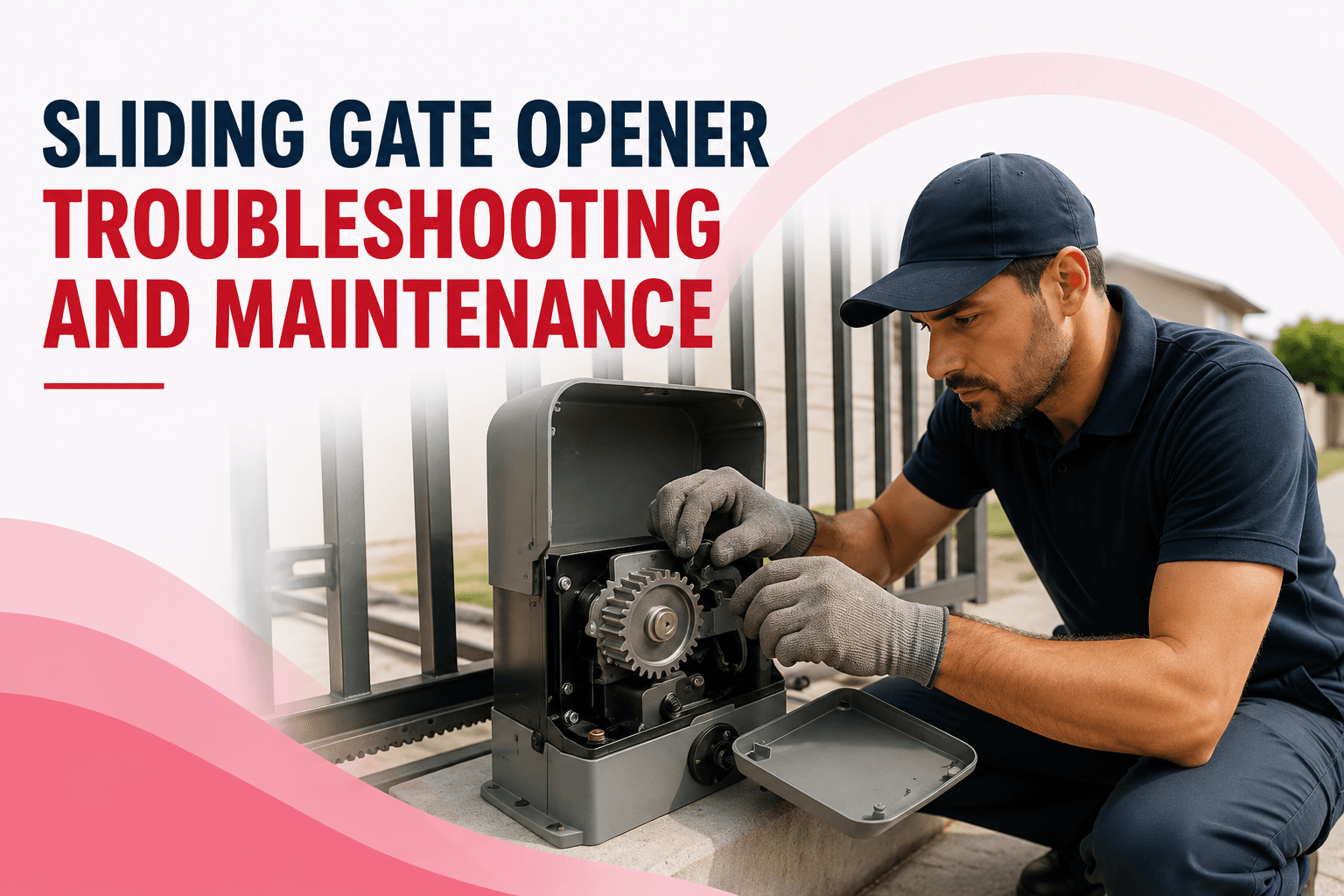
Most sliding gate faults come down to one of five things: no power reaching the operator, a safety device stopping the gate, a limit set in the wrong place, a mechanical drag the motor is fighting, or a tired run capacitor. Work through them in that order and you will find the cause faster than by guessing, because each check rules out a whole category before you move on.
This guide is written for installers and technicians servicing rack-and-pinion sliding operators. It covers the common faults, how to diagnose each one, and the routine maintenance that stops most of them from happening. Menus, limit types, and adjustment methods differ between operators, so use this as the diagnostic logic and confirm the specifics against the manual for the unit in front of you.
Diagnose in order, not at random
Before you open anything, watch the gate try to run and note exactly what it does. Does the motor stay silent, hum without moving, start and stop, or run weakly? That single observation points you at the right section below.
Then follow the same sequence every time:
- Power and supply
- Control board and its status lights
- Safety inputs (photocells, edges, loops)
- Travel limits
- Mechanical drag on the gate and rack
- Motor and capacitor
Jumping straight to "the motor is dead" is how good capacitors and control boards get replaced for no reason. The order above costs a few extra minutes and saves the wrong part.
The gate does nothing at all
A completely dead gate is almost always power or a safety lockout, not a burned-out motor.
Check the supply first. Confirm voltage at the operator matches its rating, and check the breaker or fuse on the circuit. On solar or battery-backed units, test the battery under load, because a battery that reads fine at rest can collapse the moment the motor draws current. A flat or failing battery is one of the most common causes of a solar sliding gate that has simply stopped.
Next, look at the control board. Most boards have status LEDs that tell you whether they have power, whether a safety input is open, or whether a fault is latched. If a safety light shows an open circuit, the board may be refusing to move on purpose. Also confirm the manual release is fully engaged. A gate left on manual release after someone pushed it open by hand will sit there powered up and do nothing when you press the remote.
If the board is dead with confirmed supply voltage, then you are into board or transformer territory. A common trigger there is a nearby lightning strike or surge, which is worth checking for if the site is exposed and the board died suddenly.
The gate opens but will not close
When a sliding gate opens normally but refuses to close, suspect a safety device before anything else. Closing is the direction most safety inputs guard, so a fault there blocks closing while leaving opening untouched.
Start with the photocells. A dirty lens, a spider web, a knocked bracket, or slight misalignment between the transmitter and receiver reads to the operator as a permanent obstruction in the path, and the gate will not close into what it thinks is a blocked opening. Clean both lenses, confirm they face each other squarely, and watch the board's safety LED as you break and clear the beam to prove the input is switching.
After photocells, check any loop detector. A stuck or wrongly tuned loop can hold the gate open as if a vehicle were parked over it. Then check for a hold-open command: a timer, a jammed keypad button, or an access control input latched on will keep the gate open by design. This is the logic to walk when a sliding gate opener is not closing, and it usually ends at a sensor rather than the motor.
The gate stops halfway or reverses
A gate that starts, then stops or backs off partway through travel, is reading resistance as an obstruction. The question is whether the resistance is real.
Release the operator and roll the gate by hand across its full travel. If you feel a tight spot, the operator is doing its job by stopping, and the fix is mechanical. Look for a fouled track on ground-track gates, debris packed into the rack teeth, a dragging or seized roller, or a rack section that has worked loose and tightened the mesh at one point. Clear and correct the mechanical cause rather than turning up the force to push through it, because raising force to overcome a real fault removes the protection that setting exists for.
If the gate genuinely moves freely by hand but still stops under power, the obstruction sensitivity may be set too tight for the gate, or the run capacitor may be weakening so the motor loses torque mid-travel and the board reads the slowdown as an obstruction. A gate that stops or reverses at roughly the same point every cycle points at a mechanical spot or a limit; one that stops at random points more often points at capacitor or voltage trouble.
The gate runs slowly or struggles
Weak, laboured movement has a short list of causes.
A degrading run capacitor is high on that list. As it loses capacity, the motor cannot develop full torque, so the gate moves slowly, hums, or struggles to start on the first push and then runs once it gets going. Capacitors are a normal wear item on these motors, and swapping a suspect one for a correctly rated replacement is a standard test. Treat a bulged or leaking capacitor as failed.
Low supply voltage produces the same symptoms, so confirm the operator is on an adequate, dedicated circuit and not sharing a long, undersized run that drops voltage under load. Mechanical drag from a stiff gate makes the motor work harder for the same reason covered above.
Overheating is its own case. If the gate runs fine cold but slows or quits after several cycles in a row, the motor's thermal protection may be cutting in. That is the operator protecting itself from a duty cycle beyond its rating, which is common when a residential-grade unit ends up on a busy shared entrance. The short-term answer is to let it cool; the real answer is an operator rated for the traffic. Sizing for peak traffic rather than the daily average is covered in our guide to high-speed sliding gate motors for commercial traffic.
Limit and force adjustment
Two settings cause a large share of "faults" that are really just misadjustment.
Travel limits tell the operator where to stop. Sliding operators usually use magnetic limits, with magnets on the rack triggering a sensor, or mechanical cams. If the gate over-runs, stops short, or no longer stops in the same place, a limit magnet has often shifted or the sensor is mounted where the rack flexes. Reposition the magnet so the gate slows into its physical stop rather than hitting it, then run several cycles to confirm the stop point holds. This is the practical side of setting the travel limits, and drifting limits almost always trace back to a loose magnet or a bad rack joint.
Force or obstruction sensitivity decides how much resistance triggers a stop or reverse. Set it so the gate moves reliably but still reverses on modest resistance when you test it against a firm obstruction by hand. Too tight and wind or a slightly stiff gate causes nuisance stops. Too loose and the gate becomes unsafe. Adjusting the force is a balance, not a way to muscle past a mechanical problem you have not fixed yet.
If the board behaves erratically after you change wiring or settings, a reset is reasonable. On many operators, resetting a sliding gate opener means cutting power for a short interval and restoring it, and some boards then need a force-learn or limit-learn routine so they relearn the gate's travel. Check the manual for whether yours auto-learns after a reset or needs the routine run manually.
A maintenance routine that prevents faults
Most call-backs are preventable. A short service two to four times a year, more often on heavy or coastal sites, keeps a sliding operator reliable.
- Clear the rack and, on ground-track gates, the track. Grit packed into rack teeth or a track full of leaves and gravel is the single most common cause of drag and mid-travel stops. Brush the rack clean and keep the track clear and draining.
- Check the rack fixings and joints. Retighten any loose section and confirm the small, even gap between rack and pinion is still there along the travel.
- Inspect rollers, wheels, and cantilever trucks. Replace worn running gear before it starts loading the motor.
- Clean photocell lenses and confirm alignment. Test every safety device by triggering it during motion and watching the gate respond correctly.
- Test the battery on solar and battery-backed systems, and check the panel is clean and unshaded.
- Follow the manufacturer's lubrication guidance. Many rack-and-pinion systems are designed to run with little or no grease on the rack, because heavy grease collects grit and turns into a grinding paste, so do not add lubricant the manual does not call for.
- Run a full manual-release check so the owner can move the gate by hand in a power cut, and confirm the release still operates smoothly.
Sliding operators share the same diagnostic habits as swing units, and if you also service swing gates, our swing gate motor troubleshooting guide walks the equivalent faults on that side.
FAQs
Why is my sliding gate opening but not closing?
Almost always a safety device guarding the closing direction. Check the photocells first for a dirty lens or misalignment, then any loop detector, then any hold-open timer or latched access input. The motor is rarely the cause when opening still works.
How do I reset a sliding gate opener?
On most units you remove power for a short interval, then restore it. Some control boards then need a force-learn or limit-learn cycle so they relearn the gate's travel and effort. Confirm the exact routine in the operator's manual, because it varies by brand.
My gate reverses partway through closing. What is wrong?
It is sensing resistance. Roll the gate by hand with the operator released: if you feel a tight spot, fix the mechanical cause such as a fouled track, debris in the rack, or a dragging roller. If it moves freely by hand, look at the obstruction-force setting or a weakening run capacitor.
How often should a sliding gate opener be serviced?
Two to four times a year for most sites, and more often for high-traffic, dusty, or coastal locations. The core tasks are clearing the rack and track, testing safety devices, and checking the battery on solar systems.
Can I fix a slow or weak sliding gate myself?
You can rule out the common causes: confirm the gate rolls freely by hand, check for low or shared supply voltage, and inspect the run capacitor for bulging or leaking. Persistent slowness after several cycles usually means the motor is overheating on a duty cycle beyond its rating, which points to a better-matched operator rather than a repair.
When troubleshooting turns into replacement
Some faults are worth fixing and some are the gate telling you it was under-specified from the start. Repeated thermal cut-outs, a motor that has been run past its duty cycle for years, or an operator too light for the gate it is moving will keep generating faults whatever you replace. At that point the reliable fix is an operator matched to the gate's weight, length, and real traffic.
If you are servicing or supplying sliding gates at volume and want the running gear and operator specified as one correctly rated system, see our sliding gate operators and accessories or contact our team for help matching a unit to the sites you look after.

Explore Related Automation Systems
Looking for motors, hardware, or installation systems mentioned in this guide? Discover our factory-direct gate opener range:
All Gate Openers
Browse DC24V sliding, swing & barrier operators with full factory warranty.
Explore Products →Residential Gate Operators
Ultra-quiet, solar-ready sliding & swing gate motors for homes and villas.
Residential Solutions →Commercial Gate Systems
Continuous-duty operators for gated communities, business parks & parking.
Commercial Solutions →Industrial Heavy-Duty
High-torque motors engineered for gates up to 4,000 kg and logistics hubs.
Industrial Solutions →