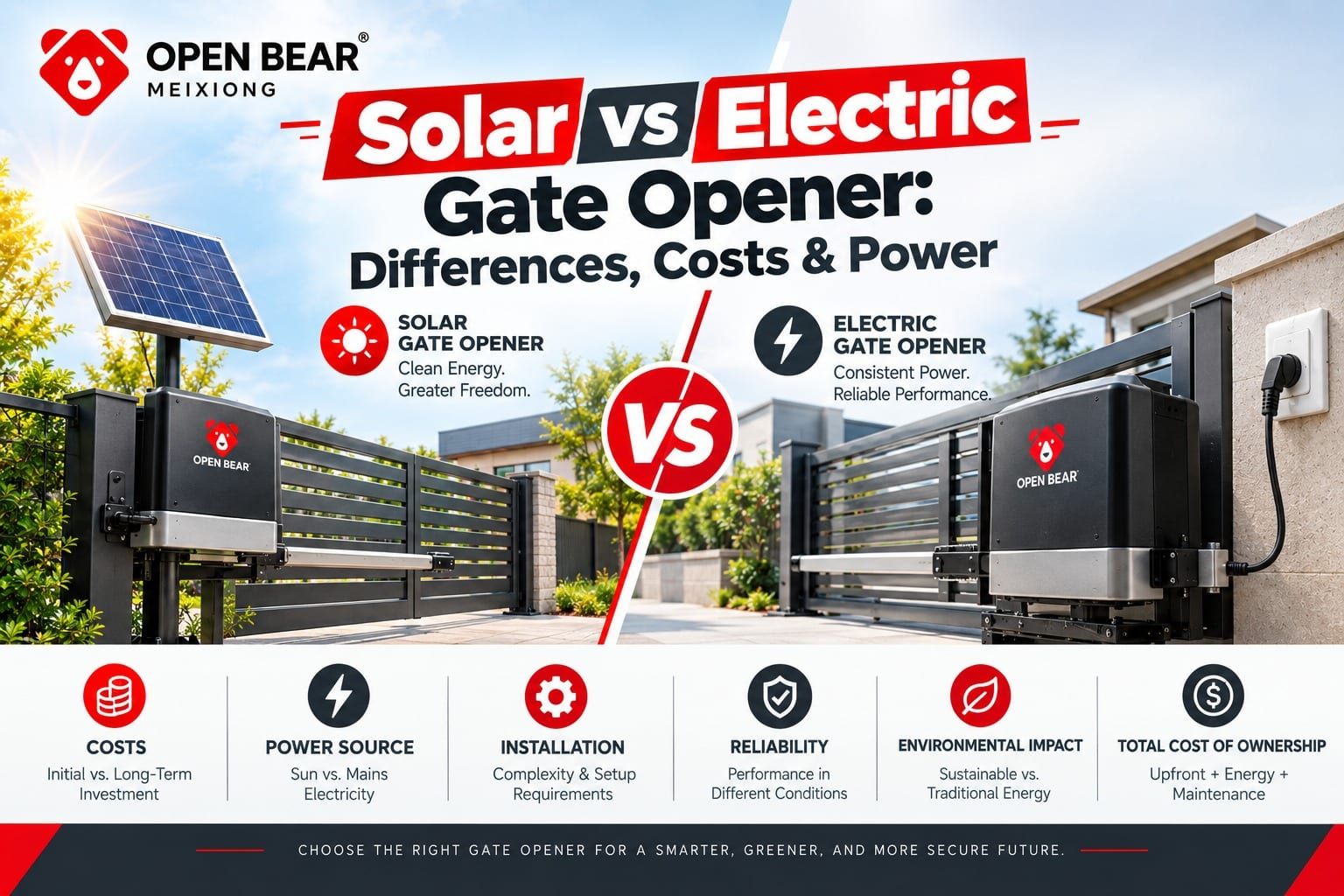
A solar gate opener charges its battery from a solar panel, so it suits gates far from mains power. An electric gate opener runs on the mains supply, so it suits busy gates near a power outlet. Both can use the same 24V DC motor.
Running cable to a remote gate can cost more than the opener itself, and power cuts can leave a mains gate stuck. This solar vs electric gate opener guide comes from Open Bear, the brand of Gate Opener Factory. We build every gate operator in our ISO 9001 certified factory and test each unit under that process.
How Does a Solar vs Electric Gate Opener Work?
Both systems use a 24V DC gate motor to move the gate. A solar system charges a battery from a panel, and the battery runs the motor. An electric system takes mains power through a transformer. So the main difference is the charging side, not the motor itself.
How a Solar Swing Gate Opener Gets Its Power
A solar swing gate opener stores daylight as battery power. The panel charges the battery during the day. The battery then runs each open and close cycle, day or night.
A typical solar kit includes:
- A solar panel on a post near the gate
- A charge controller that stops the battery from overcharging
- A sealed battery in or near the control box
- The control board, remote receiver and gate operator arm
For off-grid sites, read our guide to Solar Powered Swing Gate Openers.
How a Mains-Powered Electric Gate Motor Works
A mains-powered electric gate motor gets its power through a cable from the house or a nearby outlet. A transformer lowers the mains voltage to the 24V DC the motor needs.
This setup needs a trench, conduit and cable to the gate. Longer runs need thicker cable.
Why the Motor Stays the Same
Our gate operators run on 24V DC across the range, whether the power comes from a solar-charged battery or a transformer. So the solar vs electric gate opener decision does not change the opener's rated performance. For example, our side-mounted swing gate opener runs at ≤60 dB and holds CE certification. Our heavy-duty swing gate opener works from -35°C to 70°C.
Which Gate Opener Power Supply Fits Your Property?
The best gate opener power supply depends on three things: how far the gate is from mains power, how much sun the gate post gets, and how often the gate opens. Solar suits remote, sunny gates. Mains suits busy gates near an outlet.
When a Solar Gate Opener Makes More Sense
In most solar vs electric gate opener decisions, solar wins when:
- The gate is far from the house and trenching would be costly
- The gate post gets several hours of direct sun each day
- The gate opens a moderate number of times a day, as on a farm or private driveway
- You want the gate to keep working when the grid goes down
When an Electric Gate Is the Better Fit
A mains-powered automatic gate opener is the safer choice when:
- A power outlet already sits near the gate
- Trees or buildings shade the gate for most of the day
- Traffic is high, as at a shared entrance or commercial site
- You plan to add lights, cameras or other accessories that draw power all day
Hybrid Setups With Battery Backup
Some sites skip the solar vs electric gate opener choice altogether. They use mains as the main charger and keep a battery on standby. This gives the gate steady power on busy days and backup during outages.
A key wiring rule: never connect a solar panel and a mains transformer to the same control board unless the board supports both inputs. Mixing them can damage the electronics.
Comparing models? Our Top 10 Swing Gate Opener guide lists options for different gate sizes.
Solar vs Electric Gate Opener: How Do Costs Compare?
Solar usually costs less to install when the gate is far from power, because it skips trenching and cabling. Mains usually costs less when an outlet is close. Running costs are low for both. The main ongoing cost for solar is battery replacement.
What Drives the Upfront Cost
For a mains electric gate, the cost rises with:
- Distance from the power source to the gate
- Trenching through lawn, paving or concrete
- Cable, conduit and a licensed electrician's labor
For a solar gate opener, the cost depends on:
- Panel size and the number of panels
- Battery capacity
- The post or bracket that holds the panel
On a long driveway, the solar vs electric gate opener cost gap often favors solar. On a short run, mains is usually cheaper.
Running and Maintenance Costs
A mains system adds a little to your power bill. A solar battery wears out and needs replacing over time. Basic care is the same for both: check the hinges, keep the arm clean and test the safety features every few months. Our drive mechanisms carry a 5-year warranty, and our control boards carry a 1-year warranty.
Solar vs Electric Gate Opener Comparison Table
Factor | Solar Gate Opener | Electric Gate Opener (Mains) |
Power source | Solar panel + battery | Mains supply + transformer |
Installation work | Panel mount, no trenching | Trench, conduit and cable to gate |
Best site | Remote gates with good sun | Gates near an existing power outlet |
Power outage | Keeps running on battery | Stops unless a backup battery is fitted |
Daily traffic | Light to moderate | Moderate to high |
Ongoing upkeep | Battery replacement, clean panel | Minimal, check cable and transformer |
Upfront cost | Lower on long runs | Lower on short runs |
Motor voltage | 24V DC | 24V DC |
Operating temperature (heavy-duty model) | -35°C to 70°C | -35°C to 70°C |
Why Does a Battery Backup Gate Opener Matter?
A battery backup gate opener keeps the gate moving when the power fails or the sun stays hidden. Without a battery, a mains gate stops in an outage, and a solar gate cannot work at night. The battery is what keeps access reliable.
Power Outages: Mains vs Solar
On a mains-only system, a power cut stops the gate. You then need the manual release key to open it by hand.
Our residential gate openers include battery backup. When the power fails, the control board switches to the battery, and the gate keeps running until mains power returns.
This is where the solar vs electric gate opener gap is clearest. A solar gate does not notice an outage, because it never relied on the grid.
Simple Battery Care Tips
These tips apply to both sides of the solar vs electric gate opener choice:
- Keep the panel clean. Dust, leaves and bird droppings cut charging power.
- Check the battery voltage before winter, not after the gate stops.
- Switch off accessories you do not need, since each one draws power all day.
- Replace the battery with the type and capacity the manual lists.
How Do You Size a Solar Gate Opener System?
To size a solar gate opener, work out how much power the gate uses each day. Then pick a panel and battery that can supply that power in your darkest month. Daily cycles, accessories, gate weight and leaf length set the load.
Count Daily Cycles and Accessories
One cycle is one open and one close. Count how often the gate moves on a normal day, then add a margin for busy days. Also list every accessory, such as photocells, keypads and lights, because each one draws standby power all day.
Place the Panel in Full Sun
- Mount the panel where it gets direct sun for most of the day.
- Face it toward the equator: south in the northern hemisphere, north in the southern hemisphere.
- Keep it clear of trees, walls and roof shadows, and check again in winter when the sun sits lower.
Match the Gate to the Gate Motor
A heavier or longer leaf makes the motor work harder on every cycle. Check your gate against the opener's rated capacity first:
- Side-mounted swing gate opener: gates up to 200 kg
- Concealed floor swing gate opener: gates up to 250 kg
- Heavy-duty swing gate opener: gates up to 1,200 kg, with leaves up to 6 m
If your gate is close to the limit, choose the next model up. An overloaded electric gate motor drains the battery faster and wears out sooner.
Safety note: Gate automation involves electrical wiring and moving parts. Always use a professional installer for the wiring, and make sure safety photocells are fitted and tested.
Conclusion
The solar vs electric gate opener choice depends on your site, not on which technology sounds newer. Choose solar for remote gates with good sun. Choose mains for busy gates near an outlet. Add a backup battery to either, and your gate keeps working through outages and cloudy weeks.
Not sure which setup suits your gate? Send us its weight, leaf length and power situation. Our technical team will recommend the right operator for your automatic driveway gate.

Frequently Asked Questions
Key engineering and selection answers regarding this topic
In the solar vs electric gate opener debate, neither option wins in every case. A solar gate opener is better for remote gates with good sun, because it avoids trenching and keeps working in outages. An electric gate opener is better for busy gates near a power outlet. Choose based on your site.
The main difference is the power source. A solar gate opener charges its battery from a solar panel. An electric gate opener draws power from the mains through a transformer. With 24V DC operators, the motor and control board are often the same, so only the charging side changes.
Yes. Solar panels still produce some charge on cloudy days, and the battery stores energy for low light and night use. A long run of cloudy days can drain the battery, so size the battery and panel for the worst winter weather in your area.
Yes. A solar panel cannot run the motor directly, because sunlight changes through the day and stops at night. The battery stores the panel's charge and gives steady power for every cycle. Without a battery, the gate would only work in strong sunlight.
The best power supply depends on your site. Use mains power when an outlet is near the gate and traffic is high. Use solar when the gate is far from power and gets good sun. For the most reliable setup, add a backup battery to either option.
Yes, if it has a backup battery. A mains-only electric gate opener stops when the power fails, and you must open it by hand with the manual release. With a backup battery, the gate keeps running on stored power until the mains supply returns.
There is no single number for every gate. The panel count depends on daily cycles, gate weight, leaf length, accessories and local sunlight. A double gate or busy entrance needs more charging power than a light single gate. Check your operator's manual, or ask our team to size the system.
Explore Related Automation Systems
Looking for motors, hardware, or installation systems mentioned in this guide? Discover our factory-direct gate opener range:
All Gate Openers
Browse DC24V sliding, swing & barrier operators with full factory warranty.
Explore Products →Residential Gate Operators
Ultra-quiet, solar-ready sliding & swing gate motors for homes and villas.
Residential Solutions →Commercial Gate Systems
Continuous-duty operators for gated communities, business parks & parking.
Commercial Solutions →Industrial Heavy-Duty
High-torque motors engineered for gates up to 4,000 kg and logistics hubs.
Industrial Solutions →