

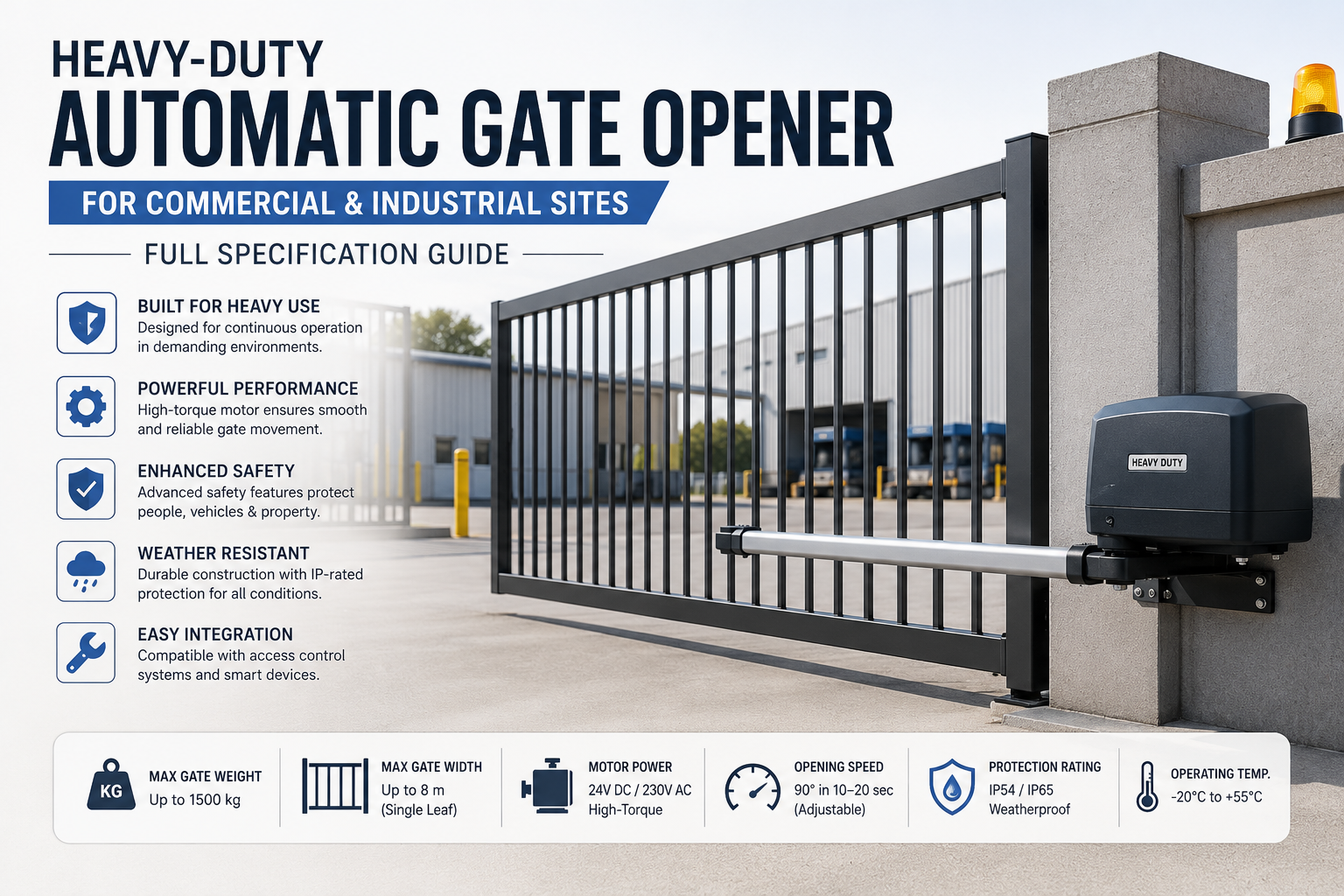
A residential automatic gate opener and a commercial-grade gate operator share a basic function — both move a gate automatically. Beyond that, they are different products designed for different operating environments. Putting a residential unit on a commercial entrance does not save money. It creates a system that will fail inside 18 months and require full replacement at a higher total cost than a correct commercial specification would have cost from the start.
This guide is about getting the commercial and industrial specification right the first time.
Key Takeaways
- Heavy-duty commercial gate operators sustain 60–100+ cycles per hour continuously — three to five times the capacity of residential-grade units
- UL 325 Class II compliance is legally required at any gate with unrestricted public or commercial vehicle access — a Class I residential operator there is a code violation
- DC brushless motors outperform AC induction at high duty cycles: cooler running, longer service life, higher torque at low speed
- Access control integration is a control board decision, not a motor decision — confirm Wiegand, RS-485, and loop detector inputs before specifying any commercial operator
- Commercial gate operators at 150 daily cycles accumulate 54,750 full cycles per year — annual professional inspection is not optional at that workload
Why "Heavy-Duty" Means Something Specific
The term heavy-duty automatic gate opener is not marketing language in the gate automation industry. It refers to a set of measurable performance characteristics that separate commercial and industrial-grade operators from residential-grade products.
Three specifications define the category:
Duty cycle: A heavy-duty commercial gate operator sustains 60–100+ open-close cycles per hour continuously without thermal cutout. A residential operator sustains 15–25. That gap — three to five times the cycle capacity — reflects real differences in motor construction, heat management, gearbox engineering, and control board current handling.
Torque output: Heavy-duty operators produce 800–3,000+ N·m of drive torque depending on application. This handles gates weighing 1,000–3,000 lb per leaf, at widths up to 30–40 feet, through their full arc without the motor loading toward its thermal limit at end-of-travel.
Structural build: Commercial and industrial operators use steel housings with NEMA 4X or IP65 environmental ratings, three-phase motor options for industrial service, and control boards designed for integration with building management systems, fleet access platforms, and hardened security infrastructure.
UL 325 Application Classes for Commercial Gate Operators
UL 325 divides automatic gate operators into four application classes. Commercial and industrial installations almost always require Class II, III, or IV — not the Class I rating that covers residential applications. Installing a Class I operator at a commercial site is a code violation in most US jurisdictions, regardless of whether the gate functions correctly.
UL 325 Class
Application
Access Type
Required Entrapment Protection
Class I
Residential
Family/household vehicles only
One device (inherent, photo-eye, or edge sensor)
Class II
Commercial, general access
Unrestricted public or commercial vehicle access
Two independent devices
Class III
Industrial, restricted access
Authorized employees/vehicles
One monitored device + inherent protection
Class IV
Restricted access, guarded
Security personnel present at all times
One monitored device
For most commercial automatic gate opener applications — office parks, gated communities, commercial parking, logistics entrances — UL 325 Class II is the correct specification. This requires two independent entrapment protection devices operating simultaneously: typically a photo-eye pair across the gate opening and an edge pressure sensor on the gate panel.
For industrial and manufacturing facilities with controlled access — the gate is operated by authorized personnel who understand the equipment — UL 325 Class III is appropriate. The entrapment protection requirement is one monitored device (monitored meaning the control board detects sensor failure and prevents gate operation when sensors are offline).
Motor Types in Heavy-Duty Commercial Gate Operators
The motor inside the operator is the most significant factor in long-term reliability under high duty cycles. Three motor types appear in commercial and industrial swing gate operators.
AC Induction Motor:
The traditional commercial motor. Time-tested, proven, and widely serviceable. Runs directly off single-phase or three-phase AC power. Heat dissipation is its limitation — AC induction motors produce significant heat at high duty cycles, and adequate ventilation or active cooling is required in enclosed installations. Operating temperature range is generally narrower than DC brushless alternatives.
DC Brushless Motor:
The dominant motor type in modern high-performance commercial operators. DC brushless motors produce higher torque at lower speeds, run cooler at high duty cycles, and have longer service lives because there are no brushes to wear. The control board complexity is higher (brushless motors require electronic commutation), but the operational advantages justify the cost difference at commercial duty cycle levels.
Hydraulic Drive:
Used in the heaviest industrial and high-security applications — gates over 2,000 lb per leaf, spans over 25 feet, or sites requiring 200+ cycles per day without any thermal performance degradation. Hydraulic operators use a pump-driven actuator rather than a direct-drive motor, providing essentially unlimited duty cycle capacity. Installation is more complex and oil reservoir maintenance is required, but service life in high-cycle industrial applications typically exceeds 20 years.
Access Control Integration at Commercial Sites
A heavy-duty automatic gate opener at a commercial site is not just a motor and an arm — it's one component in an access control architecture. The control board's integration capability determines how well the gate operator fits into the broader security and management infrastructure.
Standard integration points on commercial gate operator control boards:
Input/Output Type
What It Connects
Commercial Use Case
Dry contact (NO/NC)
Any switched output device
Keypads, push buttons, emergency stops
Wiegand 26-bit
Card readers, key fobs
Credential-based access control
RS-485
Access control panels, BMS
Building-wide integration, audit trail
Loop detector input
Vehicle detection loops
Automatic entry on vehicle detection
Free exit output
Exit loop or push-to-exit button
Egress without credential requirement
Alarm output
Security panel
Gate fault or forced-open alert
Open collector
Traffic lights, warning barriers
Safety signal coordination
A gate operator control board with only dry contact inputs is adequate for simple keypad and remote access. A board with Wiegand and RS-485 integration connects to enterprise access control systems — enabling credential management, time-of-day restrictions, audit logs, and remote monitoring from a security operations center.
For commercial sites handling 50+ vehicles per day: specify vehicle loop detectors at both the entry and exit positions. Loop detectors prevent gate closure on a vehicle that's still in the gate opening (a common cause of vehicle damage and operator liability) and allow free exit without a credential swipe — a practical requirement for any commercial entrance.
Specifying Heavy-Duty Gate Operators by Application Type
Different commercial and industrial applications have distinct performance requirements that map to specific product specifications.
Gated Residential Community / HOA:
- Cycle count: 80–300/day at peak (morning and evening commute)
- Gate type: typically single or dual swing, 12–20 feet per leaf
- Operator spec: commercial-grade DC brushless, 60+ cycles/hour duty cycle, dual photo-eye, access control with resident credentials + visitor intercom
- UL 325 Class II
Commercial Office / Business Park:
- Cycle count: 60–200/day, concentrated in peak hours
- Gate type: swing or sliding, 14–24 feet
- Operator spec: commercial DC brushless or heavy-duty sliding, 80+ cycles/hour, Class II, integrated with parking management or access control platform
- UL 325 Class II
Logistics / Distribution Yard:
- Cycle count: 100–400/day continuous
- Gate type: typically sliding, 20–40 feet
- Operator spec: heavy-duty DC brushless or hydraulic sliding operator, 100+ cycles/hour, Class III, vehicle loop detectors both sides, intercom or guard integration
- UL 325 Class II–III
Industrial Manufacturing / Utilities:
- Cycle count: 50–500/day depending on facility
- Gate type: heavy swing or sliding, 20–40 feet, gate weight 1,500–3,000 lb
- Operator spec: hydraulic or heavy-duty electromechanical, continuous duty, Class III, hardened control board, redundant safety systems
- UL 325 Class III
High-Security Government / Military:
- Cycle count: variable, but security requirements dominate over throughput
- Gate type: anti-ram rated swing or sliding, reinforced
- Operator spec: crash-rated operator per K4/M30 or equivalent, anti-tailgate sensors, integrated with guard post and command-level override
- UL 325 Class IV
Maintenance Requirements for High-Cycle Commercial Operators
Heavy-duty gate operators running at commercial and industrial cycle counts require more structured maintenance than residential units. An annual residential-style check is not adequate.
Maintenance Task
Residential (Annual)
Commercial (Interval)
Industrial (Interval)
Drive mechanism lubrication
Annually
Every 6 months
Quarterly
Control board inspection
Annually
Every 6 months
Quarterly
Battery backup test & capacity check
Annually
Every 6 months
Quarterly
Safety device test (photo-eye function)
Monthly
Weekly
Daily
Motor temperature monitoring
Not typical
Every 6 months
Monthly
Hydraulic fluid level (hydraulic units)
N/A
N/A
Monthly
Full professional service inspection
Every 3 years
Annually
Every 6 months
The professional service interval at commercial cycle counts is annual minimum. A heavy-duty swing gate operator running 150 cycles per day accumulates 54,750 full cycles per year. At that cycle count, arm pivot wear, gearbox bearing condition, and control board capacitor health all warrant expert evaluation annually — not when something breaks.
Internal Links
→ Automatic Gate Opener: Complete Guide to Every Type (/blog/automatic-gate-opener-complete-guide)
→ Side-Mounted Swing Gate Operator: What It Is, How It Works & Who Needs It (/blog/side-mounted-swing-gate-operator)
→ Single Leaf vs Double Leaf Swing Gate Operator: The Installer's Decision Guide (/blog/single-leaf-vs-double-leaf-swing-gate-operator)
→ How to Choose the Right Automatic Gate Opener (/blog/how-to-choose-automatic-gate-opener)
→ Automatic Gate Opener Installation: What Installers Need to Know (/blog/automatic-gate-opener-installation-guide)
FAQs
How do I know if I need a commercial-grade automatic gate opener instead of a residential-grade unit?
Three thresholds trigger the commercial specification: daily cycle count above 40–50/day, gate weight above 600 lb per leaf, or unrestricted public vehicle access (which requires UL 325 Class II compliance by code). If any one of these conditions applies to your site, a residential-grade operator is the wrong product regardless of whether the gate dimensions fall within its technical capacity. Residential-grade operators at commercial cycle counts overheat, trigger thermal protection repeatedly, and fail within 6–18 months. The cost difference between a residential and commercial-grade operator on a commercial site is recovered in avoided replacement costs within the first two years.
What is the difference between a high-duty-cycle gate operator and a standard commercial operator?
Standard commercial gate operators are rated for 40–60 cycles per hour. High-duty-cycle operators — sometimes called continuous-duty operators — are rated for 80–100+ cycles per hour without thermal restriction. The engineering difference is in the motor construction (typically DC brushless in high-duty-cycle units versus AC induction in standard commercial), the housing ventilation design, and the thermal management electronics in the control board. For most commercial sites running under 150 cycles per day, a standard commercial operator is adequate. For logistics yards, high-traffic parking facilities, and transit applications running 300+ cycles per day, a high-duty-cycle or hydraulic operator is required.
Can heavy-duty automatic gate openers operate in extreme temperature environments?
Yes, but the specification must match the climate. Standard commercial operators are typically rated for operating temperatures of -4°F to 140°F (-20°C to 60°C). Industrial-grade hydraulic operators extend to -22°F (-30°C) at the cold end, with appropriate hydraulic fluid specifications for low-temperature performance. In very cold climates, the lubricant specification for all mechanical components — arm pivots, gearbox, drive mechanism — must be appropriate for the minimum operating temperature. Standard petroleum-based greases become stiff below 14°F and significantly increase motor load. Synthetic lubricants rated for low-temperature operation are required on any installation in a climate where sustained temperatures below 14°F are expected.
Does a commercial gate operator need a dedicated electrical circuit?
Yes, in virtually all cases. Commercial gate operators draw 6–15 amps at 120V AC during motor operation, with higher surge current at startup. A dedicated 20-amp circuit prevents tripping shared circuits during gate operation and ensures stable voltage delivery to the control board. In three-phase industrial installations, the electrical specification should be confirmed against the operator's nameplate data by a licensed electrician before installation. Underground conduit runs to the gate operator should also be sized for the full circuit current with appropriate wire gauge — voltage drop over long conduit runs causes erratic motor behavior and is one of the most common causes of commercial gate operator performance complaints.
About the Author
Hasib Iftikhar is a gate automation specialist and technical content writer with hands-on experience across residential, commercial, and industrial automatic gate operator systems. He covers UL 325 compliance, swing and sliding operator selection, access control integration, and installation best practices for gate industry professionals across the US market. His work is used by distributors, system integrators, and facility managers to make better-informed specification decisions. When he is not writing about gate automation, Hasib works directly with installers and procurement teams to navigate product selection for complex commercial and industrial sites.