

The wrong automatic gate opener doesn't fail on the day it's installed. It runs. For six months, maybe a year — and then it starts straining, tripping thermal protection, losing remote range, or simply stopping mid-arc on cold mornings. By then, the installer is gone and the owner is replacing a unit that was never right for the site to begin with.
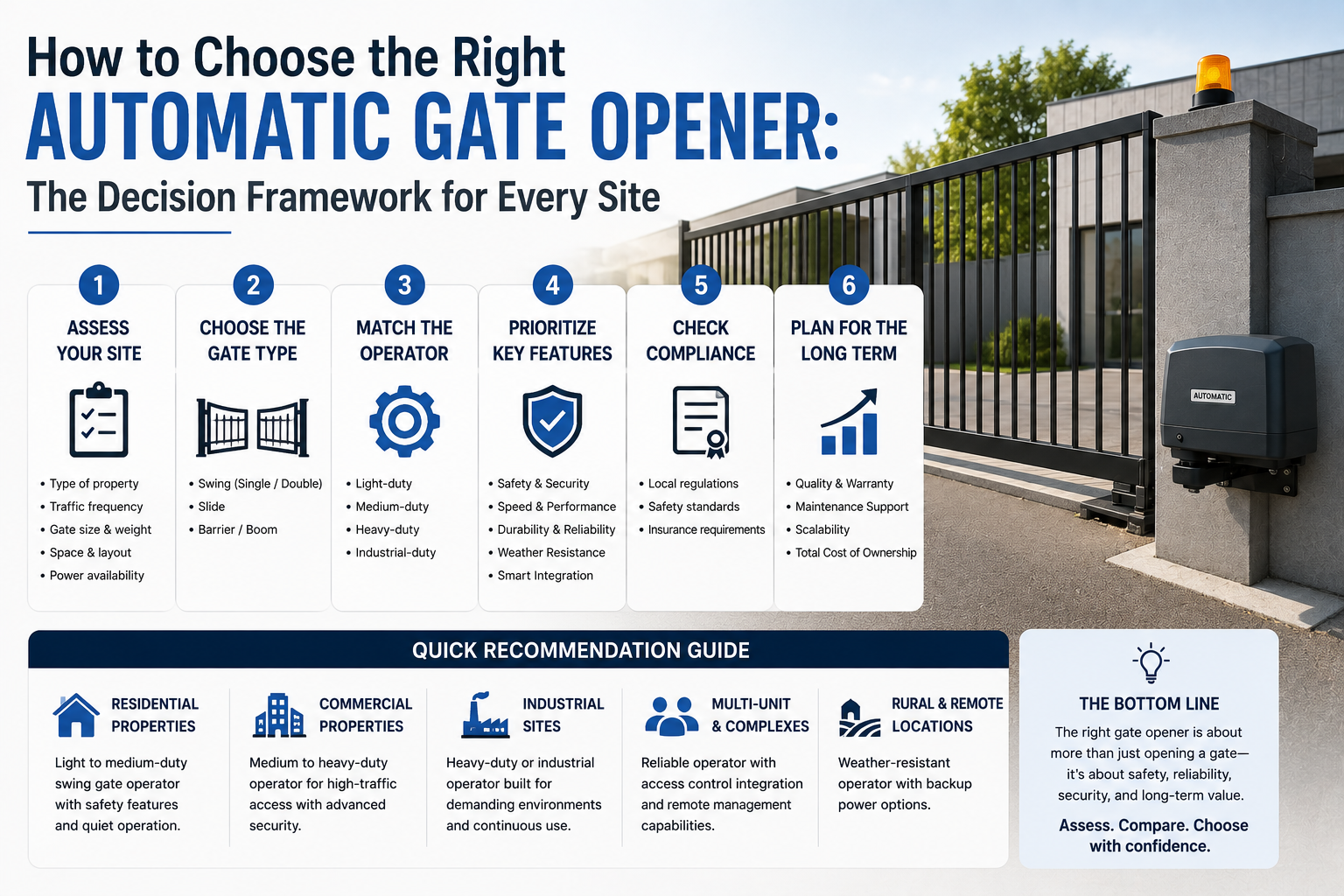
This guide exists to prevent that. It's a structured decision framework covering every factor that determines which automatic gate opener is correct for a given site — in the order those factors should be evaluated.
Key Takeaways
- Gate type (swing vs. sliding vs. barrier) is decided by site geometry — not preference. Sloped driveways and tight clearance sites require sliding operators regardless of other factors
- Peak cycle concentration per hour matters more than daily total — 120 cycles spread over 10 hours reads differently to the motor than 120 cycles in two 2-hour delivery windows
- UL 325 class is determined by access type, not gate appearance — a standard tube gate at a self-storage facility with public access requires Class II, not Class I
- Solar power is appropriate for residential and light commercial under 40 cycles/day in climates with 4+ peak sun hours — above that, pay for the conduit run
- The control board determines access control compatibility — always confirm integration specs before committing to a motor
Step 1: Establish Gate Type Before Everything Else
Gate type is non-negotiable. The operator category is determined by how the gate moves, and there is no cross-compatibility between categories.
Swing gate (hinged): opens on a vertical axis like a door. Requires a swing gate operator — side-mounted arm, underground piston, or heavy-duty arm depending on weight and site.
Sliding gate (roll gate): opens horizontally along a track parallel to the fence line. Requires a sliding gate operator with rack-and-pinion drive.
Barrier gate (boom arm): a horizontal arm lifts vertically. Requires a barrier operator. Used for traffic control, not perimeter security.
Bi-fold / vertical lift: specialist products for specific commercial and industrial applications.
If the gate type isn't yet determined — for new construction or replacement — the site geometry should drive that decision. Sloped driveways: sliding. Limited inward clearance: sliding. Tight urban sites: sliding. Flat ground with clearance and a wide-span decorative gate: swing. This matters because choosing the gate type and choosing the operator must happen simultaneously, not sequentially.
Step 2: Measure the Gate
Three measurements are required before any product specification is meaningful.
Gate leaf width: measured from hinge center to latch edge. This is not the opening width — it's the panel dimension. A 14-foot opening with a center post has two 7-foot leaves.
Gate weight: the full panel weight including all infill material, cladding, locks, and any mounted hardware. Weighing a gate requires either removing it from the hinges (not practical for most retrofit jobs) or using the material specifications. Steel tube frame with timber infill: calculate steel weight from section dimensions plus timber weight from volume. Solid wrought iron: contact the gate fabricator. Aluminum: typically 40–60% lighter than equivalent steel construction.
Gate height: relevant primarily for wind load calculations on solid-infill panels. A 6-foot solid timber gate in an exposed location carries significantly more wind load than an identical frame with open picket infill at the same height.
These three measurements feed directly into the operator selection criteria. Any product recommendation made without them is a guess.
Step 3: Calculate the Real Daily Cycle Count
Cycle count is the specification most commonly ignored in residential sales and most commonly undersized in commercial ones.
How to calculate it: count the number of times the gate will open and close per 24-hour period under realistic operating conditions — not best-case conditions. A residential driveway used by two adults has 4–8 cycles per day. A gated community with 200 households has 300–600 cycles per day. A logistics yard entrance has 100–400 cycles per day depending on shift patterns.
Why this number governs everything: every automatic gate operator has a duty cycle rating expressed in cycles per hour. Dividing the daily cycle count by the operating hours gives the cycles-per-hour demand. If that demand exceeds the operator's rating, the operator will overheat.
Example: a light industrial site runs 120 cycles over a 10-hour working day. That's 12 cycles per hour on average — well within a standard residential operator's 15–20 cycle/hour rating. But if those 120 cycles are concentrated in two 2-hour delivery windows, the actual demand during those windows is 30 cycles/hour — above the residential rating and approaching the lower end of commercial-grade capacity.
Peak cycle concentration matters as much as daily total.
Step 4: Match UL 325 Class to Access Type
This step is not optional. UL 325 compliance class is a legal specification in the United States, enforced by local AHJs (Authorities Having Jurisdiction). Installing the wrong class is a code violation.
Site Access Type
UL 325 Class Required
Typical Application
Restricted to household residents only
Class I
Single-family residential
General public or commercial vehicle access
Class II
HOA gates, commercial parking, office campus
Industrial with employee/authorized vehicle access
Class III
Warehouses, manufacturing, utilities
Security-controlled with guard supervision
Class IV
Government, military, high-security
The access type is determined by who uses the gate — not by what it looks like or how big it is. A large ornamental gate at a residential estate is Class I. A simple metal tube gate at a self-storage facility with public access is Class II. The physical appearance of the gate is irrelevant to UL 325 classification.
Step 5: Decide on Power Supply Before Specifying the Operator
Power supply choice determines which operators are available and what the installation cost structure looks like.
Power Option
Site Requirement
Operator Availability
Installation Cost Driver
120V AC hardwired
Within 100 ft of panel; conduit run feasible
All operators
Conduit run cost
240V AC (commercial)
Commercial electrical service available
Commercial/industrial operators
Electrical panel upgrade if needed
12V DC solar + battery
Minimum 4 peak sun hours/day average
Residential to light commercial
Panel and battery sizing
12V/24V DC battery + AC trickle
Mains power accessible; resilience required
Most residential/commercial
Battery maintenance cost
Three-phase 480V
Industrial electrical service
Heavy industrial only
Electrician and panel spec
The solar decision: solar power is appropriate for residential and light commercial sites where the daily cycle count is under 40/day and the average peak sun hours exceed 4/day annually. It is not appropriate for high-cycle commercial applications — the battery discharge rate at 100+ daily cycles exceeds what a practical panel-and-battery combination can replenish reliably.
The common trap: specifying a solar system for a commercial gate because trenching is expensive, then discovering 18 months later that battery recovery can't keep up with the actual cycle count. Trenching cost is a one-time expense. Battery replacement and system failures are recurring costs. On any site with 40+ daily cycles, pay for the conduit run.
Step 6: Map Access Control Requirements to Control Board Capability
The control board in an automatic gate operator determines what access control devices can be connected. Specifying a motor without confirming the control board's integration capability is a common and expensive oversight.
Minimal requirement (residential): a control board that accepts a rolling-code remote signal and a simple keypad input. Covers standard residential use.
Intermediate requirement (light commercial): rolling code remote, keypad, plus a dry contact input for a basic card reader or intercom trigger. Covers small commercial sites with simple access management.
Full commercial requirement: rolling code remote, keypad, Wiegand 26/34-bit for credential-based card readers, RS-485 for building management system integration, loop detector inputs, monitored safety device inputs, programmable time-of-day restrictions, and an event log output for audit trail compliance.
High-security requirement: all of the above plus hardened communication protocols, anti-tamper housing, failsafe power-off behavior (gate defaults to secure-closed during power failure), and CCTV or intercom integration.
Confirm the control board spec first. Then confirm the motor spec. Both matter equally in a correctly specified installation.
The Selection Matrix: Operator Type by Application
Application
Gate Type
Operator Category
UL 325 Class
Duty Cycle Needed
Single-family residential, flat driveway
Swing
Side-mounted arm, residential grade
I
5–15 cycles/hr
Single-family residential, sloped driveway
Sliding
Rack-and-pinion, residential grade
I
5–15 cycles/hr
HOA / gated community entrance
Swing or sliding
Commercial grade
II
30–60 cycles/hr
Commercial office parking
Swing or sliding
Commercial grade
II
40–80 cycles/hr
Logistics / warehouse yard
Sliding
Heavy-duty commercial
II–III
60–100+ cycles/hr
Industrial manufacturing
Sliding or heavy swing
Heavy-duty / hydraulic
III
80–100+ cycles/hr
Parking facility / toll
Barrier
High-speed barrier operator
II
Continuous
Government / high-security
Swing (crash-rated)
Anti-ram, security-grade
IV
Variable
Architectural / concealed
Swing
Underground / floor-mounted
I–II
10–40 cycles/hr
The Six Questions to Ask Before Finalizing Any Specification
Before signing off on any automatic gate opener specification, these six questions should have definitive answers:
- What is the gate type (swing/sliding/barrier), leaf width, and verified leaf weight?
- What is the realistic peak cycle count per hour — not average daily, but peak hour demand?
- What is the UL 325 class required for the site access type?
- What is the power supply option, and does it cover the duty cycle requirement reliably?
- What access control devices need to connect, and does the control board support them?
- What is the service access arrangement — who performs maintenance, at what interval, and is the operator location accessible for that service?
A specification that answers all six is a specification that will work for 10–15 years. One that skips any of them is a specification that will require a callback.
Internal Links
→ Automatic Gate Opener: Complete Guide to Every Type (/blog/automatic-gate-opener-complete-guide)
→ Side-Mounted Swing Gate Operator: What It Is, How It Works & Who Needs It (/blog/side-mounted-swing-gate-operator)
→ Single Leaf vs Double Leaf Swing Gate Operator: The Installer's Decision Guide (/blog/single-leaf-vs-double-leaf-swing-gate-operator)
→ Heavy-Duty Automatic Gate Opener for Commercial & Industrial Sites (/blog/heavy-duty-automatic-gate-opener-commercial-industrial)
→ Automatic Gate Opener Installation: What Installers Need to Know (/blog/automatic-gate-opener-installation-guide)
FAQs
Is there a simple way to decide between a swing gate opener and a sliding gate opener?
Two questions resolve most cases. First: does the driveway slope at the gate line by more than 5%? If yes, sliding. Second: is there 10+ feet of clear inward clearance for the gate to arc through? If no, sliding. If both answers go the other way — flat ground, adequate clearance — swing is typically the simpler and less expensive option. When both configurations are technically feasible, cycle time requirements and security priority tip the decision. Sliding gates open faster (8–15 seconds versus 15–25), resist forced entry better, and handle high-cycle commercial duty more gracefully. Swing gates are quieter, architecturally flexible, and less expensive to install in standard residential configurations.
Can one automatic gate opener control a gate that has both a pedestrian door and a vehicle gate?
Not with a single operator in the conventional sense, but there are two practical approaches. The first is specifying an operator with a "pedestrian open" function — a separate access input that opens the gate to a partial position (typically 30–45 degrees), sufficient for a person to pass through but not a vehicle. Many commercial-grade swing gate operators include this as a standard control board feature. The second approach uses a completely separate pedestrian access system — an automated door or independent gate — alongside the vehicle gate, with both integrated into the same access control platform. The pedestrian-open function is simpler and lower cost. Separate systems are more appropriate when the pedestrian access volume is high enough that a partial vehicle gate opening creates a safety or operational problem.
What is the typical lead time for commercial heavy-duty gate operators?
Standard commercial operators from stock typically ship in 3–10 business days through established distributors. Heavy-duty and industrial-grade operators — particularly hydraulic units and three-phase configurations — may have lead times of 3–8 weeks if not held in stock. Custom configurations (specific voltage, non-standard mounting, integrated access control pre-wired) extend lead times further. For project planning purposes, confirm stock availability at the specification stage — not at the time of purchase order. High-cycle commercial operators for active construction projects should be ordered 6–8 weeks before the scheduled installation date to eliminate the project delay risk of a late delivery.
How does climate affect automatic gate opener selection?
Climate affects three aspects of the specification. First, the operating temperature range of the selected operator must cover the site's seasonal extremes — both the minimum winter temperature and the maximum summer temperature in a non-ventilated enclosure (which can exceed ambient by 30–40°F in direct sun). Second, lubricant specifications must be appropriate for the temperature range — standard petroleum greases fail to flow at low temperatures and can cause significant motor overload. Third, battery backup systems using lead-acid batteries lose 20–30% of their rated capacity at freezing temperatures, which must be factored into battery bank sizing for any site where the backup system needs to sustain operation through a winter outage.
About the Author
Leo Chen is a gate automation specialist and technical content writer with hands-on experience across residential, commercial, and industrial automatic gate operator systems. He covers UL 325 compliance, swing and sliding operator selection, access control integration, and installation best practices for gate industry professionals across the US market. His work is used by distributors, system integrators, and facility managers to make better-informed specification decisions. When he is not writing about gate automation, Hasib works directly with installers and procurement teams to navigate product selection for complex commercial and industrial sites.