
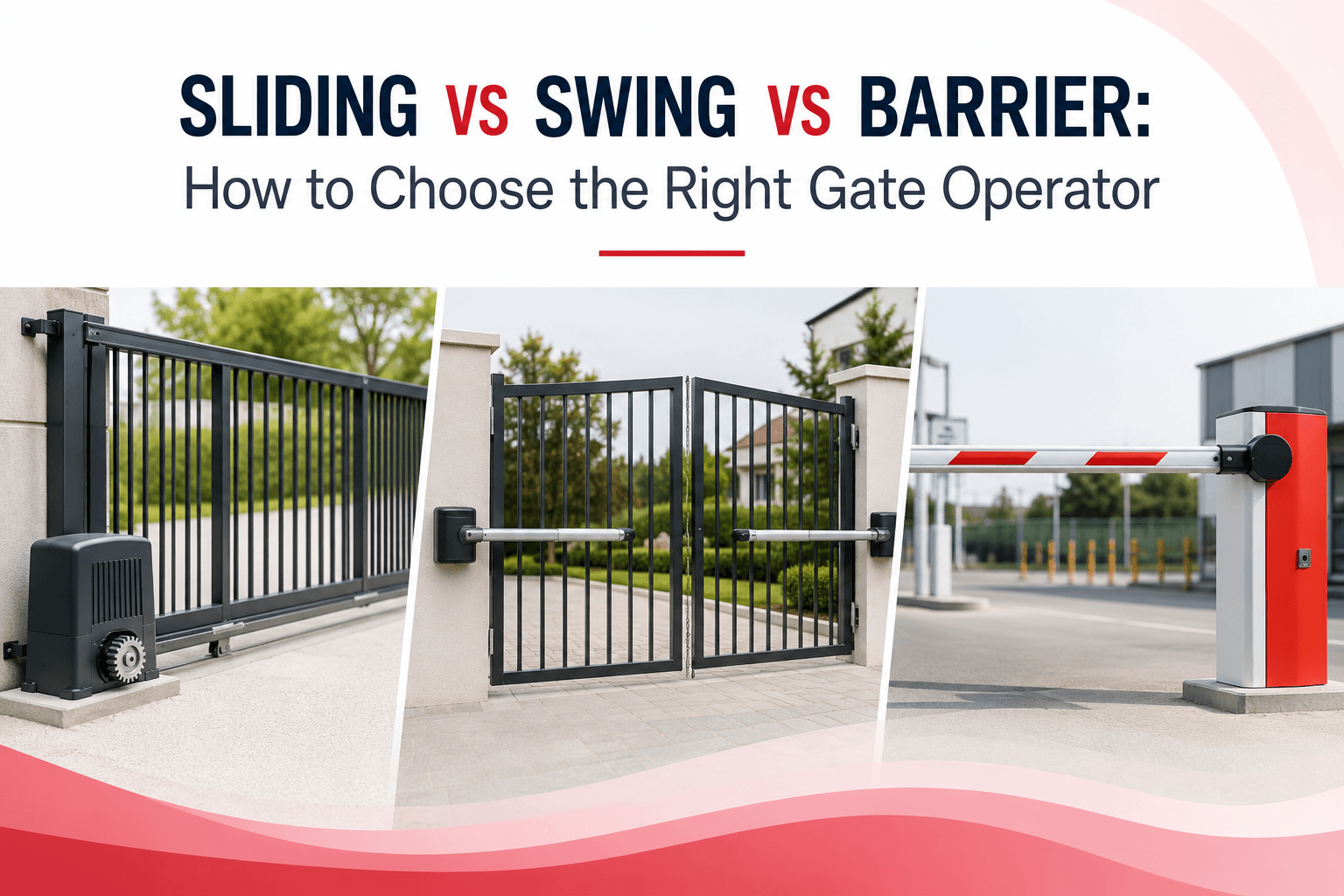
There are three main types of automatic gate openers, and the right one is decided by the site more than by preference. Swing operators suit level entrances with room for the gate to arc open. Sliding operators suit sloped ground, tight depth, wider or heavier gates, and higher traffic. Barrier operators control vehicle flow at parking and access lanes but do not secure a perimeter. Pick the type that matches the space, the slope, the gate, and the traffic, and the rest of the specification follows from there.
This guide compares the three side by side, then gives a practical framework for matching an operator to a real site. It is written for buyers, specifiers, and installers choosing between operator types before drilling into a single model.
The three types at a glance
Swing operator | Sliding operator | Barrier operator | |
How it moves | Swings a hinged gate open like a door | Slides a gate sideways along a rack | Lifts a horizontal arm to clear a lane |
Best for | Level entrances with clearance to swing | Slopes, tight depth, wide or heavy gates | Vehicle traffic control, parking, access lanes |
Space needed | Arc clearance in the swing path | Side room to slide, or a cantilever tail | Only the lane width and the arm's swept height |
Handles slope | Poorly; the gate must swing over rising ground | Well; the gate runs level along the fence | Not applicable |
Security role | Full perimeter gate | Full perimeter gate, often the more secure | Traffic control only, not a security barrier |
Typical traffic | Low to moderate | Moderate to high | High-frequency, fast cycling |
The first split is simple. If you need to secure a boundary and stop pedestrians and vehicles, you need a swing or sliding gate. If you only need to manage vehicle flow at an entry point that is already controlled or staffed, a barrier is faster and cheaper for that one job. Our boom barrier buyer's guide covers that category in depth, so the rest of this article focuses on the swing-versus-sliding decision that most perimeter gates come down to.
Swing versus sliding: what actually decides it
For a perimeter gate, five site facts usually settle the choice.
Space and layout
A swing gate needs a clear arc to open into, whether inward or outward. If vehicles queue close to the gate, if the driveway is short, or if the ground the gate would swing over is uneven, that arc becomes a problem. A sliding gate needs room to the side instead, either a run alongside the fence for the gate to slide into, or a cantilever design that carries the gate on posts with no ground track. On a plot that is wide across the entrance but short on depth, sliding almost always wins.
Slope and ground
Slope is the clearest deciding factor. A swing gate has to swing over the ground in front of it, so any rise in the opening path will catch the bottom of the gate. Sliding gates run level along the fence line and ignore the slope of the driveway entirely, which is why they are the default on hilly or graded entrances.
Gate size and weight
Wider and heavier gates favour sliding operators. A long single swing leaf puts heavy leverage on its hinges and post, so very wide openings are usually split into a dual swing pair or moved to a sliding design. Sliding operators, especially cantilever and industrial units, carry long, heavy gates more comfortably. Check the rated gate weight and length limits of any operator against the actual gate, because those ratings are the ceiling the whole system depends on.
Traffic and duty cycle
How often the gate cycles matters as much as how big it is. An operator has a duty cycle rating, which is how many cycles it can run in a period before it needs to rest or risks overheating. A quiet home driveway is undemanding. A shared community entrance or a commercial yard can cycle hundreds of times a day, and that calls for an operator sized for the peak, not the average. Sliding operators and commercial-grade motors are generally built for the higher end of this range.
Security and speed
Sliding gates are often the more secure choice because they cannot be forced open on a hinge and sit flush against the fence line when closed. Where fast entry matters, such as a busy commercial gate, high-speed sliding motors move a large gate quickly without the arc time a swing gate needs. For lighter residential security on a level plot, a swing gate is perfectly capable and usually costs less.
Drive type: electromechanical or hydraulic
Within swing and sliding operators there is a second choice that matters for heavy or high-traffic gates. Electromechanical operators use a motor and gearbox and suit most residential and light commercial gates. Hydraulic operators use a pump and ram, tolerate frequent cycling and heavy gates well, and are common on demanding commercial and industrial installations. For a home or a low-traffic entrance, electromechanical is the usual and more economical answer; for a gate that runs constantly or is very heavy, hydraulic earns its higher cost through endurance.
Match the operator to the application
The same site facts group into a few common cases.
Residential driveway. For a level driveway with room to swing, a swing operator is the straightforward pick and the more affordable one. If the driveway slopes, is short on depth, or the gate is wide, choose a sliding operator instead. When people ask for the best automatic gate opener for a driveway, the honest answer is that it depends on those two or three facts, not on a single model being best for everyone.
Gated community or shared entrance. Traffic volume drives this one. The operator has to handle the rush-hour peak and repeated cycling without overheating, so residential-rated units are usually underspecified here. Access control and safety design matter as much as the motor. Our guide to commercial swing gate motors for gated communities covers how duty cycle and redundancy change at that scale.
Commercial and industrial sites. Heavy gates, high cycle counts, and often the need for speed point to industrial sliding operators or hydraulic units. Security and integration with the site's access system usually take priority over cost. These are the sites where a heavy-duty operator specified for continuous use pays back through fewer failures. The commercial and industrial operator range is built around those requirements.
A short decision framework
If you want a quick path to the answer, work through these in order:
- Do you need to secure the boundary, or only manage vehicle flow? Perimeter security means swing or sliding. Flow control alone can use a barrier.
- Is the ground in the opening path sloped or uneven? If yes, choose sliding.
- Is the entrance short on depth or the gate wide and heavy? If yes, lean sliding.
- Is the ground level, the gate moderate, and budget tight? A swing operator fits well.
- How many cycles a day at peak? Match the duty cycle rating to that number, and step up to commercial or hydraulic for heavy, constant use.
- Confirm the chosen operator's gate weight and length ratings cover the actual gate, with margin.
Answer those and you will usually land on one operator type with confidence, which is the point where you move from choosing a category to specifying a model. For the full detail on the sliding side, including rack systems and cantilever versus ground-track, see our complete guide to sliding gate operators. For specifying swing units, the B2B guide to swing gate operators covers the same ground for hinged gates.
FAQs
What are the main types of automatic gate openers?
Swing, sliding, and barrier. Swing operators open a hinged gate, sliding operators move a gate sideways along a rack, and barrier operators lift an arm to control a vehicle lane. Swing and sliding secure a boundary; barriers only manage traffic.
Is a sliding or swing gate better for a sloped driveway?
Sliding. A swing gate has to move over the ground in front of it, so a slope or uneven ground in the opening path fouls the gate. A sliding gate runs level along the fence and is unaffected by the driveway's slope.
Which type is more secure?
Sliding gates are often considered more secure because they sit flush against the fence line and cannot be forced on a hinge, though a well-built swing gate with proper locking is also secure for residential use. Barriers are not security devices; they control vehicle flow only.
What is a duty cycle and why does it matter?
Duty cycle is how many times an operator can run within a period before it needs to rest. A gate that cycles heavily, such as a community or commercial entrance, needs an operator rated for that volume, or it will overheat and wear out early. Sizing for peak traffic rather than the daily average is the reliable approach.
Do heavy or very wide gates need a special operator?
Yes. Long and heavy gates need an operator rated for that weight and length, and often a sliding or hydraulic design that tolerates the load and frequent use. Always check the operator's rated limits against the real gate before deciding.
Choosing with confidence
The type of gate operator is not a matter of taste. It is a reading of the site: whether you are securing a boundary or moving traffic, how the ground lies, how big the gate is, and how hard it will work. Once those are clear, one type usually stands out, and the specification becomes a matter of matching ratings to reality rather than guessing.
If you want help matching an operator type and model to a specific site, or you are sourcing across swing, sliding, and barrier products for the projects you handle, browse the full operator range or talk to our team with the site details and gate dimensions.

Explore Related Automation Systems
Looking for motors, hardware, or installation systems mentioned in this guide? Discover our factory-direct gate opener range:
All Gate Openers
Browse DC24V sliding, swing & barrier operators with full factory warranty.
Explore Products →Residential Gate Operators
Ultra-quiet, solar-ready sliding & swing gate motors for homes and villas.
Residential Solutions →Commercial Gate Systems
Continuous-duty operators for gated communities, business parks & parking.
Commercial Solutions →Industrial Heavy-Duty
High-torque motors engineered for gates up to 4,000 kg and logistics hubs.
Industrial Solutions →