
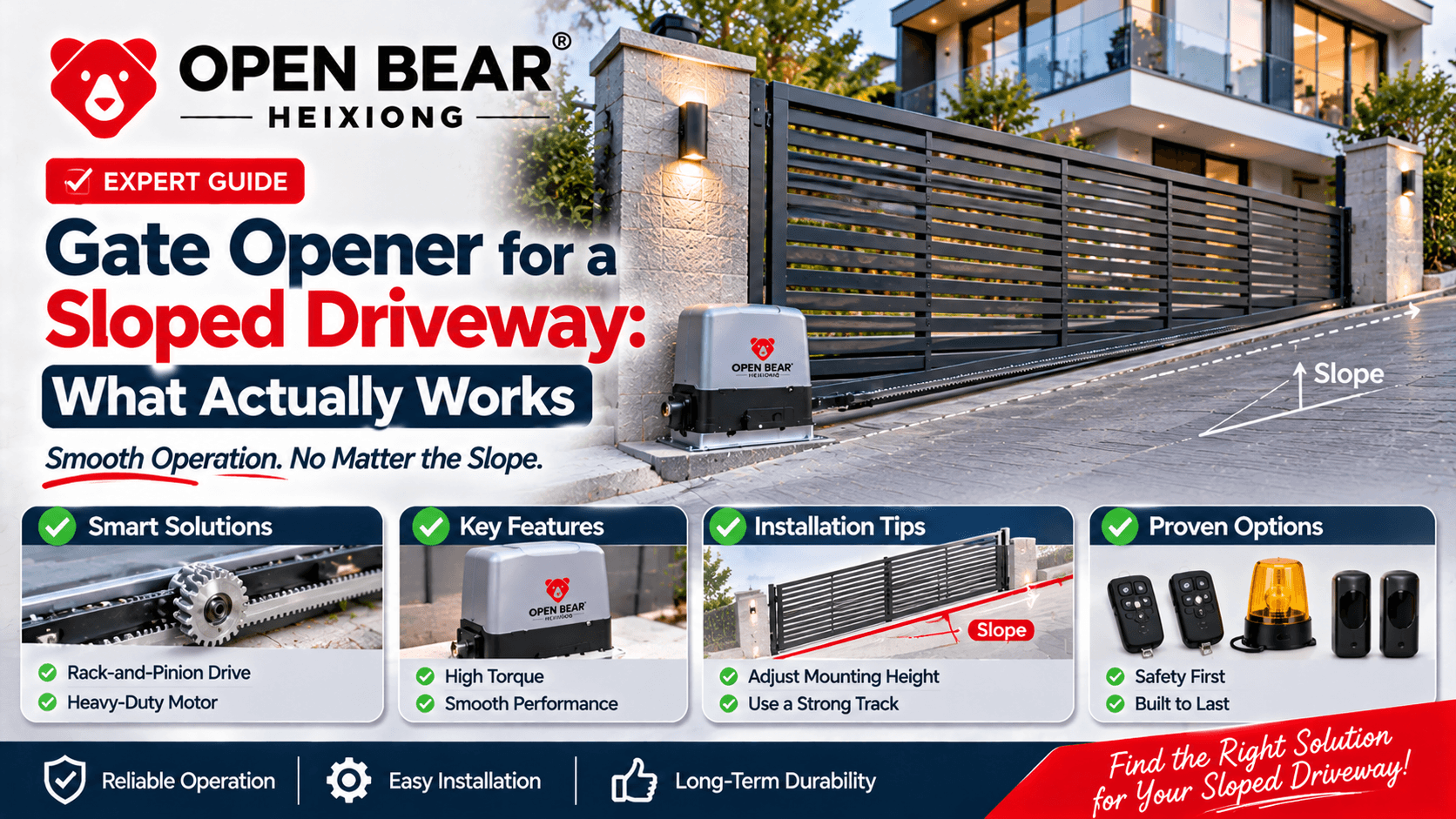
A flat driveway forgives almost any gate setup. A slope does not. The gate scrapes the pavement, drifts open on its own, or strains a motor that was never sized for the job. The right gate opener for sloped driveway setups shares a few traits, and none of them are complicated once you know what the hill is doing to your gate.
This guide covers what goes wrong on a slope, which hardware solves each problem, and how to choose between swing and sliding layouts.
What a Slope Does to Your Gate
Picture a swing gate hinged on a post at the bottom of a rise. As the leaf swings inward, it travels in a flat arc, but the ground under it climbs. The bottom rail reaches the pavement long before the gate finishes opening. People then raise the whole gate by a foot, and the result looks awkward and lets dogs and small kids walk under it.
Sliding gates have their own trouble. The track needs to sit level, and the gate rolls freely, so a slope tempts it to creep. Gravity also works against the motor, which pushes harder going uphill and gets a free ride coming down.
Four problems show up again and again:
- The leaf scrapes or jams as the ground rises.
- The gate drifts or slams because gravity helps or fights the motor.
- The motor overheats because it is undersized for the extra load.
- Safety sensors misread the gate’s position on uneven ground.
Fix those four, and the slope stops being a problem.
Rise Hinges and Other Ways to Lift a Gate Over Rising Ground
The simplest fix for a swing gate is a pair of rising hinges. The hinge barrel has a spiral cam, so the gate lifts a little as it opens and drops back down as it closes. The gate clears the high ground in the middle of its swing and still sits snug against the pavement when shut.
Many owners ask about rise hinges for sloped gate installations, and the honest answer is that they work well up to a point. Most handle a modest rise, often a few inches across the gate’s width. Past that, you need a different approach.
Options when hinges alone fall short:
- Cut the gate to follow the slope. A fabricator can taper the bottom rail to match the grade.
- Re-grade the swing path. Excavate or fill the area under the arc so the ground stays level.
- Switch to an outward-swinging gate. Sometimes the ground falls away on the other side.
- Use a different operator type. A buried operator avoids the arm geometry problem entirely.
Check the numbers before you buy anything. Measure the rise from the hinge post to the far end of the gate arc, then check it against the hinge’s rated lift.
Picking a Sloped Driveway Gate Opener That Matches the Grade
A sloped driveway gate opener has to deal with three variables: grade, gate weight, and opening direction. Gentle slopes under about five degrees rarely need special equipment. Steeper ones do.
For a swing gate opener for slope conditions, linear arm models work when the posts are stable and the gate swings inward over level or gently rising ground. They push and pull the gate through a fixed arc, which can be awkward when the leaf also lifts on rise hinges. Articulated arms handle that extra movement better because the arm bends as the gate lifts.
On a real hill, a gate often weighs more than the owner expects. Steel frames with solid infill can top 300 pounds per leaf, and the motor fights that weight on every uphill swing. A heavy duty gate opener for sloped driveways gives you stronger torque, sealed electronics, and a higher duty rating, which keeps the motor cool through repeated cycles.
When someone asks for the best gate opener for sloped driveway use, the real answer depends on gate weight and grade, not a brand name. Bigger motors cost more, but they last longer on a hill.
When Underground Operators Make Sense
Some slopes defeat any arm. The gate lifts too much, the posts sit too close, or the homeowner just hates the look of motors bolted to a pillar.
In those cases, a buried operator does the job quietly. The mechanism sits in a sealed box beneath the hinge, and the gate turns directly from the pivot. No arm sweeps across the ground, so the slope matters far less. An underground gate opener for slope installation also keeps your gate looking clean, since nothing is visible beyond the gate leaf and the posts.
The tradeoff is installation. The box needs proper drainage, because water pooling around a buried unit shortens its life. A sloped driveway can help here, since water naturally flows away, but you still need a gravel base and a drain path. Have a pro dig and set it.
Swing or Sliding on a Hill
Neither layout wins everywhere. A swing gate is cheaper and simpler, but it needs open ground to move through. A sliding gate needs a long, level run beside the driveway.
If your driveway climbs steeply toward the street, a swing gate that opens inward usually fits better because you do not have to level a long track. If the ground falls away to the side and you have room, a sliding gate can work well.
A sliding gate opener on a slope deserves extra care. The track must be perfectly level even when the driveway is not, which often means pouring a concrete footing that steps up or down. Many owners find the earthwork costs more than the opener itself. The guide to swing or sliding gate options walks through the tradeoffs in more detail if you are still deciding.
Steep Driveways and Power Choices
An automatic gate opener for steep driveway use has to hold the gate in place when the power drops. On a hill, a free-spinning motor lets the gate drift open or swing shut by gravity. Look for a self-locking gearbox, an electric lock, or a hydraulic model that resists back-driving.
Power supply matters too. Many sloped properties sit far from the house, which makes trenching expensive. Low-voltage DC systems with battery backup work well here, and solar panels can keep the batteries topped up when sunlight is reliable. Mount the panel facing the sun and clear of tree shadow.
Safety needs more attention on a slope as well. Photo-eye sensors should sit at a height that matches the real gate edge, not the ground line, and force settings should be tested after each adjustment. Add a manual release so you can still move the gate when the batteries die.
Choosing What to Buy
Before you contact a supplier, collect a few simple facts:
- Gate length, height, and weight per leaf
- Rise measured across the swing arc
- Opening direction and available space
- Distance to power or sunlight exposure
- Traffic volume and any safety requirements
With those, a supplier can narrow the choices in a single conversation rather than guessing. If you want a recommendation built around your driveway rather than a generic catalogue pick, get a quote and send your measurements and a few photos of the slope.
Start With the Slope, Not the Motor
The gate that works on a hill starts with the ground, not the product page. Measure the rise, weigh the gate, and decide how it should move. After that, the hardware choice gets simple.
Send your measurements to a specialist who handles slope installations every week, and you will skip the scraped pavement and burned-out motors that catch most first-time buyers.

Frequently Asked Questions
Key engineering and selection answers regarding this topic
Haan, bilkul kaam karta hai, bas sahi model chunna zaroori hai. Slope ke hisaab se heavy-duty motor, rise hinges ya underground operator lagana padta hai.
Zyada tar steep driveways par swing gate aasan rehta hai kyunki usko lambi level track nahi chahiye. Sliding gate tab chunein jab side mein jagah ho aur zameen level ki ja sake.
Agar hinge normal hai aur zameen upar uth rahi hai, to haan gate ghis sakta hai. Rise hinges ya gate ke neeche ka rail slope ke mutabiq kaatne se yeh masla hal ho jata hai.
Ek achha gate opener for sloped driveway wohi hai jo aapke gate ke weight aur slope ko handle kare. Heavy-duty swing opener ya underground operator aam taur par best nateeja dete hain.
Haan chal sakta hai, agar panel ko achhi dhoop mile aur battery sahi size ki ho. Rozana ke cycles aur badal wale mausam ka hisaab pehle se laga lein.
Explore Related Automation Systems
Looking for motors, hardware, or installation systems mentioned in this guide? Discover our factory-direct gate opener range:
All Gate Openers
Browse DC24V sliding, swing & barrier operators with full factory warranty.
Explore Products →Residential Gate Operators
Ultra-quiet, solar-ready sliding & swing gate motors for homes and villas.
Residential Solutions →Commercial Gate Systems
Continuous-duty operators for gated communities, business parks & parking.
Commercial Solutions →Industrial Heavy-Duty
High-torque motors engineered for gates up to 4,000 kg and logistics hubs.
Industrial Solutions →