
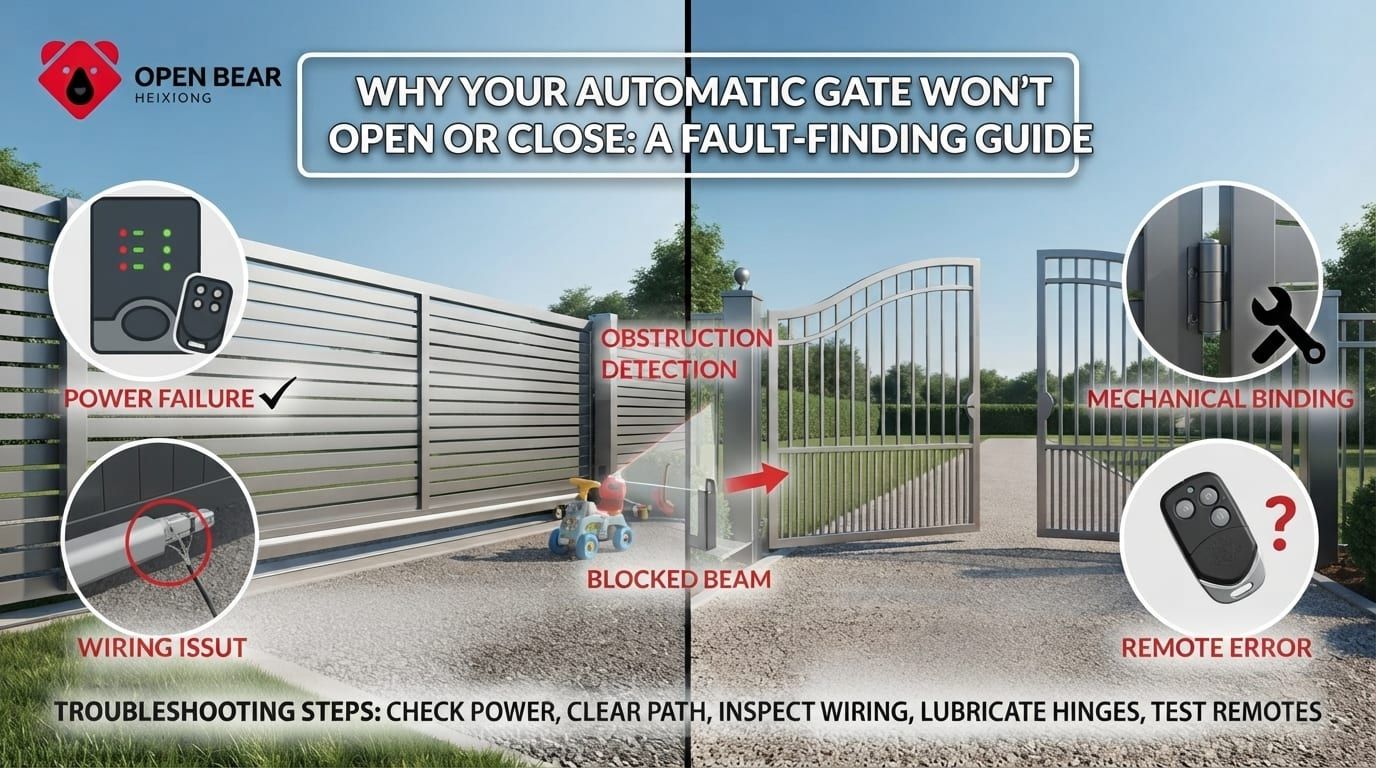
A gate that stops working is rarely the disaster it first looks like. Most of the time the cause is one of a handful of everyday faults, and you can find it in a few minutes by matching what the gate is doing to the likely reason. This guide is about diagnosis, not repair. It helps you pin down why the gate has stopped so you know whether it is a two-minute fix like a flat remote battery or something that needs a technician. Work through the checks in order, because they run roughly from most common to least.
First, read the symptom
What the gate does narrows the cause fast. Three patterns cover most calls:
- Completely dead, no lights, no hum, no response to anything: start with power.
- Opens fine but won't close: suspect the safety sensors first.
- Hums or clicks but won't move: look at the motor, clutch, or a mechanical bind.
Find your pattern below and check the causes listed under it before moving on.
Symptom-to-cause-to-fix table
Symptom | Most likely cause | First check |
No lights, no hum, no response | No power | Breaker, fuse, power lead |
One control fails, others work | Dead remote or keypad | Remote battery, reprogram |
Opens but won't close | Photo eye fault | Clean and realign sensors |
Stops or reverses partway | Obstruction or sensitivity | Clear path, check for binding |
Reaches wrong position and stops | Limit set wrong | Limit switch position |
Motor hums but gate still | Motor, capacitor, or bind | Release clutch, move by hand |
Only fails on windy days | Wind load, not a fault | See wind guide |
No power: the most overlooked cause
A gate that is completely unresponsive has usually lost power, and people skip this because it seems too obvious. Check it first anyway.
Look at your electrical panel for a tripped breaker or blown fuse on the gate circuit and reset it. If it trips again straight away, stop, that points to an electrical fault that needs a professional, not a second reset. Next, inspect the power lead running to the operator for damage from weather, rodents, or garden tools. On a solar gate, a completely dead system often means a flat battery rather than a gate fault, which usually traces back to panel or charging problems covered in our solar gate opener guide.
Remote or keypad not working
If the gate has power but ignores your remote, the problem is often the control device, not the gate. The single most common cause is a dead remote battery, so replace that first.
If a fresh battery does not help, the remote may have lost its programming. Reprogram it to the receiver using your manual. A useful test: if the wall button or keypad works but no remote does, the receiver or its antenna likely needs attention rather than the remotes. If one keypad code fails but the remote works, the keypad is the suspect. For how the different access devices connect, see our gate access control guide.
Opens but won't close: check the safety sensors
This is the most common single complaint, and it almost always comes back to the photo eyes. These are the entrapment-protection sensors that stop the gate closing on a person, car, or pet. Under the UL 325 safety standard, the operator must confirm these sensors every cycle, so if one is dirty, misaligned, blocked, or has lost its connection, the gate is designed to refuse to close. That refusal is the safety system working, not breaking.
Clean both photo eye lenses with a soft cloth, since dust or spider webs alone can block the beam. Check they line up and face each other squarely, as a knock from a car or mower easily nudges one out of alignment. Make sure nothing sits in the beam's path. Our full gate safety sensor and UL 325 guide covers how these sensors work in detail.
Stops or reverses partway
A gate that starts moving then stops or backs off has usually detected resistance. Sometimes there really is an obstruction, so clear the path and the track first. Sometimes the gate is mechanically binding, a swing gate dragging on the ground or a sliding gate off its track or with seized rollers. Release the operator's clutch with the manual override and move the gate by hand: if it drags, sticks, or grinds, the fault is mechanical, not electronic.
If the path is clear and the gate moves freely by hand but still reverses, the obstruction sensitivity or stall force may be set too tight, reading normal resistance as a blockage. On gates that only misbehave in wind, the wind itself is usually the culprit, which our gate wind load guide explains.
Reaches the wrong point and stops
If the gate stops short, runs past where it should, or slams, the limit settings are likely off. Limit switches tell the operator where fully open and fully closed are. They can drift over time or after a knock. This is a diagnosis you can confirm, the gate consistently stopping in the wrong place points here, but the adjustment itself varies by model and is best done with the manual or a technician, since a wrong close limit can drive the gate too hard into the closed position.
Hums or clicks but won't move
If the motor makes noise but the gate stays put, first rule out a mechanical bind using the clutch-release test above. If the gate moves freely by hand yet the motor cannot shift it, the problem is likely inside the operator: a worn gear, a failed capacitor on AC units, or a motor near the end of its life. On battery or solar gates, low battery voltage under load causes the same symptom, so check the charge.
These are the point where DIY diagnosis ends and parts come in. Identifying which component has failed is covered in our gate opener parts guide, and much of this wear is preventable with the routine in our maintenance guide.
When to stop and call a professional
Some findings mean you should stop testing and get a technician. Any burning smell, sparking, or visible damage to the control board or wiring. A breaker that trips again the moment you reset it. A gate physically sagging, binding, or making grinding or popping noises. A motor that hums with power but will not move after the basic checks. Any time limits or a diagnostic code are involved, or the gate has been hit by a vehicle or storm. Automatic gates carry heavy parts under real mechanical force and mains electrical connections, so these are not worth risking.
For anything beyond the checks here, our team can help you identify the fault or the right replacement part. Reach us through the contact page.
Frequently asked questions
Why does my gate open but not close?
The most common reason is a photo eye fault. These safety sensors must confirm the path is clear every cycle, so if one is dirty, misaligned, or blocked, the gate refuses to close to avoid hitting something. Clean both lenses, check they line up squarely, and make sure nothing sits in the beam.
My gate is completely dead. Where do I start?
Start with power, since a total lack of response usually means the operator has lost it. Check for a tripped breaker or blown fuse and reset it, then inspect the power lead for damage. If the breaker trips again immediately, stop and call a professional, as that signals an electrical fault.
My remote stopped working but the gate has power. What's wrong?
Replace the remote battery first, as a dead battery is the single most common cause. If that does not help, the remote may have lost its programming and need reprogramming to the receiver. If the wall button works but no remote does, the receiver or antenna likely needs service.
Why does my gate stop or reverse halfway?
The gate has detected resistance. Clear the path and track, then release the clutch and move the gate by hand. If it drags or sticks, the fault is a mechanical bind. If it moves freely but still reverses, the obstruction sensitivity may be set too tight, or wind may be loading the gate.
The motor hums but the gate doesn't move. What does that mean?
First release the clutch and move the gate by hand to rule out a mechanical bind. If it moves freely but the motor cannot shift it, the cause is usually inside the operator, such as a worn gear, a failed capacitor, or a worn-out motor. On solar or battery gates, low battery voltage causes the same symptom.
When should I call a technician instead of fixing it myself?
Call a professional for any burning smell, sparking, or visible board or wiring damage, a breaker that keeps tripping, a gate that is sagging or grinding, or a motor that hums but will not move after basic checks. Also call when limit switches, diagnostic codes, or storm or vehicle damage are involved.

Frequently Asked Questions
Key engineering and selection answers regarding this topic
The most common reason is a photo eye fault. These safety sensors must confirm the path is clear every cycle, so if one is dirty, misaligned, or blocked, the gate refuses to close to avoid hitting something. Clean both lenses, check they line up squarely, and make sure nothing sits in the beam.
Start with power, since a total lack of response usually means the operator has lost it. Check for a tripped breaker or blown fuse and reset it, then inspect the power lead for damage. If the breaker trips again immediately, stop and call a professional, as that signals an electrical fault.
Replace the remote battery first, as a dead battery is the single most common cause. If that does not help, the remote may have lost its programming and need reprogramming to the receiver. If the wall button works but no remote does, the receiver or antenna likely needs service.
The gate has detected resistance. Clear the path and track, then release the clutch and move the gate by hand. If it drags or sticks, the fault is a mechanical bind. If it moves freely but still reverses, the obstruction sensitivity may be set too tight, or wind may be loading the gate.
First release the clutch and move the gate by hand to rule out a mechanical bind. If it moves freely but the motor cannot shift it, the cause is usually inside the operator, such as a worn gear, a failed capacitor, or a worn-out motor. On solar or battery gates, low battery voltage causes the same symptom.
Call a professional for any burning smell, sparking, or visible board or wiring damage, a breaker that keeps tripping, a gate that is sagging or grinding, or a motor that hums but will not move after basic checks. Also call when limit switches, diagnostic codes, or storm or vehicle damage are involved.
Explore Related Automation Systems
Looking for motors, hardware, or installation systems mentioned in this guide? Discover our factory-direct gate opener range:
All Gate Openers
Browse DC24V sliding, swing & barrier operators with full factory warranty.
Explore Products →Residential Gate Operators
Ultra-quiet, solar-ready sliding & swing gate motors for homes and villas.
Residential Solutions →Commercial Gate Systems
Continuous-duty operators for gated communities, business parks & parking.
Commercial Solutions →Industrial Heavy-Duty
High-torque motors engineered for gates up to 4,000 kg and logistics hubs.
Industrial Solutions →