
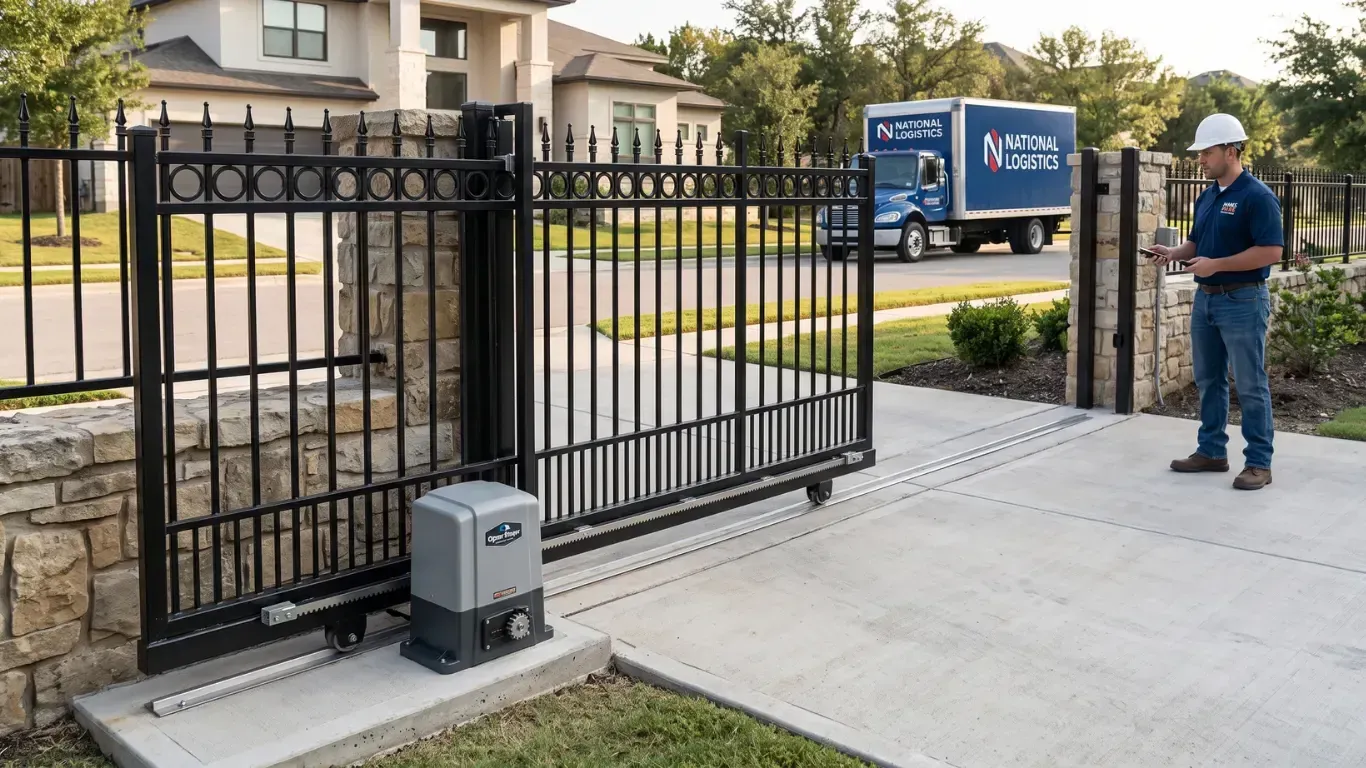
A rolling gate opener is a motor unit that pulls a gate sideways along its track, so the gate slides open instead of swinging. It sits on a pad next to the gate and drives a gear or chain. It stops at set points when the gate is fully open or closed. If your driveway is short, sloped, or right next to the road, this is often the most practical way to automate the entrance.
This guide explains how an automatic rolling gate opener works, the main types, how to size one correctly, and the safety features that matter. We build sliding gate openers at our own factory in Shenzhen, so the advice here comes from how these machines are designed, tested, and installed.
What Is a Rolling Gate?
A rolling gate is a sliding gate that moves on wheels or rollers. People use "rolling gate," "sliding gate," and "slide gate" to mean the same thing. The gate travels across the opening and parks alongside the fence when it opens.
There are two common builds.
V-Track Rolling Gates
A V-track gate rides on grooved wheels along a steel track set in the ground. It's simple and affordable. The downside is that the track needs to stay clean. Gravel, ice, and leaves in the groove add drag and can stop the gate.
Cantilever Rolling Gates
A cantilever gate has no ground track. It hangs from roller trucks mounted on posts to one side of the opening, and a counterbalance section extends behind the opening. Cantilever gates suit gravel drives, snowy sites, and uneven ground. They need more space along the fence line, usually around half the opening width again.
Both types can be automated. The opener doesn't care which build you have, as long as the gate moves freely by hand.
How the Drive Moves the Gate
Every opener has the same core parts. There's a motor, a gearbox, and a control board. There's also a drive connection to the gate and limit sensors that tell the board where to stop.
The drive connection is where designs differ.
Drive type | How it works | Best fit |
Rack and pinion | A gear on the opener meshes with a toothed rack fixed along the gate | Most residential and commercial gates, tidy look, easy to service |
Chain drive | A roller chain runs from end to end of the gate and loops through the opener | Very long or heavy commercial gates, common in North American commercial work |
Rack and pinion is the most common choice for driveway and light commercial gates. Nylon rack works on lighter gates. Steel rack is the better choice for heavy gates and busy sites because it resists wear and holds its shape in heat.
Our sliding gate opener uses a rack-and-pinion drive with magnetic limit switches. Magnets on the rack pass a sensor in the opener, and the board stops the motor at the right point every cycle.
AC or DC: Choosing the Rolling Gate Motor
The rolling gate motor is either AC (usually 110V or 230V) or low-voltage DC (usually 24V). Both can move a gate. They behave differently in daily use.
DC motors start and stop softly, which is easier on the gate hardware. That's one reason many electric rolling gate opener kits for homes use a 24V DC motor. DC motors can also run from a backup battery, so the gate keeps working during a power cut. They also suit solar setups on remote sites. A 24V system keeps the voltage at the gate low, which makes the moving parts safer to be around.
AC motors are a traditional choice for very high duty commercial gates. They need mains power at the gate and usually need extra equipment for battery backup.
Every opener in the Open Bear range runs on 24V DC and is rated for operation from -35°C to 70°C (-31°F to 158°F). If you want the full comparison, our guide on 24V DC vs AC gate motors walks through the tradeoffs.
How to Size an Automatic Rolling Gate Opener
Sizing is where most problems start. An undersized motor works hard on every cycle, runs hot, and wears out early. Check these four factors before you choose a model.
1. Gate Weight
Weight is the first number on every spec sheet. Ask your fabricator for it or calculate it from the material. Don't guess low. Pick an opener rated comfortably above the real weight so it isn't running at its limit.
For example, our range covers two sizes:
- 200W model: gates up to 1,200 kg (about 2,650 lb)
- 400W model: gates up to 1,800 kg (about 3,970 lb)
A 1,000 kg gate could run on the 200W unit. If that gate is tall, solid, and on a busy site, the 400W unit gives useful headroom.
2. Gate Length and Condition
Longer gates take longer to move and carry more momentum. The gate should also roll freely with light hand pressure. If it sticks, fix the wheels, track, or rollers first. An opener can't fix a gate that drags.
3. Daily Cycles
Count how many times the gate opens per day. A family home might see 10 to 20 cycles. A shared entrance or a business yard may see hundreds. Higher traffic calls for a stronger motor and heavier rack.
4. Wind Exposure
A solid gate acts like a sail. Wind adds load the motor must push through, and that load isn't on the weight chart. If your gate is tall with little open space, read our explanation of gate wind load before choosing a model.
Safety Features Every Rolling Gate Opener System Needs
A moving gate is heavy machinery. Safety is not optional.
Obstruction Sensing
The control board watches motor current. When the gate meets resistance, the opener stops or reverses. This is the built-in layer of protection.
Photocells and Safety Edges
Photocells send an infrared beam across the opening. If a car or person breaks the beam, the gate won't close. Safety edges are pressure strips on the gate's leading edge that stop the gate on contact.
Standards to Know
In the United States, UL 325 sets safety requirements for gate openers. It groups sites into four usage classes, from Class I (residential) to Class IV (restricted access such as prisons). It also requires two independent means of entrapment protection for each entrapment zone. ASTM F2200 covers the gate itself, such as screening low openings and guarding exposed rollers.
A compliant rolling gate opener system uses both built-in sensing and external devices. Our article on gate safety sensors and UL 325 explains how the zones and device types work.
Control Options
Most people open the gate with a handheld remote. That's only one option. Any modern automatic gate opener can take several inputs at once. You can also add:
- Keypads for visitors and delivery drivers
- Phone apps over WiFi or Bluetooth
- Vehicle loop detectors that open the gate as a car approaches from inside
- Intercoms that let you open the gate for guests
Your choice depends on who uses the entrance. A home usually needs remotes and a keypad. A commercial site may need an access system that logs each entry.
Where Rolling Gates Make the Most Sense
Rolling gates suit sites where a swing gate would be awkward:
- Short driveways where a swing gate would hit parked cars
- Driveways that slope up from the gate
- Entrances next to a public road or sidewalk
- Wide commercial openings that would need very long swing leaves
An electric rolling gate opener also suits wide farm and yard entrances, where long swing leaves would sag and catch the wind.
If you're still deciding between gate types, our guide to sliding vs swing gates compares space needs, cost, and upkeep side by side.
Before You Buy
A good automatic gate opener lasts for years when it matches the gate. Many early failures trace back to a skipped step on this list, not to a faulty motor. Run through this short list before you order:
- Confirm the gate weight and length
- Check that the gate rolls smoothly by hand
- Estimate daily cycles
- Think about wind exposure
- Plan the power supply and backup
- Decide on safety devices and controls
At Gate Opener Factory, every Open Bear opener is tested under full load before it ships. Each kit comes with English manuals, wiring diagrams, and parameter tables, so installers can set it up without chasing documents. If you're unsure which size fits your gate, send us the weight, length, and site details and we'll help you pick.
FAQs
Q: What is the difference between a rolling gate and a sliding gate?
There is no real difference. Both names describe a gate that moves sideways on wheels or rollers. Some people use "rolling gate" for V-track gates with ground wheels, but the same openers work on both designs.
Q: How long does a rolling gate opener last?
Lifespan depends on sizing, daily cycles, climate, and maintenance. A correctly sized opener on a free-rolling gate, serviced two to four times a year, lasts far longer than an undersized unit fighting a dragging gate.
Q: Can the gate still open during a power outage?
Yes, if it has battery backup. 24V DC openers can run from backup batteries for a number of cycles. Every opener also has a manual release, so you can release the drive and push the gate by hand.
Q: Can I use a rolling gate opener on a cantilever gate?
Yes. The opener only needs a place to mount and a straight run for the rack or chain. Cantilever gates often suit automation well because they have no ground track to clog with gravel, leaves, or snow.
Q: Do rolling gate openers need a concrete pad?
Most do. A level concrete pad keeps the opener at the right height and distance from the gate, which keeps the gear and rack aligned. In cold climates, the pad should sit deep enough to stay stable through frost.

Frequently Asked Questions
Key engineering and selection answers regarding this topic
A rolling gate is a sliding gate that moves on wheels or rollers. People use "rolling gate," "sliding gate," and "slide gate" to mean the same thing. The gate travels across the opening and parks alongside the fence when it opens.
There is no real difference. Both names describe a gate that moves sideways on wheels or rollers. Some people use "rolling gate" for V-track gates with ground wheels, but the same openers work on both designs.
Lifespan depends on sizing, daily cycles, climate, and maintenance. A correctly sized opener on a free-rolling gate, serviced two to four times a year, lasts far longer than an undersized unit fighting a dragging gate.
Yes, if it has battery backup. 24V DC openers can run from backup batteries for a number of cycles. Every opener also has a manual release, so you can release the drive and push the gate by hand.
Yes. The opener only needs a place to mount and a straight run for the rack or chain. Cantilever gates often suit automation well because they have no ground track to clog with gravel, leaves, or snow.
Most do. A level concrete pad keeps the opener at the right height and distance from the gate, which keeps the gear and rack aligned. In cold climates, the pad should sit deep enough to stay stable through frost.
Explore Related Automation Systems
Looking for motors, hardware, or installation systems mentioned in this guide? Discover our factory-direct gate opener range:
All Gate Openers
Browse DC24V sliding, swing & barrier operators with full factory warranty.
Explore Products →Residential Gate Operators
Ultra-quiet, solar-ready sliding & swing gate motors for homes and villas.
Residential Solutions →Commercial Gate Systems
Continuous-duty operators for gated communities, business parks & parking.
Commercial Solutions →Industrial Heavy-Duty
High-torque motors engineered for gates up to 4,000 kg and logistics hubs.
Industrial Solutions →