
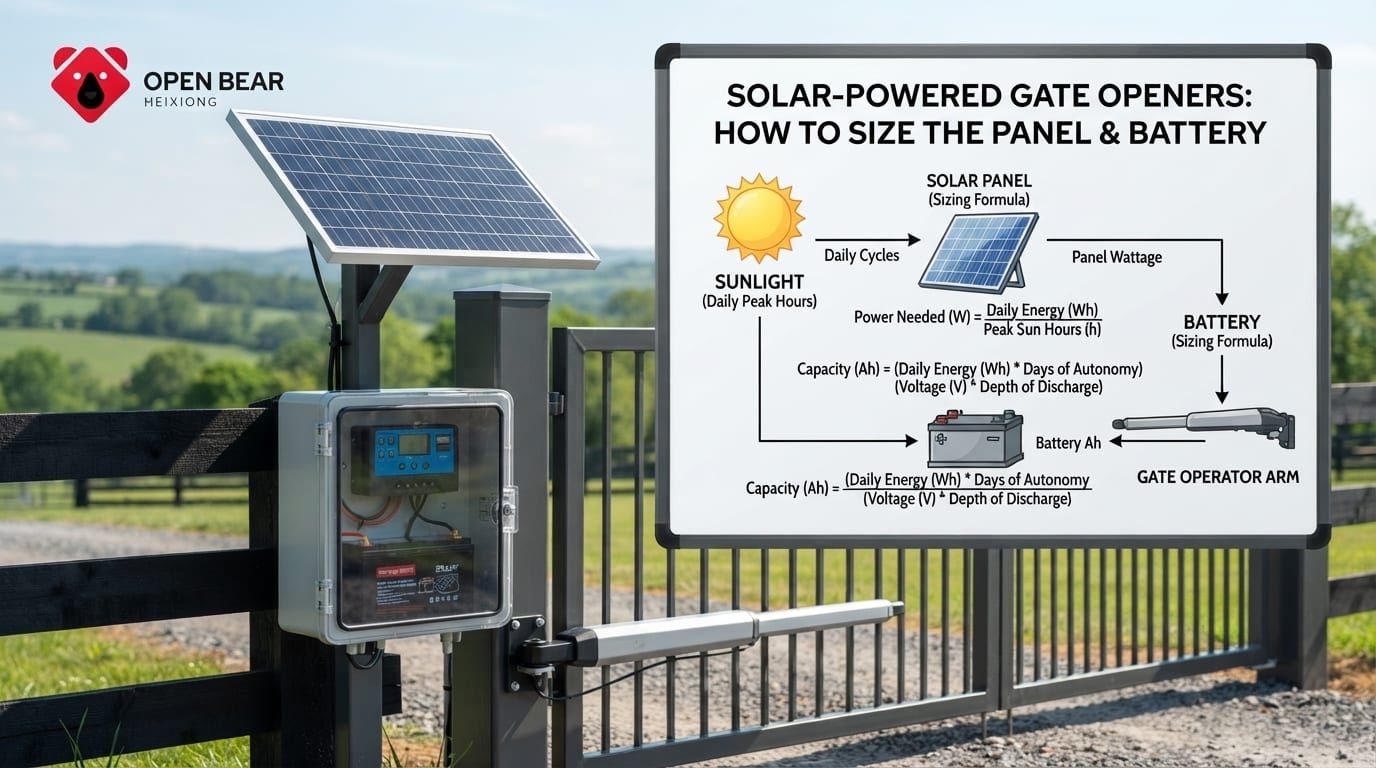
A solar gate opener that works fine in July can leave you stranded at the gate in January. The gate never changed, and the motor never failed. The solar system was just sized for summer sun and ran out of reserve when the days got short. Getting a solar setup right is mostly arithmetic: how much power the gate uses per day, how much sun your site actually gets, and how much battery you keep in hand for the bad weeks. This guide walks through that math so you can size the panel and battery for your own gate instead of guessing.
When solar makes sense
Solar suits gates where running mains power is expensive or impractical. A gate at the end of a long driveway, a field entrance far from the house, or a remote property with no nearby supply are all strong candidates. Trenching a cable 150 metres to a gate can cost more than the whole opener, so a panel and battery often win outright.
Solar pairs naturally with low-voltage DC motors. All Open Bear openers run on 24V DC, which draws less current than an AC asynchronous motor at the same job and stores easily in a battery. If you want the background on why DC suits this, our guide on 24V DC vs AC gate motors covers it.
Solar is a weaker fit for continuous-duty commercial gates cycling hundreds of times a day. Those need panel and battery banks large enough that mains power is usually simpler. Solar is at its best on residential and light-traffic gates.
The four numbers you need
Sizing a solar gate opener comes down to four figures:
- Daily energy use: how much power the gate consumes over 24 hours
- Standby draw: what the controller and receiver sip while the gate sits idle
- Peak sun hours: the hours of usable sun your location averages, by season
- Autonomy: how many cloudy days the battery must cover on its own
Get these four and the panel and battery sizes fall out of simple multiplication. Skip any one and you are back to guessing.
Step 1: work out daily energy use
Start with how often the gate moves. One full open and close counts as one cycle. A typical home runs 20 to 60 cycles a day once you add commuting, deliveries, and visitors.
Each cycle draws current from the battery for the few seconds the motor runs. As a working estimate, a 24V residential opener uses roughly 2 to 4 watt-hours (Wh) per cycle. Take 40 cycles a day at 3 Wh each:
40 cycles × 3 Wh = 120 Wh per day for motor operation.
Now add standby draw, which people almost always forget. The controller, radio receiver, and any keypad pull a small current every hour of every day, whether the gate moves or not. A standby draw of 30 milliamps at 24V is about 0.72 watts, or roughly 17 Wh a day. Standby often costs as much as the gate movement itself, sometimes more on a low-traffic gate.
120 Wh (movement) + 17 Wh (standby) = about 137 Wh per day total.
Round up to 150 Wh a day to give yourself margin.
Step 2: size the battery
The battery has to carry the gate through the night and through cloudy stretches when the panel gives little. That is where autonomy comes in. For most residential sites, size the battery for three to five days of autonomy so a bad weather run does not flatten it.
Battery capacity is measured in amp-hours (Ah) at a voltage. Convert your daily watt-hours to amp-hours by dividing by battery voltage:
150 Wh ÷ 24V = 6.25 Ah per day.
For four days of autonomy:
6.25 Ah × 4 = 25 Ah.
There is one more correction. You should not drain a lead-acid battery fully, or it dies young. Plan to use only about half its rated capacity. So double the figure:
25 Ah ÷ 0.5 = 50 Ah battery.
A 24V 50Ah battery gives this gate four cloudy days with the motor still working and the battery never deeply discharged. Lithium (LiFePO4) batteries tolerate deeper discharge and can be sized closer to the raw number, which is part of why they are worth the higher price on solar gates.
Step 3: size the solar panel
The panel has to replace everything the gate used in a day, plus enough extra to recharge the battery after a cloudy spell, and it only has a few useful sun hours to do it.
Peak sun hours are not daylight hours. They are the equivalent hours of full-strength sun your site averages, and they swing hard by season and latitude. A location might see 5 peak sun hours in summer and barely 1.5 in midwinter. Always size on your winter figure, not the annual average, or the gate will fail in the season it is most needed.
Take a winter figure of 2 peak sun hours and the 150 Wh daily need:
150 Wh ÷ 2 hours = 75 watts, before losses.
Panels never deliver their rated output in the field. Dirt, heat, wiring loss, and charge controller inefficiency shave off a good chunk, so add about 30 percent:
75W × 1.3 = about 100 watts of panel.
A 100W panel covers this gate through winter. In a foggy or high-latitude location, size up again rather than trusting the brochure.
Winter and fog change everything
The single biggest mistake with solar gates is sizing for summer. Fog, low winter sun, and short days can cut panel output by half or more for weeks at a time. A system that looked generous in June starves in December.
Three habits keep you out of trouble. Size the panel on your worst month, not the yearly mean. Give the battery enough autonomy to ride out a cloudy week without help. Keep the panel clear of leaves, snow, and dust, since a dirty panel in weak winter light produces almost nothing.
Add a charge controller
Never wire a panel straight to a battery. A charge controller sits between them and manages the charge so the battery is not overcharged in strong sun or drained back into the panel at night. An MPPT controller squeezes more usable energy out of the same panel than a cheaper PWM type, which matters most in winter when every watt counts. Match the controller to your panel wattage and battery voltage.
Worked example: remote 4 m driveway gate
Pull it together for one gate. A 24V swing opener on a rural driveway, about 40 cycles a day, in a region with 2 winter peak sun hours.
- Daily use: 40 cycles at 3 Wh, plus standby, rounded to 150 Wh
- Battery: 150 Wh gives 6.25 Ah/day, four days autonomy at 50 percent depth needs a 24V 50Ah battery
- Panel: 150 Wh over 2 winter sun hours plus losses needs about 100W
- Controller: an MPPT unit matched to a 100W panel and 24V battery
That package runs the gate through winter with reserve for cloudy spells. For a gate this size, check if the motor itself is sized right too, using our guide on how to size a gate opener, then browse the full opener range or ask our team for a solar sizing check.
Frequently asked questions
What size solar panel do I need for a gate opener?
For a typical residential 24V gate at around 40 cycles a day, a panel near 100W covers year-round use in most climates. Size it on your winter peak sun hours rather than the summer figure, and add about 30 percent for real-world losses from dirt, heat, and wiring.
How big a battery does a solar gate opener need?
Work out daily watt-hours, divide by battery voltage for amp-hours per day, then multiply by three to five days of autonomy. Double the result for a lead-acid battery so you only use about half its capacity. A common residential answer is a 24V 50Ah battery.
Why do solar gates fail in winter?
Short days, low sun angle, and fog cut panel output sharply for weeks, sometimes by half or more. A system sized for summer runs out of reserve. Sizing the panel on the worst month and giving the battery several days of autonomy prevents it.
How many cycles can a solar gate opener do per day?
That depends on battery capacity and how well the panel recharges it. A correctly sized residential solar setup comfortably handles 40 to 60 cycles a day. High-traffic gates cycling hundreds of times usually need a larger system or mains power.
Does standby power really matter on a solar gate?
Yes. The controller and receiver draw a small current every hour, and over a full day that can equal or beat the energy used by the gate moving. Always add standby draw to your daily total before sizing the panel and battery.
Can I run any gate opener on solar?
Low-voltage DC openers suit solar best because they store and draw power efficiently. AC-only openers are harder to run from a battery and usually need an inverter, which adds loss. All Open Bear openers run on 24V DC, which pairs directly with a solar panel and battery.

Frequently Asked Questions
Key engineering and selection answers regarding this topic
For a typical residential 24V gate at around 40 cycles a day, a panel near 100W covers year-round use in most climates. Size it on your winter peak sun hours rather than the summer figure, and add about 30 percent for real-world losses from dirt, heat, and wiring.
Work out daily watt-hours, divide by battery voltage for amp-hours per day, then multiply by three to five days of autonomy. Double the result for a lead-acid battery so you only use about half its capacity. A common residential answer is a 24V 50Ah battery.
Short days, low sun angle, and fog cut panel output sharply for weeks, sometimes by half or more. A system sized for summer runs out of reserve. Sizing the panel on the worst month and giving the battery several days of autonomy prevents it.
That depends on battery capacity and how well the panel recharges it. A correctly sized residential solar setup comfortably handles 40 to 60 cycles a day. High-traffic gates cycling hundreds of times usually need a larger system or mains power.
Yes. The controller and receiver draw a small current every hour, and over a full day that can equal or beat the energy used by the gate moving. Always add standby draw to your daily total before sizing the panel and battery.
Low-voltage DC openers suit solar best because they store and draw power efficiently. AC-only openers are harder to run from a battery and usually need an inverter, which adds loss. All Open Bear openers run on 24V DC, which pairs directly with a solar panel and battery.
Explore Related Automation Systems
Looking for motors, hardware, or installation systems mentioned in this guide? Discover our factory-direct gate opener range:
All Gate Openers
Browse DC24V sliding, swing & barrier operators with full factory warranty.
Explore Products →Residential Gate Operators
Ultra-quiet, solar-ready sliding & swing gate motors for homes and villas.
Residential Solutions →Commercial Gate Systems
Continuous-duty operators for gated communities, business parks & parking.
Commercial Solutions →Industrial Heavy-Duty
High-torque motors engineered for gates up to 4,000 kg and logistics hubs.
Industrial Solutions →