
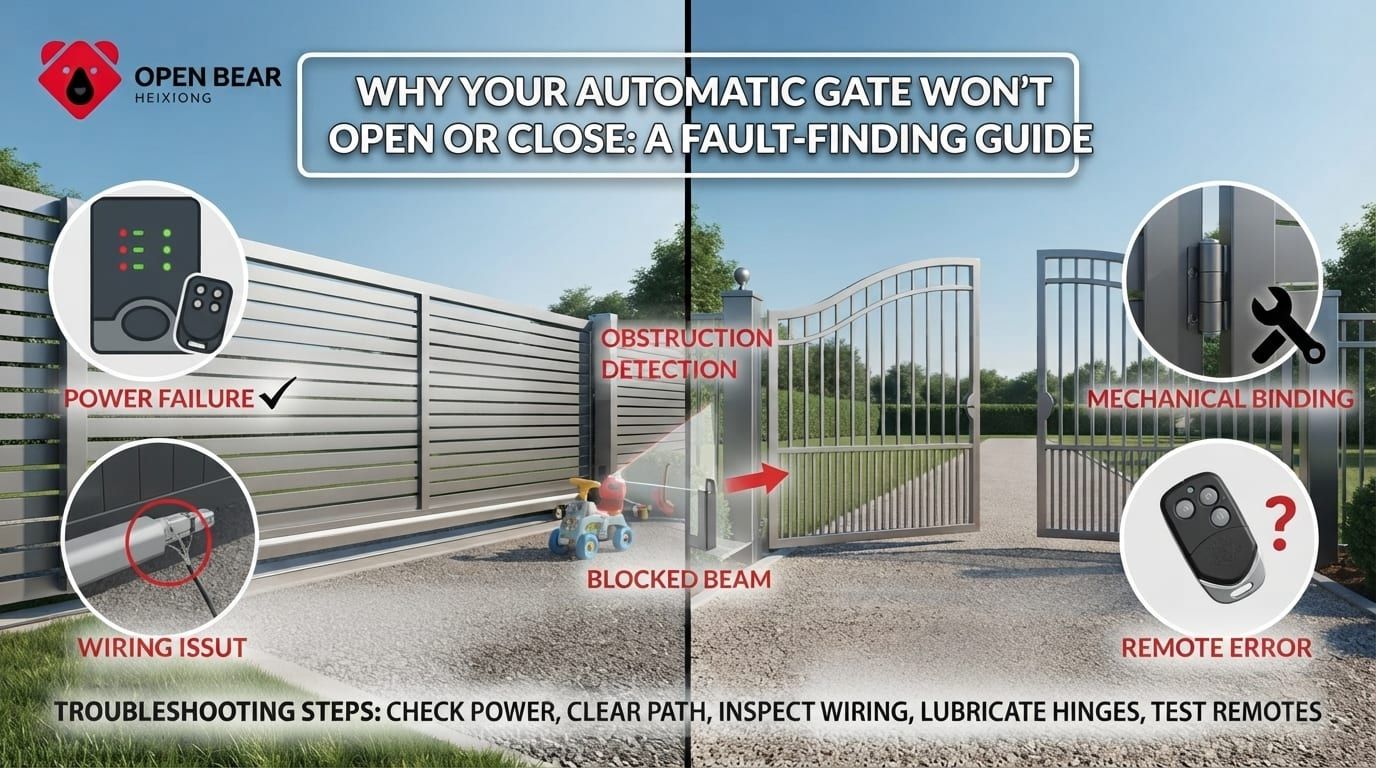
Une porte qui cesse de fonctionner est rarement la catastrophe à laquelle elle ressemble en premier. La plupart du temps, la cause est l'un des quelques défauts de tous les jours, et vous pouvez le trouver en quelques minutes en comparant ce que la porte fait à la raison probable. Ce guide traite du diagnostic, pas de la réparation. Il vous aide à épingler pourquoi la porte s'est arrêtée afin que vous sachiez si c'est une réparation de deux minutes comme une batterie à distance plate ou quelque chose qui a besoin d'un technicien. Travaillez à travers les contrôles dans l'ordre, parce qu'ils courent approximativement du plus commun au moins.
Premièrement, lisez le symptôme
Ce que la porte fait rétrécit la cause rapidement. Trois modèles couvrent la plupart des appels :
- Totalement mort, pas de lumières, pas de bourdonnement, pas de réponse à quoi que ce soit : commencez par la puissance.
- Ouvre bien mais ne ferme pas: suspecter d'abord les capteurs de sécurité.
- Hums ou clics mais ne bouge pas: look at the motor, clutch, or a mechanical bind.
Find your pattern below and check the causes listed under it before moving on.
Symptom-to-cause-to-fix table
Symptôme | Most likely cause | First check |
No lights, no hum, no response | No power | Breaker, fuse, power lead |
One control fails, others work | Dead remote or keypad | Remote battery, reprogram |
Opens but won't close | Photo eye fault | Clean and realign sensors |
Stops or reverses partway | Obstruction or sensitivity | Clear path, check for binding |
Reaches wrong position and stops | Limit set wrong | Limit switch position |
Motor hums but gate still | Motor, capacitor, or bind | Release clutch, move by hand |
Only fails on windy days | Wind load, not a fault | See wind guide |
No power: the most overlooked cause
A gate that is completely unresponsive has usually lost power, and people skip this because it seems too obvious. Check it first anyway.
Look at your electrical panel for a tripped breaker or blown fuse on the gate circuit and reset it. If it trips again straight away, stop, that points to an electrical fault that needs a professional, not a second reset. Next, inspect the power lead running to the operator for damage from weather, rodents, or garden tools. On a solar gate, a completely dead system often means a flat battery rather than a gate fault, which usually traces back to panel or charging problems covered in our guide d'ouverture de portail solaire.
Remote or keypad not working
If the gate has power but ignores your remote, the problem is often the control device, not the gate. The single most common cause is a dead remote battery, so replace that first.
If a fresh battery does not help, the remote may have lost its programming. Reprogram it to the receiver using your manual. A useful test: if the wall button or keypad works but no remote does, the receiver or its antenna likely needs attention rather than the remotes. If one keypad code fails but the remote works, the keypad is the suspect. For how the different access devices connect, see our guide de contrôle d'accès aux portes.
Opens but won't close: check the safety sensors
This is the most common single complaint, and it almost always comes back to the photo eyes. These are the entrapment-protection sensors that stop the gate closing on a person, car, or pet. Under the UL 325 safety standard, the operator must confirm these sensors every cycle, so if one is dirty, misaligned, blocked, or has lost its connection, the gate is designed to refuse to close. That refusal is the safety system working, not breaking.
Clean both photo eye lenses with a soft cloth, since dust or spider webs alone can block the beam. Check they line up and face each other squarely, as a knock from a car or mower easily nudges one out of alignment. Make sure nothing sits in the beam's path. Our full gate safety sensor and UL 325 guide covers how these sensors work in detail.
Stops or reverses partway
A gate that starts moving then stops or backs off has usually detected resistance. Sometimes there really is an obstruction, so clear the path and the track first. Sometimes the gate is mechanically binding, a swing gate dragging on the ground or a sliding gate off its track or with seized rollers. Release the operator's clutch with the manual override and move the gate by hand: if it drags, sticks, or grinds, the fault is mechanical, not electronic.
If the path is clear and the gate moves freely by hand but still reverses, the obstruction sensitivity or stall force may be set too tight, reading normal resistance as a blockage. On gates that only misbehave in wind, the wind itself is usually the culprit, which our gate wind load guide explains.
Reaches the wrong point and stops
If the gate stops short, runs past where it should, or slams, the limit settings are likely off. Limit switches tell the operator where fully open and fully closed are. They can drift over time or after a knock. This is a diagnosis you can confirm, the gate consistently stopping in the wrong place points here, but the adjustment itself varies by model and is best done with the manual or a technician, since a wrong close limit can drive the gate too hard into the closed position.
Hums ou clics mais ne bouge pas
If the motor makes noise but the gate stays put, first rule out a mechanical bind using the clutch-release test above. If the gate moves freely by hand yet the motor cannot shift it, the problem is likely inside the operator: a worn gear, a failed capacitor on AC units, or a motor near the end of its life. On battery or solar gates, low battery voltage under load causes the same symptom, so check the charge.
These are the point where DIY diagnosis ends and parts come in. Identifying which component has failed is covered in our guide des pièces d'ouverture de porte, and much of this wear is preventable with the routine in our guide d'entretien.
When to stop and call a professional
Some findings mean you should stop testing and get a technician. Any burning smell, sparking, or visible damage to the control board or wiring. A breaker that trips again the moment you reset it. A gate physically sagging, binding, or making grinding or popping noises. A motor that hums with power but will not move after the basic checks. Any time limits or a diagnostic code are involved, or the gate has been hit by a vehicle or storm. Automatic gates carry heavy parts under real mechanical force and mains electrical connections, so these are not worth risking.
For anything beyond the checks here, our team can help you identify the fault or the right replacement part. Reach us through the contact page.

Frequently Asked Questions
Key engineering and selection answers regarding this topic
La raison la plus courante est une faute d'oeil de photo. Ces capteurs de sécurité doivent confirmer que le chemin est libre à chaque cycle, donc si on est sale, mal aligné ou bloqué, la barrière refuse de se fermer pour éviter de frapper quelque chose. Nettoyez les deux verres, vérifiez qu'ils s'alignent carrément, et assurez-vous que rien ne se trouve dans le faisceau.
Commencez par la puissance, car un manque total de réponse signifie généralement que l'opérateur l'a perdu. Vérifiez un disjoncteur ou un fusible soufflé et réinitialisez-le, puis inspectez le plomb d'alimentation pour endommager. Si le disjoncteur voyage à nouveau immédiatement, arrêtez et appelez un professionnel, car cela signale une panne électrique.
Remplacez d'abord la batterie distante, car une batterie morte est la cause la plus courante. Si cela n'aide pas, la télécommande peut avoir perdu sa programmation et avoir besoin de reprogrammation au récepteur. Si le bouton mural fonctionne sans télécommande, le récepteur ou l'antenne a probablement besoin de service.
La barrière a détecté la résistance. Effacer le chemin et la piste, puis relâcher l'embrayage et déplacer la porte à la main. Si elle traîne ou colle, la faute est une liaison mécanique. S'il se déplace librement mais s'inverse encore, la sensibilité à l'obstruction peut être trop serrée, ou le vent peut charger la barrière.
D'abord relâchez l'embrayage et déplacez la porte à la main pour exclure une liaison mécanique. S'il se déplace librement mais que le moteur ne peut pas le déplacer, la cause est habituellement à l'intérieur de l'opérateur, comme un engin usé, un condensateur défaillant ou un moteur usé. Sur les portails solaires ou de batterie, la basse tension de la batterie provoque le même symptôme.
Appeler un professionnel pour toute odeur brûlante, étincelle, ou de panneaux visibles ou de dommages au câblage, un disjoncteur qui continue de trébucher, une porte qui est en train d'agresser ou de broyer, ou un moteur qui hume mais ne bouge pas après des vérifications de base. Appelez également lorsque des interrupteurs limites, des codes de diagnostic ou des dommages causés par la tempête ou le véhicule sont en cause. .
Explore Related Automation Systems
Looking for motors, hardware, or installation systems mentioned in this guide? Discover our factory-direct gate opener range:
All Gate Openers
Browse DC24V sliding, swing & barrier operators with full factory warranty.
Explore Products →Residential Gate Operators
Ultra-quiet, solar-ready sliding & swing gate motors for homes and villas.
Residential Solutions →Commercial Gate Systems
Continuous-duty operators for gated communities, business parks & parking.
Commercial Solutions →Industrial Heavy-Duty
High-torque motors engineered for gates up to 4,000 kg and logistics hubs.
Industrial Solutions →