A boom barrier gate is a motorized arm that rises and lowers across a vehicle lane to control when cars and trucks enter or leave. It is built for traffic flow, not for sealing a perimeter. Car parks, toll lanes, logistics yards, corporate campuses and gated communities use boom barriers because they open in a second or two, cycle thousands of times a month, and connect directly to card readers, ticket machines, and cameras.
At Open Bear, we design and build gate openers in-house in Shenzhen, so this guide draws on the specs and lessons from our own barrier range. It explains what a boom barrier gate is, how it works, the main types, the features that matter, what drives the price, and how to choose the right one for your property.
What Is a Boom Barrier Gate?
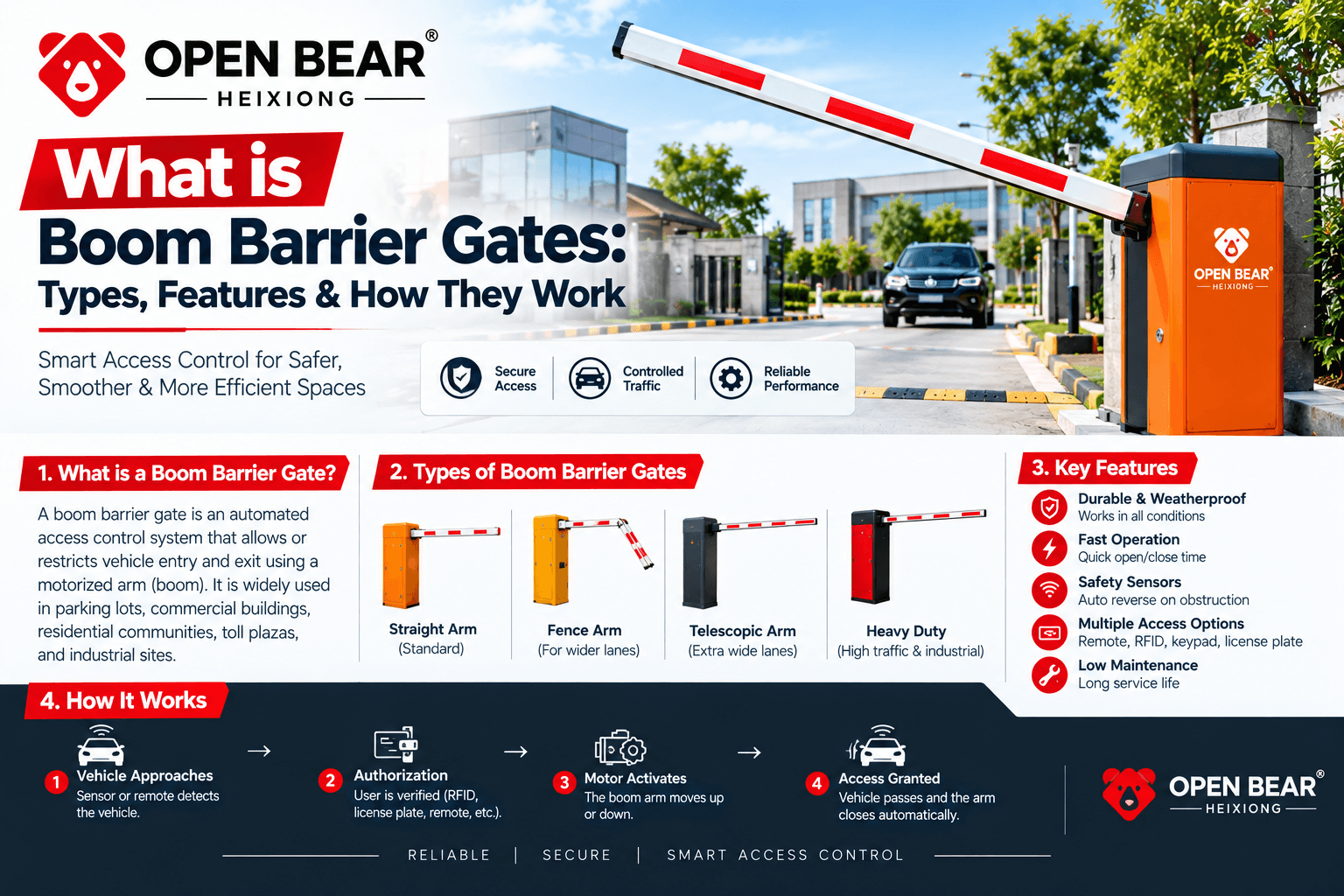
A boom barrier gate, also called a boom gate, barrier arm or parking barrier, is an automatic vehicle access device made of three core parts: a housing with a drive motor, a horizontal arm (the boom), and a controller that decides when the arm moves. Some suppliers call the drive unit a barrier gate operator. We call it a barrier gate opener, and this guide uses both terms for the same equipment.
The defining feature is purpose. A boom barrier manages vehicle flow. A person can walk around or under the arm, so it does not stop intrusion on its own. If your goal is to seal a boundary, a sliding or swing gate is the better tool. If your goal is to move vehicles through an entry point quickly and in order, a boom barrier is usually the right choice.
How Does a Boom Barrier Gate Work?
A boom barrier follows a simple five-step loop:
- A trigger sends a signal. A push button, IC card, remote control, microwave sensor or camera tells the controller that a vehicle is approaching or has been authorized.
- The controller validates the signal and powers the motor.
- The motor lifts the arm to vertical, often through a gearbox or spring-balanced mechanism.
- The arm stays raised while a safety device, such as a loop detector or photocell, confirms a vehicle is still passing.
- Once the lane is clear, the controller lowers the arm and the system resets.
Each raise-and-lower sequence counts as one cycle. A busy lane repeats this thousands of times a month, so the motor, spring mechanism and controller are engineered around how many cycles they can survive, not only how much they can lift.
As a real example, our barrier gate opener uses a 300W, 24V DC servo motor running at 3,000 rpm. A spring mechanism lets the arm fold on vehicle impact so the motor is protected. The 24V DC supply is also a low-voltage system, which makes the unit safer to handle during installation and service. If mains power fails, a controller with a battery backup module connected can keep the barrier running, and our controllers support that connection.
Parking access control: what triggers the barrier
A barrier rarely works alone. Its value comes from the parking access control system connected to it. Common triggers include inductive loop detectors, RFID or UHF readers, licence-plate recognition cameras, ticket machines, intercoms and manual overrides. Our controller accepts five trigger methods through a single unit: push button, IC card, microwave sensor, remote control and face recognition terminal. You can run one method or several at the same time.
The practical check is signal compatibility. Confirm that the barrier controller accepts the signal your access system sends, usually a dry contact or relay output, before you order.
Types of Boom Barrier Gates
Boom barriers are grouped by arm style, arm material and the traffic they serve.
By arm style
- Straight arm: the standard design, a single straight boom. Our straight arms reach up to 6 metres.
- Fence-style arm: a lattice arm that is more visible and offers less wind resistance. Our fence arms reach up to 5 metres.
- Folding or articulated arm: bends to clear low ceilings, which suits underground or covered car parks.
By arm material
- Carbon fiber: lighter, allowing the fastest trip time. Our unit reaches 0.7 seconds with a carbon fiber arm.
- Aluminium: a heavier option, with a minimum trip time of 0.9 seconds on the same unit.
By application
Site | Main priority | What to weigh most |
Public car park | Throughput | High duty cycle, fast boom, ticketing integration |
Toll or controlled lane | Speed and order | Fastest boom, loop and reader integration |
Logistics or loading gate | Reliability | Continuous duty, long boom, rugged build |
Corporate campus | Access control | Reader and intercom integration, clean appearance |
Residential community | Quiet, steady use | Moderate duty, safety devices, low noise |
Need a barrier for a busy lane? Our Barrier Gate Opener has a 0.7s trip time, takes arms up to 6 m and is rated for 10,000,000 cycles.
Key Features That Matter
- Opening speed. Barriers are measured by how many seconds the arm takes to lift. A fast lane keeps queues short, but speed and a heavy boom together need a strong motor and good balancing. Our trip time is adjustable from 0.7 to 6 seconds on carbon fiber and 0.9 to 6 seconds on aluminium.
- Arm length. Booms commonly run from about 3 to 6 metres. A longer boom is heavier, needs more torque and strains the motor more, so size the arm to the lane first, then check the barrier gate operator is rated for that length.
- Duty cycle and rated life. This predicts whether a barrier survives its first busy year. A light-duty barrier gate operator on a high-traffic lane overheats and trips its thermal cut-out. Match the rating to your peak traffic, not your average.
- Safety devices. Look for a safety loop that stops the arm closing on a vehicle, photocells, obstacle detection that reverses the arm, and a breakaway or sprung boom. Our controller can also hold the arm open when connected to a fire alarm signal during an evacuation.
- Climate tolerance. Check the operating temperature range, cabinet protection and humidity limits. Our barrier is specified for -35°C to 70°C, up to 95% non-condensing humidity and altitudes up to 2,000 m.
- Noise. Residential and campus entrances benefit from quiet running. Our unit runs at 60 dB or below.
Installation and Maintenance Basics
A boom barrier needs a solid concrete foundation, a power supply and cable runs to every reader and loop. Confirm which side of the lane the cabinet mounts on and leave clearance for the boom's full arc. Because barriers cycle so often, schedule regular checks of boom balance, spring tension, lubrication, loop connections and cabinet seals. Keep spare parts on hand for the components that wear first.
High-Cycle Barrier Gates: What 10 Million Cycles Means
A high cycle barrier gate 10 million cycles rating means the unit is built to open and close far more often than a standard one before wearing out. Our barrier gate opener is rated for 10,000,000 life cycles, with a mean cycles between failures (MCBF) of 2,000,000.
Those numbers translate into time. At 500 trips a day, 10 million cycles lasts roughly 54 years. At 1,000 trips a day, it lasts about 27. For most parking and logistics sites, the rated life exceeds the life of the facility.
Treat these figures as design ratings, not guarantees. Real service life also depends on correct boom balancing, spring tension, lubrication, clean loop connections and a sealed cabinet. Maintenance is not optional on a lane that cycles hundreds of times a day. We test every unit individually before it ships, but correct installation and upkeep still decide how long it lasts.
Boom Barrier vs Gate Opener: What Is the Difference?
A gate opener is the motor and controller that automates a gate. A boom barrier is one type of opener, specialized for moving an arm across a lane. The difference is in the job:
- Boom barrier: moves an arm quickly and repeatedly to control traffic flow. It is optimized for speed and very high cycle counts, and pedestrians can pass around it.
- Sliding or swing gate opener: moves a solid gate leaf to close an opening. It is optimized for security and gate weight, with slower travel and fewer cycles.
Many properties use both: a barrier at the car park entrance and a sliding or swing gate on the perimeter.
Compare the full range. Browse Open Bear's product range for our sliding, swing and barrier gate openers.
Automatic Boom Barrier Price and Parking Barrier Gate Cost
Automatic boom barrier price depends on the specification, not just the unit. Parking barrier gate cost is shaped by:
- Arm length and material: longer, faster arms need stronger motors.
- Duty rating and motor type: high-cycle units cost more up front and less over their life.
- Access integration: readers, loops, cameras and ticketing add equipment and wiring.
- Safety options: photocells, loops and boom lights.
- Climate: cold, coastal or dusty sites need better sealing.
- Installation: a concrete foundation, power supply and cabling are part of the project, not extras.
- Quantity: order volume can affect the unit price, so mention quantity when you request a quote.
Compare total cost of ownership rather than the lowest quote. A cheaper light-duty barrier on a busy lane costs more once downtime and replacement are counted. For an accurate figure, send your lane width, peak traffic and access system to our team and ask for a written quote.
How to Choose the Right Boom Barrier Gate for Your Property
- Confirm a barrier is the right tool. If the priority is stopping intrusion, choose a sliding or swing gate.
- Measure the lane. Match boom length to the opening, and choose a folding arm if headroom is low.
- Estimate peak traffic. Count trips in your busiest hour and choose a duty rating above it.
- Set a speed target. Busy lanes need faster trip times; quiet entrances can run slower.
- List your access methods. Confirm the controller accepts your readers, loops or cameras.
- Check safety and climate. Make sure safety devices and the temperature range suit the site.
- Plan the civil work. Allow for the foundation, power and cabling.
For a deeper walkthrough, read our boom barrier gate operator buyer guide.
Need help matching a barrier to your lane? Send us your lane width, peak traffic and access system, and our team will recommend a barrier and send you a quote.

Frequently Asked Questions
Key engineering and selection answers regarding this topic
Une barrière de boom est un bras automatique qui monte et descend sur une voie de véhicule pour contrôler l'entrée et la sortie. Il est fait d'un boîtier moteur, d'un boom et d'un contrôleur. Il est conçu pour une circulation rapide dans les parkings, les voies de péage et les sites logistiques plutôt que pour la sécurité du périmètre.
Un déclencheur tel qu'une carte, une télécommande ou un capteur signale le contrôleur, qui permet au moteur de soulever le bras. Un capteur de sécurité maintient le bras debout pendant qu'un véhicule passe. Lorsque la voie est libre, le contrôleur baisse le bras et le cycle se répète.
Ils sont groupés par style de bras (droit, style de clôture, pliage), matériau de bras (aluminium ou fibre de carbone) et application (parking, péage, logistique, campus, résidentiel). Le type droit dépend de la largeur de la voie, de la salle de tête, de la vitesse et du volume de la circulation.
Une barrière de boom est un ouvre-porte spécialisé qui déplace un bras pour le contrôle de la circulation à grande vitesse. D'autres ouvre-portes déplacent des portes coulissantes solides ou pivotantes pour la sécurité. Les barrières sont plus rapides et plus fréquentes, tandis que les portes coulissantes et balançoires bloquent également les piétons.
Commencez par la largeur de la voie, la circulation horaire maximale et le système d'accès. Faire correspondre la longueur des bras, la cote de service et la vitesse à ces nombres, confirmer les dispositifs de sécurité et la tolérance au climat, et planifier la fondation et le câblage. Notre équipe peut confirmer le match à partir des détails de votre site.
Explore Related Automation Systems
Looking for motors, hardware, or installation systems mentioned in this guide? Discover our factory-direct gate opener range:
All Gate Openers
Browse DC24V sliding, swing & barrier operators with full factory warranty.
Explore Products →Residential Gate Operators
Ultra-quiet, solar-ready sliding & swing gate motors for homes and villas.
Residential Solutions →Commercial Gate Systems
Continuous-duty operators for gated communities, business parks & parking.
Commercial Solutions →Industrial Heavy-Duty
High-torque motors engineered for gates up to 4,000 kg and logistics hubs.
Industrial Solutions →