Most people pick a gate the way they pick a sofa. They look at photos, fall for one, and only later find out it doesn’t fit the room. With sliding gate design, that mistake costs real money, so a little thinking up front pays off.
Here’s the basic appeal. A sliding gate moves sideways along a track or a rail. It never swings out over your driveway. If you’ve ever watched a swing gate scrape a parked car or get stuck against a snowbank, you already know why that matters.
Let’s go through styles, metals, space, motors and a few mistakes I’d avoid.
Modern Sliding Gate Design Styles People Actually Choose
Gate fashion changes slowly. Nobody redoes a gate every three years, so the looks that last tend to be plain ones.
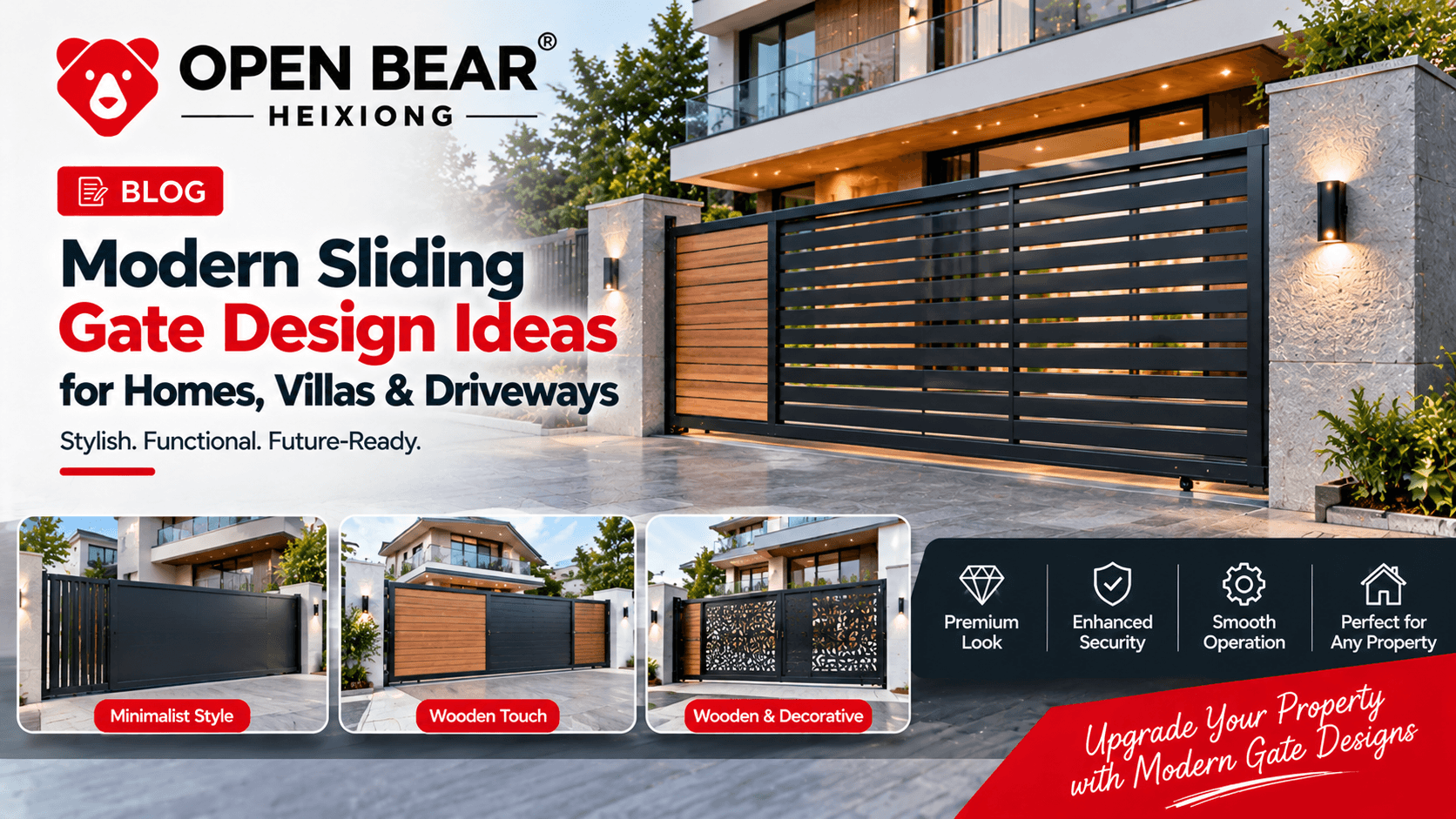
Horizontal slats are the big one right now. Flat aluminum or wood-look boards, set tight or with narrow gaps. They suit houses with large windows and flat or low-pitched roofs. Vertical bars on top of a solid lower panel come next. You get privacy at car-window height and light above it.
Laser-cut steel is the showy choice. A pattern of leaves, a geometric grid, maybe the family name. Put LEDs behind it and the gate glows after dark. It looks great, but dust collects in the cutouts, so expect to wipe it down.
Solid panels suit villas on busy roads. If you go that way, add a small camera or a narrow viewing slot, because driving out blind onto a main road gets old quickly.
A good modern sliding gate design holds back. Two materials, one color family, motor hidden. Add a fourth finish and it starts looking like a catalog page.
Sliding Gate Ideas That Match the House You Already Own
Walk to the street and look at your home. Front door color, window frames, roof angle, the stone on the porch. Your gate should repeat one of those, not all of them.
Some sliding gate ideas I like because they cost almost nothing extra: paint the gate the same charcoal as your window frames. Copy the slope of your roof in the top rail. Use timber-look cladding over a steel frame if the house is older and a pure metal gate feels cold. Pick matte black if you have light render or pale stone, since the contrast does half the design work for you.
Maybe you don’t want a sideways slider at all. Some owners prefer a gate that lifts and rolls away. Our Rolling Gate Ideas page shows how that style compares.
Metal Sliding Gate Design: Steel, Aluminum or Iron?
You’ll live with this choice for twenty years, so it’s worth getting right.
Steel is cheap and tough. Galvanized and powder-coated, it resists rust for a long time, but it’s heavy. A heavy gate means a bigger motor and a track that wears sooner.
Aluminum doesn’t rust at all. If you live near the sea, that settles it for most people. It costs more per square meter, yet the lighter weight often lets you buy a smaller operator, so the gap narrows.
Wrought iron has the best character of the three. It also needs repainting every few years and weighs the most. Pretty, but you’re signing up for a chore.
One more thing on metal sliding gate design: the frame matters more than the infill. A thin frame on a four-meter gate will sag within a couple of seasons. Once it droops, it rubs the track and the whole system fights itself.
What Does a Residential Sliding Gate Need in Terms of Space?
A residential sliding gate needs a clear stretch of fence or wall beside the opening. The usual rule is about the same length as the gate, plus roughly half a meter for the motor and stops.
Before you fall for a design, walk that stretch. Look for a tree trunk, a water meter, a step, a rise in the ground. I’ve seen people order a lovely gate and then discover a drainage box sitting right in its path.
If the run is short, you still have choices. Telescopic gates stack in sections and need much less room. Cantilever gates float on rollers with no track on the ground, which suits gravel, mud and uneven drives.
Going Electric: What an Electric Sliding Gate Really Involves
Almost everybody automates in the end. Easier to plan for it now than to cut into a finished driveway later.
An electric sliding gate can open from a remote, keypad, phone app or intercom, and you stay dry in the car. The part that does the work is the sliding gate motor. Choose it by gate weight, length and how many times a day it runs. A light gate at a quiet house barely taxes a small unit. A wide steel gate at a busy villa needs real muscle.
Check for adjustable force, a gentle start and stop, and a manual release for blackouts. Fit photo-eyes too. They stop the gate if a kid, a dog or a bumper crosses the line.
Money is the next question. Our breakdown of sliding gate opener cost shows what pushes the price up or down: motor size, accessories, and whoever does the install.
Villa Gate Design vs. a Plain Driveway Sliding Gate
Big plots ask for a bolder look. Villa Gate Design usually means a wide opening, stone or rendered pillars, built-in lights and a solid or near-solid panel. Scale is the trap. A small gate between two massive pillars looks like an afterthought.
A driveway sliding gate has a different job. It takes daily traffic, rain, sun and dust, and ideally it stays quiet at 6 a.m. Think about where a delivery van will stop. Mount the keypad or intercom at driver-window height, and set the gate back a car length if you can, so vans don’t block the road while they wait.
LED strips along the base finish it nicely. They make the gate visible at night and add a bit of polish for very little money.
What to Sort Out Before You Order
Grab a pen. Measure the opening, the run-off space and any slope. Pick the material and finish. Decide whether you want manual or automatic from day one. Plan the power: mains, solar or battery. Think about sensors and sightlines at the exit. Check local rules on height, setbacks and permits.
That’s an hour of work, and it saves weeks of regret.
Ready to Plan Your Gate?
Start with the basics: your opening, your style, and how you’ll use the gate day to day. Then talk to people who can match the design to the hardware.
When you want numbers, get a quote and send your gate size, preferred style and budget. You’ll hear back with advice built around your property, not a one-size package.

Frequently Asked Questions
Key engineering and selection answers regarding this topic
The best sliding gate design suits your home’s style, fits the driveway width and balances privacy with light. Horizontal slats and slats over a solid base are safe, popular picks.
They win when space is tight, since they slide along the fence instead of into the drive. Swing gates often cost less and work well on wide, flat entrances.
Leave a clear run beside the opening about equal to the gate width, plus a little extra for the motor. Telescopic and cantilever types need less.
Yes. Add a motor, a control board and safety sensors, then choose remotes, a keypad or an app. You can also upgrade an older manual gate later.
Aluminum suits wet and coastal areas, steel gives strength for less money, and wrought iron gives a classic look. Match the metal to your climate and budget.
Explore Related Automation Systems
Looking for motors, hardware, or installation systems mentioned in this guide? Discover our factory-direct gate opener range:
All Gate Openers
Browse DC24V sliding, swing & barrier operators with full factory warranty.
Explore Products →Residential Gate Operators
Ultra-quiet, solar-ready sliding & swing gate motors for homes and villas.
Residential Solutions →Commercial Gate Systems
Continuous-duty operators for gated communities, business parks & parking.
Commercial Solutions →Industrial Heavy-Duty
High-torque motors engineered for gates up to 4,000 kg and logistics hubs.
Industrial Solutions →