The Question Most Buyers Skip — And Later Regret
A buyer spends weeks comparing specs, places the order, and two months later runs into inconsistent units, doubled lead times, or a warranty claim nobody wants to own. Turns out they were buying from a trading company pulling stock from four different factories, not a source where the gate opener manufacturer vs. distributor question was ever properly answered before the first invoice was signed.
Nobody lied. They just never asked who they were actually buying from before committing to anything.
If that comparison matters to your sourcing decision, and it should — our breakdown of heavy duty commercial gate openers covers exactly what separates factory-built quality from repackaged catalog stock.
What You Actually Get When You Go Factory Direct
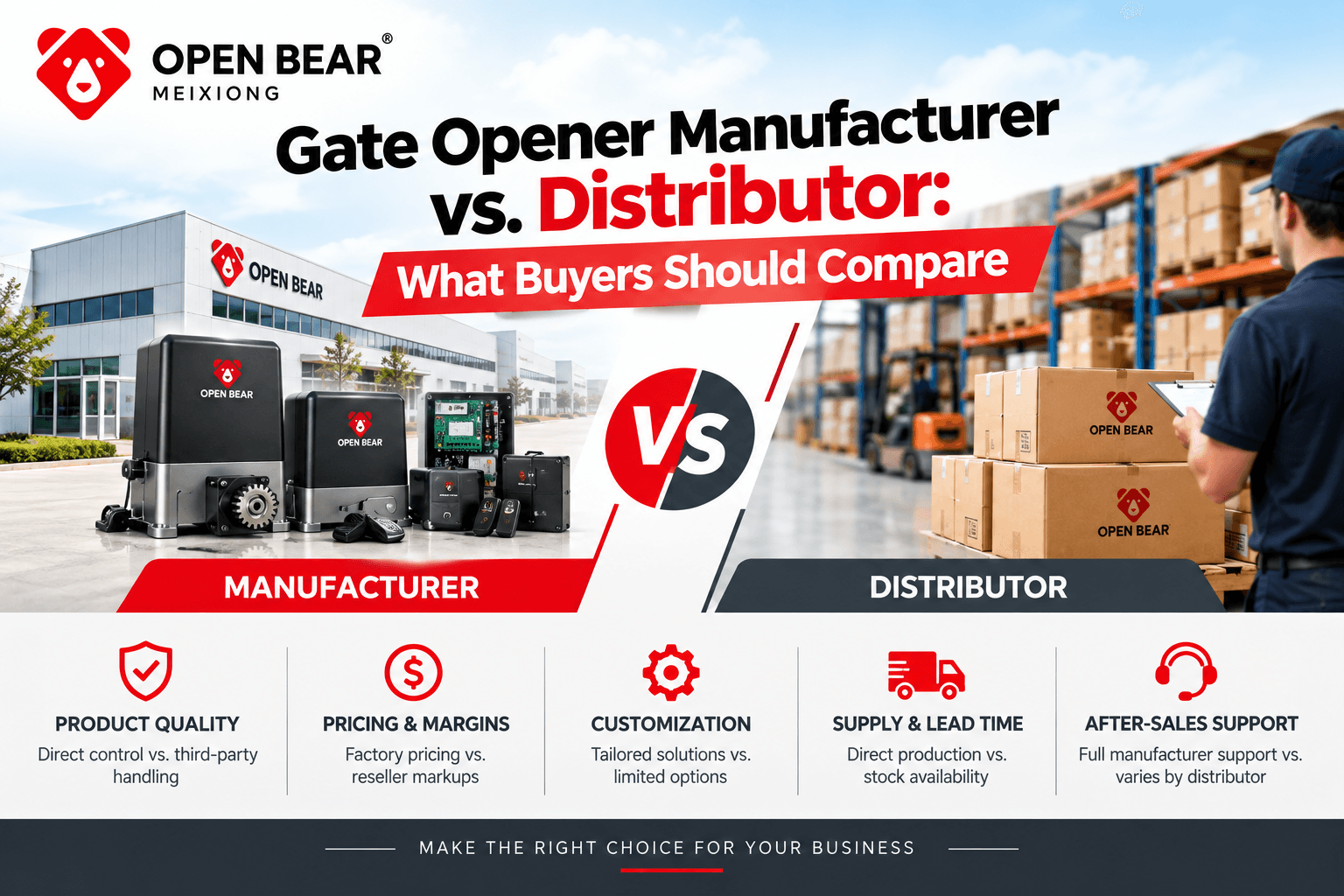
A gate opener manufacturer is not just a cheaper version of a distributor. The difference is structural, not just financial.
When you buy through a distributor, you are buying whatever they decided to stock, at a price that includes their margin, with technical support that goes as deep as their training allows. That works fine for buyers who need small quantities, fast local delivery, or consolidated purchasing across multiple product categories. Distributors solve real problems for the right buyer.
But when your requirements go beyond what a catalog can answer, specific voltage configurations, custom housing specs, firmware modifications, branded packaging, or consistent supply across a multi-year project, the distributor cannot help you. They do not control any of those things. The factory does.
Going direct to a gate opener manufacturer means:
- Pricing reflects production cost and margin, not production cost plus distributor margin plus your margin
- Customization conversations happen with engineers, not sales reps reading from a spec sheet
- Supply planning connects directly to production schedules rather than someone else's inventory decisions
- Warranty and after-sales issues get handled by the people who built the product
For buyers doing real volume or managing complex projects, these are not minor conveniences. They change how the whole relationship works.
How a Gate Opener Supplier Fits Into the Picture
None of this means distributors and gate opener suppliers have no value. They clearly do, for specific situations.
A regional supplier carries local inventory, which means shorter lead times for smaller orders. They handle import logistics, which removes a layer of complexity for buyers who do not import regularly. They often consolidate products from multiple manufacturers, which simplifies purchasing for buyers who need a variety of components from one invoice.
The trade-off is straightforward. You pay more per unit. You have less flexibility on specifications. And when something needs to go back to the factory, a technical question, a warranty claim, a production change, it goes through an extra communication layer that slows everything down.
For a contractor buying 10 units for a residential development, a local supplier probably makes more sense than a direct factory relationship. For a company importing 500 units per quarter for commercial installation or resale, the calculation flips entirely.
Gate Motor Wholesale: What the Numbers Actually Look Like
Gate motor wholesale pricing is where the manufacturer vs. distributor question becomes concrete very quickly.
The markup between factory price and distributor price varies by product category, region, and relationship, but a range of 25 to 45 percent is common in the gate operator market. On a single unit that might mean a difference of $30 or $40. Across a 300-unit order that same percentage gap becomes a meaningful number, sometimes enough to change whether a project is profitable.
Volume thresholds matter here. Most manufacturers set minimum order quantities, sometimes 100 units, sometimes 500, sometimes more depending on whether customization is involved. Buyers who cannot meet those minimums are genuinely better served by a wholesale supplier who absorbed the MOQ on their behalf.
Buyers who can meet the minimums, or who are willing to plan purchasing around them, almost always find the direct relationship worth building.
OEM Gate Openers: When Building Your Own Brand Makes Sense
An OEM gate opener arrangement is a specific type of factory relationship worth understanding separately.
OEM means the manufacturer produces the product to your specifications and you sell it under your brand. Your name on the box, your documentation, your warranty terms to your customers, the factory handles production, you handle everything customer-facing.
This model works well for installation companies with enough volume to justify the commitment, distributors building a private label product line, and regional brands competing against global names on specification and price rather than brand recognition alone.
The requirements are real. OEM arrangements involve volume commitments, sometimes tooling costs for custom components, sample approval rounds before production begins, and longer initial lead times. None of that is unreasonable for the commercial upside, your brand builds equity with every unit sold rather than the manufacturer's, but it is not the right fit for every buyer.
If you are somewhere between "occasional buyer" and "serious volume," an OEM conversation with a gate opener manufacturer is worth having before you assume it is out of reach. Many factories are more flexible on initial minimums than their standard terms suggest, particularly with buyers who can show a credible growth path.
Visiting a Gate Operator Factory Before You Commit
For any serious sourcing relationship, whether that means a large single order or ongoing supply, a gate operator factory visit belongs in the qualification process.
A product catalog tells you what a manufacturer claims about their product. A factory visit shows you whether those claims are backed by the actual production environment. You see the equipment condition, the component storage practices, the quality control process, and the people running it. You get a direct sense of capacity and whether stated lead times are realistic based on what you observe rather than what someone tells you over email.
Buyers who source regularly from overseas manufacturers tend to treat this as standard practice, not a special step. The travel cost is small relative to a large order value, and the risk reduction it provides is significant.
When travel is genuinely not possible, a live video factory tour with direct questions to engineering and production staff is a reasonable first step. It does not replace an in-person visit for a major relationship but it screens out unsuitable suppliers quickly.
Ready to Talk Directly With a Gate Opener Manufacturer?
Most sourcing problems trace back to one thing, the wrong relationship for the buyer's actual situation. A distributor when the volume justified going direct. A trading company presented as a manufacturer. A catalog product when the application needed something custom.
Getting this right starts with a direct conversation.
Tell us your gate type, order volume, target market, and any specific requirements. We will give you a straight answer on pricing, lead times, customization options, and what working with us actually looks like, no sales pitch, no vague commitments.
Looking for a trusted source? Visit our Automatic Gate Opener Manufacturer page to see what factory-direct supply actually looks like.

Frequently Asked Questions
Key engineering and selection answers regarding this topic
Buying direct removes the distributor markup from your unit cost and puts you in contact with the actual technical team. It makes the most sense once your order volume justifies a factory relationship.
A supplier holds local inventory for faster delivery on smaller orders and simplifies import logistics for buyers who do not source internationally on a regular basis. For standard catalog products in low volumes, that convenience is worth the added cost.
Wholesale pricing is structured around volume tiers, the more you order, the lower your per-unit cost. Some manufacturers also offer annual volume agreements that apply tiered pricing across multiple smaller orders placed throughout the year.
Confirm the minimum volume commitment, what customization is included in base pricing, and how long sample approval takes before full production begins. Also clarify who handles warranty support in your market once units are in the field.
Ask for current third-party certifications and verify them directly with the issuing body. Request client references and a factory video tour if an in-person visit is not immediately possible.
Explore Related Automation Systems
Looking for motors, hardware, or installation systems mentioned in this guide? Discover our factory-direct gate opener range:
All Gate Openers
Browse DC24V sliding, swing & barrier operators with full factory warranty.
Explore Products →Residential Gate Operators
Ultra-quiet, solar-ready sliding & swing gate motors for homes and villas.
Residential Solutions →Commercial Gate Systems
Continuous-duty operators for gated communities, business parks & parking.
Commercial Solutions →Industrial Heavy-Duty
High-torque motors engineered for gates up to 4,000 kg and logistics hubs.
Industrial Solutions →