If you have ever wondered whether someone could copy your gate remote and walk (or drive) straight in, you are asking the right question. The short answer: yes, some gate remotes can be copied, but a properly implemented rolling code remote is far harder to attack. This guide explains how gate remotes work, where the real weaknesses are, and what you can do to keep your gate secure.
The short answer
Whether a gate remote can be hacked depends mostly on one thing: does it use fixed code or rolling code?
- Fixed-code remotes send the same signal every time you press the button. If someone captures that signal, they can replay it.
- Rolling-code remotes send a different signal every time. A captured signal is useless on its own, because the gate has already moved on to expecting the next one.
No security system is perfect, but moving from fixed code to rolling code removes the easiest and most common attack.
How a gate remote talks to your gate
A gate remote is a small radio transmitter. When you press the button, it sends a short coded message, usually on a frequency such as 433 MHz, to a receiver on or beside the gate operator's control board. If the code matches one the receiver has stored, the operator opens the gate.
The whole security question comes down to what that coded message looks like, and whether an attacker who hears it can make use of it later.
Fixed code: the weak spot in older remotes
In a fixed-code system, the remote sends the same code on every press. Many older remotes set that code with a row of small DIP switches inside the case. The code never changes, so anyone with the right radio equipment who records it once can transmit it again later.
This is why fixed-code remotes are the main target when people ask whether a gate remote can be cloned. Cheap copy remotes exist precisely for these systems, and the process is simple compared with attacking anything more advanced.
If your gate or remote is more than a decade old and uses DIP switches to set the code, it is worth checking what type you have.
Rolling code: how it fixes the problem
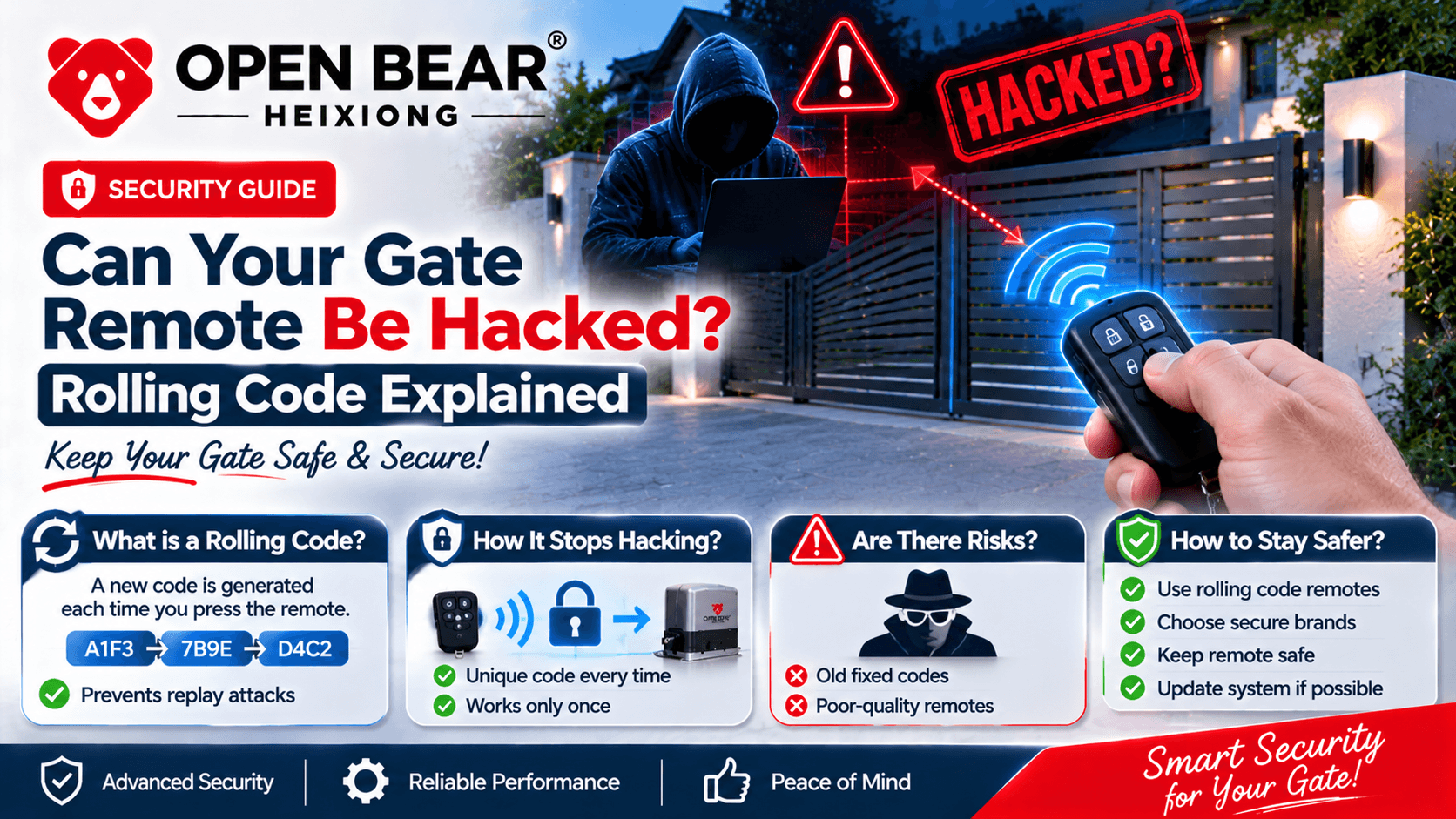
Rolling code, also called hopping code, changes the transmitted value every time you press the button. The remote and the receiver share a secret key and use the same algorithm, so both can calculate what the next valid code should be.
Here is what that means in practice:
- You press the button and the remote sends the next code in the sequence.
- The receiver checks the code, opens the gate, and moves its own counter forward.
- That code is now used up. If someone recorded it and replays it, the receiver rejects it.
The receiver also accepts a small window of upcoming codes, so the gate still works if you press the remote while out of range. Codes that are older than the current position are ignored.
This is why the difference between rolling code and fixed code matters so much. With fixed code, a recording is a working key. With rolling code, a recording is a used key.
Can a rolling code gate remote be cloned?
A basic copy-and-replay attack does not work against a well-designed rolling code system. That is the whole point of the technology.
It is fair to be honest about the limits, though:
- Rolling code is not unbreakable. Security researchers have shown that weaknesses in specific implementations, older algorithms, or poor key handling can be exploited. The strength of the protection depends on the quality of the design, not just the label.
- Attacks are harder and rarer. They need more equipment, more skill, and usually targeted effort. For a typical home or business, the risk is far lower than with fixed code.
- The weak point is often not the radio. A lost remote that was never removed from the system, a shared keypad code that never changes, or a gate that is left open can matter more than any radio attack.
So the realistic answer is: rolling code removes the easy attack, and good habits cover most of what remains.
How to tell which type of remote you have
Check these in order:
- The manual or spec sheet. Look for the words "rolling code" or "hopping code". Some listings mention the chip or protocol name.
- The remote itself. If you open it and see a row of tiny DIP switches that set the code, it is almost certainly fixed code.
- How it pairs. Remotes that are learned by pressing a learn button on the receiver are usually rolling code, but this is a clue, not proof.
- Ask the supplier. If you cannot find it written down, ask the manufacturer or installer directly. A reputable supplier will answer plainly.
If you are specifying remotes for a new installation, make rolling code a stated requirement and confirm the receiver supports it. Our guide to Control Access Guide and the wider access control setup covers how remotes, keypads and readers fit together.
Practical steps to keep your gate remote secure
Technology helps, but habits matter just as much.
- Replace fixed-code remotes and receivers. If your system is old, upgrading the receiver and remotes is usually a small cost compared with the security gain.
- Delete lost remotes from the system. A lost remote is a working key until you remove it from the receiver. Most control boards let you clear stored remotes and re-pair only the ones you still have.
- Change keypad codes regularly. Where your system allows it, give different people different codes and remove them when they no longer need access.
- Do not leave remotes in parked vehicles. A remote left in a car is easy for a thief to take.
- Keep spare remotes accounted for. Know how many are in circulation and who has them.
- Watch for odd behaviour. If the gate opens or closes on its own, it is worth investigating. Interference, faults and wiring problems are more common causes than hacking, and our guide on a gate remote not working from a distance covers the usual range and signal problems.
- Add a second layer where it matters. For higher-security sites, combine remotes with a keypad, RFID credentials or app control so one stolen device is not enough.
What to ask when buying remotes and receivers
When you are choosing gate remotes and access accessories, ask these questions:
- Is the remote rolling code or fixed code?
- Can individual remotes be deleted from the receiver without resetting everything?
- What frequency does it use, and does the receiver match it?
- How many remotes can the receiver store?
- Is there documentation explaining pairing and clearing remotes?
You can browse compatible gate remotes and accessories, or contact our team with your operator model and we will confirm what the remotes for that model support before you order.
Final thoughts
So, can your gate remote be hacked? A fixed-code remote can be copied with little effort. A rolling code remote is a strong defence against that, and combined with good habits, it keeps your gate secure for everyday use. If your system is old or you are not sure what you have, check it now: it is one of the cheapest security upgrades you can make.

Frequently Asked Questions
Key engineering and selection answers regarding this topic
Yes, some can. Fixed-code remotes are the most exposed because their signal can be recorded and replayed. Rolling code remotes are much harder to attack because every press sends a new code. Risk also depends on habits such as removing lost remotes and changing keypad codes.
Rolling code, or hopping code, is a security method where the remote sends a different code on every button press. The remote and receiver share a secret key and calculate the same sequence, so a code that has already been used is rejected if it is replayed.
A fixed-code remote sends the same signal every time, so a recorded signal can be reused. A rolling-code remote sends a new signal each time, so a recorded signal is already out of date. Rolling code is the more secure option for any gate.
A simple copy-and-replay attack does not work on a well-designed rolling code system. Advanced attacks on weak implementations are possible but need more skill and equipment. Choosing a quality system and removing lost remotes covers most of the practical risk.
Check the manual or spec sheet for the words rolling code or hopping code. Remotes that set their code with DIP switches are usually fixed code. If you are unsure, ask the manufacturer or installer to confirm the remote type and receiver.
Explore Related Automation Systems
Looking for motors, hardware, or installation systems mentioned in this guide? Discover our factory-direct gate opener range:
All Gate Openers
Browse DC24V sliding, swing & barrier operators with full factory warranty.
Explore Products →Residential Gate Operators
Ultra-quiet, solar-ready sliding & swing gate motors for homes and villas.
Residential Solutions →Commercial Gate Systems
Continuous-duty operators for gated communities, business parks & parking.
Commercial Solutions →Industrial Heavy-Duty
High-torque motors engineered for gates up to 4,000 kg and logistics hubs.
Industrial Solutions →