
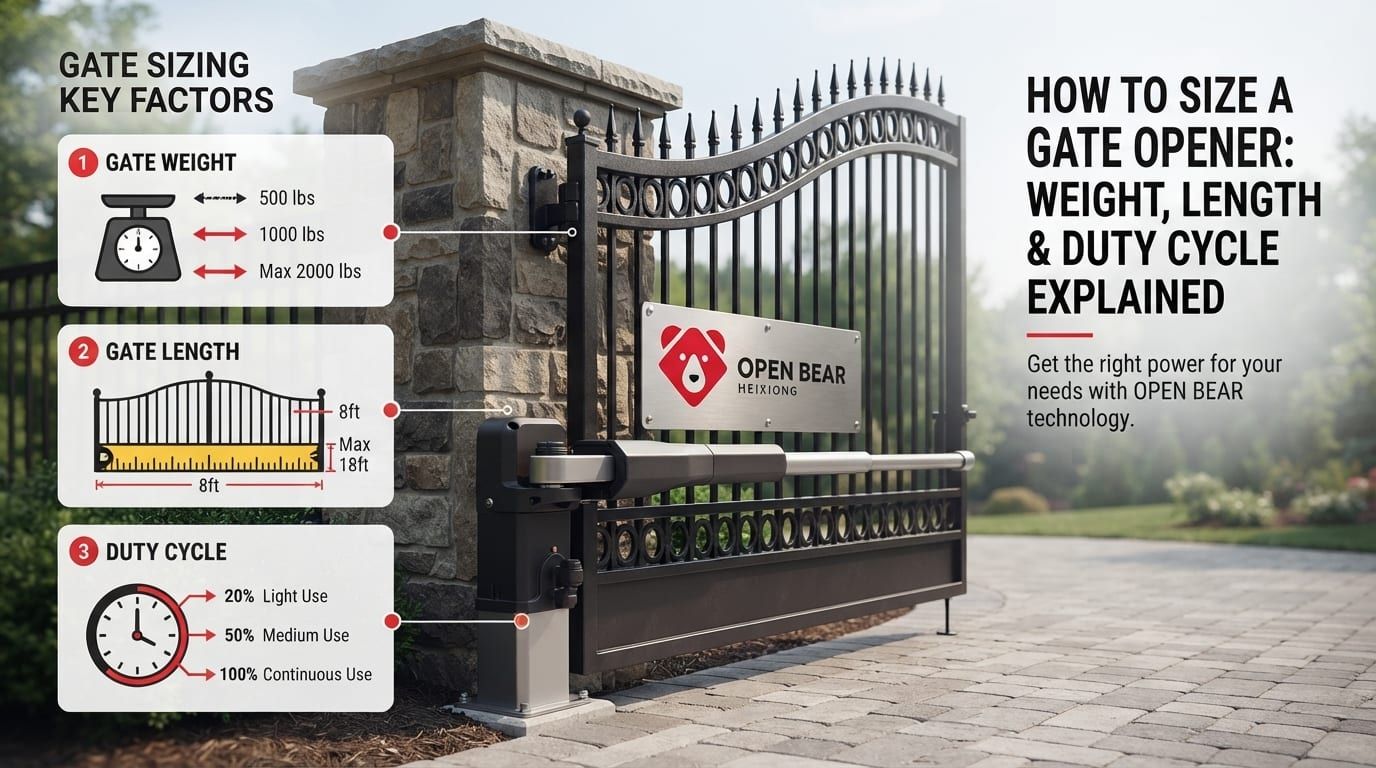
Most gate motor failures aren't manufacturing faults, they're sizing mistakes. An opener rated close to your gate's weight will move it fine on day one, then overheat, stall, or burn out within a season because the real load was always higher than the number on the box. Knowing how to size a gate opener means reading three specs together (weight, length, and duty cycle) and leaving reserve for the forces you can't see, like wind and hinge friction. This guide gives you the math, a worked example in kilograms, and a quick capacity chart so you can specify with confidence.
Start With Three Numbers, Not One
Every gate opener carries a headline "maximum weight" rating, and it's the most misread spec in the industry. That figure is a ceiling under ideal conditions: a perfectly balanced gate, clean hinges, no wind, light use. Real installations are never ideal.
To size correctly, you need three inputs about your gate:
- Weight of one moving leaf (for swing) or the complete moving panel (for sliding)
- Daily cycles, how many times it opens and closes in 24 hours
- Daily cycles — how many times it opens and closes in 24 hours
Miss any one and you'll undersize. A motor that clears the weight rating can still fail if the leaf is too long or the gate cycles too often. Read all three against the manufacturer's capacity chart together.
Understanding Gate Opener Weight Capacity
Weight is the foundation, so start by getting it right rather than guessing.
How to Estimate Gate Weight
If you don't have the fabricator's figure, estimate from material and size. As a rough guide, a 4 m × 1.8 m gate runs approximately:
- Aluminium: 40–70 kg
- Steel (open/tubular): 80–150 kg
- Solid steel or timber infill: 150–300 kg+
Solid and taller gates weigh far more than open designs of the same footprint. When in doubt, weigh the leaf or ask your fabricator; never assume the lighter end.
The Rule of Reserve: Size 1.5–2× Gate Weight
Here's the single most useful rule for how to size a gate opener: choose a motor rated for at least 1.5 to 2 times your gate's actual weight.
For a 300 kg gate, specify a motor rated for 450–600 kg. That headroom isn't waste — it absorbs wind gusts, hinge friction as bearings age, minor misalignment, and cold-weather stiffness. A motor running permanently near its ceiling has no reserve for any of these, so it draws more current, runs hotter, and wears out early. This is why undersizing shows up as motor overheating months after a trouble-free start.
Gate Length vs Weight: Why Leverage Matters
Weight tells only part of the story. Length multiplies the load the motor actually feels through simple leverage.
On a swing gate, the motor pushes near the hinge, but the weight is distributed along the whole leaf. The further that weight sits from the hinge, the more leverage works against the motor, the same principle as a longer spanner loosening a tight bolt. A 4 m leaf at 200 kg places far more strain on the operator than a 2 m leaf at the same 200 kg.
This is why every proper gate length vs weight chart shows a trade-off: an opener rated for, say, 400 kg at 3 m may only be rated for 250 kg at 5 m. You must check where both your numbers land, not just the weight column.
For sliding gates, leverage isn't the issue; roller and track condition are. A binding roller or debris-filled track raises resistance sharply, so keep the same reserve rule and make sure the gate rolls freely by hand before you trust any weight figure. If you're still deciding between the two gate types, see our guide on sliding vs swing gates.
Duty Cycle: The Spec That Decides Longevity
Weight and length decide whether the motor can move your gate. Duty cycle decides how long it survives doing so. Duty cycle is how many open-close operations an opener can perform in a given period before it needs to rest and cool.
Light, Medium and Continuous Duty
- Light duty: ~10–20 cycles per day. Single-family homes with one or two vehicles.
- Medium duty: ~50–100 cycles per day. Busy households, small shared driveways, light commercial sites.
- Continuous duty: hundreds to thousands of cycles per day. Apartment complexes, business entrances, and any gate that rarely "rests."
Count one full open-and-close as one cycle. A family of four leaving and returning can easily hit 40–60 cycles a day once you add deliveries and visitors, comfortably into medium-duty territory.
Putting a light-duty opener on a high-traffic gate is a guaranteed early failure: the motor never fully cools, heat cycling stresses the electronics, and the gears wear fast. Match the duty rating to your real traffic, and if you're between classes, size up. For 24/7 sites, our heavy-duty gate automation guide for warehouses and logistics yards covers continuous-duty selection in depth.
Don't Forget Wind Reserve
Wind is the hidden load that turns a "correctly sized" opener into an undersized one. A solid gate acts like a sail, pressure across its whole face pushes back against the motor every time it moves in a breeze. Two gates of identical weight can present completely different loads if one is open-framed and the other is solid-infill.
If your gate is solid, tall, or on an exposed site, treat the upper end of the 2× reserve as your minimum, not your maximum. We cover the engineering in detail in our gate opener wind load guide, but for sizing purposes the rule is simple: solid gate plus exposed location equals more reserve.
Worked Example: Sizing for a 300 kg, 4 m Swing Gate
Let's size a real gate step by step.
The gate: one solid steel swing leaf, 300 kg, 4 m long, on a suburban driveway used by two cars, roughly 40 cycles per day, moderately exposed to wind.
- Weight + reserve: 300 kg × 2 (solid gate, so upper reserve) = 600 kg minimum motor rating.
- Length check: at 4 m, confirm the chosen motor still rates for 600 kg at that leaf length, not just at a shorter 3 m figure.
- Duty cycle: 40 cycles/day = medium duty. Specify a medium-duty (or higher) operator, not light duty.
- Wind: solid leaf on an open site, the 2× reserve already covers this; no undersizing.
Result: a medium-duty swing operator rated ~600 kg at 4 m. Note how the naive approach ("it's 300 kg, buy a 300 kg motor") would have failed on all three counts.
Quick Capacity Reference Chart
Use this as a starting reference, then confirm against the exact model's capacity chart:
Gate weight (actual) | Minimum motor rating (2× reserve) | Typical use |
Up to 150 kg | 300 kg | Light residential |
150–300 kg | 400–600 kg | Standard residential / villa |
300–600 kg | 700–1,200 kg | Heavy residential / light commercial |
600–1,200 kg | 1,500 kg+ | Commercial / industrial |
Always cross-check leaf length and daily cycles before you commit, the weight column alone is never the full answer. You can match these figures against our full range on the products page, and if you want a spec checked, our engineers offer a free sizing review.
Frequently Asked Questions
What size gate opener do I need for a heavy gate?
Choose a motor rated for 1.5 to 2 times your gate's actual weight. For a 500 kg gate, specify an opener rated for at least 750–1,000 kg. The reserve absorbs wind, hinge friction, and wear, so the motor isn't running at its limit every cycle.
Why does gate length matter if the weight is within the rating?
Because length creates leverage. A longer leaf places more strain on the operator even at the same weight, so a motor rated for 400 kg at 3 m may only handle 250 kg at 5 m. Always check weight and length together on the capacity chart.
What is duty cycle on a gate opener?
Duty cycle is how many open-close operations an opener can perform before it needs to cool. Light duty suits ~10–20 cycles a day, medium duty ~50–100, and continuous duty handles hundreds or thousands for high-traffic commercial gates.
How many cycles per day does a typical home use?
A single-family home usually runs 20–60 cycles a day once you include commuting, deliveries, and visitors. Many households that assume "light use" are actually in the medium-duty range, so it's safer to size up if you're close to the boundary.
Does a solid gate need a bigger motor than an open one?
Yes. A solid gate catches wind like a sail, adding load the weight figure alone doesn't show. For solid, tall, or exposed gates, use the upper end of the 2× reserve rule as your minimum.
Can I use the maximum weight rating on the box as my guide?
No. That figure assumes ideal conditions: balanced gate, clean hinges, no wind, light use. Real gates never match that, which is why sizing to 1.5–2× actual weight and matching the duty cycle is essential.

Frequently Asked Questions
Key engineering and selection answers regarding this topic
Choose a motor rated for 1.5 to 2 times your gate's actual weight. For a 500 kg gate, specify an opener rated for at least 750–1,000 kg. The reserve absorbs wind, hinge friction, and wear, so the motor isn't running at its limit every cycle.
Because length creates leverage. A longer leaf places more strain on the operator even at the same weight, so a motor rated for 400 kg at 3 m may only handle 250 kg at 5 m. Always check weight and length together on the capacity chart.
Duty cycle is how many open-close operations an opener can perform before it needs to cool. Light duty suits ~10–20 cycles a day, medium duty ~50–100, and continuous duty handles hundreds or thousands for high-traffic commercial gates.
A single-family home usually runs 20–60 cycles a day once you include commuting, deliveries, and visitors. Many households that assume "light use" are actually in the medium-duty range, so it's safer to size up if you're close to the boundary.
Yes. A solid gate catches wind like a sail, adding load the weight figure alone doesn't show. For solid, tall, or exposed gates, use the upper end of the 2× reserve rule as your minimum.
No. That figure assumes ideal conditions: balanced gate, clean hinges, no wind, light use. Real gates never match that, which is why sizing to 1.5–2× actual weight and matching the duty cycle is essential.
Explore Related Automation Systems
Looking for motors, hardware, or installation systems mentioned in this guide? Discover our factory-direct gate opener range:
All Gate Openers
Browse DC24V sliding, swing & barrier operators with full factory warranty.
Explore Products →Residential Gate Operators
Ultra-quiet, solar-ready sliding & swing gate motors for homes and villas.
Residential Solutions →Commercial Gate Systems
Continuous-duty operators for gated communities, business parks & parking.
Commercial Solutions →Industrial Heavy-Duty
High-torque motors engineered for gates up to 4,000 kg and logistics hubs.
Industrial Solutions →