
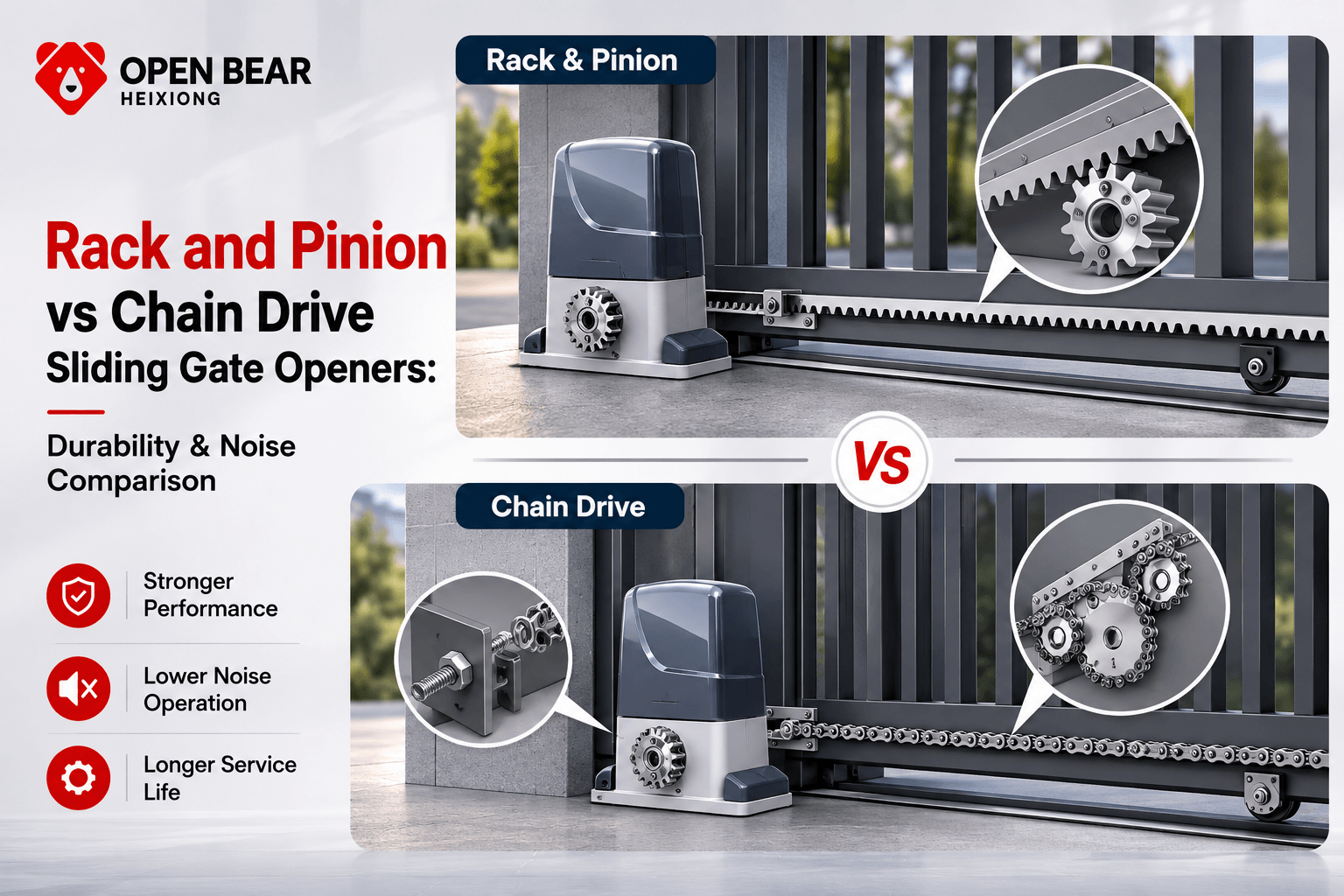
Two sliding gates can look identical from the driveway and behave nothing alike, and the reason is hidden underneath. One runs on rack-and-pinion. The other runs on a chain drive. That single choice quietly decides how loud the gate is, how much it costs to keep running, how it copes with a really long span, and how it holds up against grit and weather. Pick the wrong drive for the site and you either overpay or spend the next few years listening to a gate clatter every time someone comes home.
So here is the head-to-head, on the things that actually matter: durability, noise, cost, span, and maintenance.
Key Takeaways
- Rack-and-pinion uses a gear meshing with a toothed rack on the gate; chain drive pulls the gate along a fixed chain
- Rack-and-pinion is generally quieter, more precise, and lower maintenance for typical residential and commercial gates
- Chain drive handles very long spans and heavy industrial gates cheaply, but it tends to be noisier and needs the chain tensioned
- Rack-and-pinion is the mainstream pick; chain drive is a specialist tool for long or heavy installs
- Site length, gate weight, how much noise you can live with, and maintenance access should decide it, not price alone
Rack-and-pinion and chain drive are the two main ways to power a sliding gate. Rack-and-pinion puts a pinion gear on the operator that meshes with a toothed rack fixed to the gate, moving it precisely and quietly with fairly little maintenance. Chain drive uses a motor to pull the gate along a fixed chain that runs the length of the opening, which handles very long spans and heavy gates economically but runs louder and wants periodic chain tensioning and lubrication. For most residential and commercial gates, rack-and-pinion is the better all-rounder. Chain drive earns its spot on long or exceptionally heavy industrial gates.
How Each Drive System Works
Rack-and-pinion fixes a toothed metal rack horizontally along the bottom rail of the gate. The operator sits beside the gate with a pinion gear that drops into the rack, and when the motor turns the pinion, the teeth walk the gate along. The gate is carrying its own drive surface, so the whole thing is compact and self-contained.
Chain drive works differently. A chain stretches the full length of the gate's travel, anchored at both ends. The operator engages that chain, and as the motor turns it effectively pulls itself, and the gate, along the fixed chain, or pulls the chain to move the gate, depending on how it is set up. Because the chain spans the entire opening, this system scales to very long gates without the rack length ever becoming a limit.
Aspect | Rack-and-Pinion | Chain Drive |
Drive surface | Toothed rack on the gate | Chain spanning the opening |
Motion | Pinion gear walks along rack | Motor pulls along fixed chain |
Precision | High, positive gear mesh | Good, some chain slack |
Best span | Standard to wide | Very long spans |
Noise | Lower | Higher |
Maintenance | Rack alignment, occasional | Chain tension and lube, more often |
Durability and Reliability
Both are durable when they are installed and maintained properly. They just wear in different places.
Rack-and-pinion wear happens at the gear mesh. Line the rack up to the correct clearance against the pinion and wear is slow and predictable, and the positive bite of gear teeth gives you strong, steady performance for years. Get the alignment wrong, either too tight or too loose, and wear accelerates, which is why install quality matters so much here. The rack sits exposed but it is tough, and you can replace individual sections if one gets damaged.
Chain drive lives and dies by the chain and its tension. A chain stretches over time and needs re-tensioning to stay honest, because a slack chain skips, snatches, and chews up sprockets. Chains also collect grit and want lubrication, or they wear fast and rust. On a very long or heavy gate, chain drive is proven and genuinely hard-wearing, but it asks for more ongoing attention to stay that way. Where a rack-and-pinion gate can coast for long stretches on light maintenance, a chain gate rewards regular tensioning and a bit of oil.
Noise Comparison
For a lot of residential and mixed-use sites, noise is the deciding factor, and rack-and-pinion usually wins it.
Rack-and-pinion runs relatively quiet because the gear mesh is smooth and continuous, especially with a good nylon or hardened rack and correct alignment. It suits homes, apartments, hotels, anywhere a gate clattering at six in the morning turns into a complaint.
Chain drive is louder. The chain engaging the sprockets makes a mechanical clatter that carries, particularly on long runs and heavy gates, and a slack or dry chain is louder still. Out in an industrial yard where the ambient noise is already high and nobody lives nearby, that is a non-issue. Right next to somebody's bedroom window, it is a real drawback. If low noise is the priority, rack-and-pinion is the answer. If the gate sits in a noisy yard, the chain's noise stops mattering and its span advantage may take over.
Span and Gate Weight
This is where chain drive earns its niche.
Rack-and-pinion works beautifully across standard and wide gates, but the rack has to run the whole length of the gate, and a very long gate means very long, heavy rack sections. There is a practical range where it is the cleanest solution, and that range covers the huge majority of residential and commercial gates.
Chain drive shines on the long openings. A chain spans a long distance more cheaply than a full-length rack, and it can be set up for heavy industrial gates over long travel. For a wide industrial or logistics gate that has to slide a long way, chain drive can be both the cheaper and the more practical choice.
Scenario | Better Drive | Reasoning |
Residential driveway gate | Rack-and-pinion | Quiet, precise, low maintenance |
Commercial entrance, standard width | Rack-and-pinion | Reliable, mainstream, quiet |
Very long industrial span | Chain drive | Economical over long travel |
Heavy gate, noisy yard | Chain drive | Handles the weight, noise does not matter |
Hotel / apartment gate | Rack-and-pinion | Low noise near residents |
Cost and Maintenance Over Time
Upfront cost swings with the manufacturer and gate size, but the comparison that actually means something is total cost with maintenance folded in.
Rack-and-pinion: the rack adds material cost, but once it is aligned the system is low maintenance. Periodic gear-mesh checks, a clean, some lube on the moving parts, and it just runs. For standard gates it usually comes out the better value over its life.
Chain drive: it can be cheaper to cover a long span, since a chain costs less than an equivalent length of quality rack. But the ongoing maintenance runs higher, because chain tensioning, lubrication, and eventual chain replacement all pile up cost and labor over the years. On a long industrial gate where a crew is already doing rounds, that is fine. On a residential gate, it is an annoyance.
Honest summary: rack-and-pinion tends to cost a little more upfront and less to maintain, while chain drive can cost less to span long distances but more to keep alive. Match that trade to the site's length and to how much attention the gate is realistically going to get.
Which Should You Choose?
Three questions get you there.
First, how long is the gate's travel? Standard to wide favors rack-and-pinion. Very long spans favour chain drive. Second, how much does noise matter? Near residents or guests, choose rack-and-pinion. In a noisy yard, either works. Third, how much maintenance will the gate actually get? Low-attention sites suit rack-and-pinion's lighter needs. Sites with regular maintenance routines can handle a chain just fine.
For the overwhelming majority of residential and commercial gates, rack-and-pinion is the right default: quieter, more precise, less demanding. Chain drive is the specialist's tool for long, heavy industrial gates where its span and cost advantages outweigh the noise and the upkeep.
FAQs
Is rack-and-pinion or chain drive better for a sliding gate?
For most residential and commercial gates, rack-and-pinion is better. It runs quieter, positions the gate more precisely, and asks for less maintenance. Chain drive is better on very long industrial spans and heavy gates, where a chain covers the distance more cheaply than a full-length rack and the extra noise does not matter in an industrial setting. Neither one wins everywhere. The right choice depends on the length of travel, how much noise the site can tolerate, and how much routine maintenance the gate is realistically going to get.
Which sliding gate drive is quieter?
Rack-and-pinion, generally. Its gear mesh moves the gate smoothly and continuously, especially with a quality rack and correct alignment, which makes it a good fit for homes, hotels, and apartments where noise complaints are a real concern. Chain drive is noisier, because the chain engaging the sprockets makes a mechanical clatter that carries, and it gets worse on long or heavy gates and worse still if the chain is slack or dry. If low noise matters to you, rack-and-pinion is the safer bet.
Does chain drive need more maintenance?
Usually, yes. Chain drive wants periodic chain tensioning, because chains stretch and a slack one skips and wears sprockets, plus regular lubrication to keep grit wear and rust at bay, and eventually a chain replacement. Rack-and-pinion, once it is aligned, needs attention less often, mainly checking the gear mesh and lubing the moving parts. On a long industrial gate with maintenance already scheduled, the chain's extra needs are no big deal. On a low-attention residential gate, the lighter upkeep of rack-and-pinion is a genuine advantage.
When is chain drive the better choice?
Chain drive is the better choice on very long spans and heavy industrial gates. A chain covers a long distance more cheaply than an equivalent length of quality rack, and it handles serious gate weight over long travel. On a wide logistics or industrial site where the gate slides a long way, the ambient noise is already high, and crews visit regularly, the chain's span and cost advantages outweigh its noise and upkeep. For standard gates, rack-and-pinion stays the mainstream pick.
Can I convert a gate from chain drive to rack-and-pinion?
In principle, yes, but it is really a new drive install rather than a simple swap. You would fit a toothed rack along the gate's bottom rail, mount a compatible rack-and-pinion operator, align the gear mesh to the correct clearance, then set up the limits and safety devices for the new system. Whether it is worth doing depends on why you are switching, usually noise or maintenance, and on the gate's length and weight being suited to rack-and-pinion in the first place. For a very long or heavy gate, converting may not be practical.
Conclusion
The rack-and-pinion versus chain drive decision really comes down to matching the drive to the gate and the site, not chasing the lowest price tag. Rack-and-pinion is the sensible default for the great majority of gates, quiet, precise, and undemanding, which is exactly why it dominates residential and commercial work. Chain drive is the specialist choice that earns its keep on long, heavy industrial gates, where it spans distance cheaply and its noise disappears into the surroundings. Ask how far the gate travels, how much noise the site can take, and how much maintenance it will actually see, and the right drive picks itself.
About the Author
Aurthur is a gate automation specialist and technical content writer with hands-on experience across residential, commercial, and industrial sliding gate systems. He covers drive system selection, rack-and-pinion and chain drive comparison, installation quality, and maintenance for gate industry professionals across the US market. His work helps installers and buyers choose the drive that fits the site.

Frequently Asked Questions
Key engineering and selection answers regarding this topic
Three questions get you there.
Explore Related Automation Systems
Looking for motors, hardware, or installation systems mentioned in this guide? Discover our factory-direct gate opener range:
All Gate Openers
Browse DC24V sliding, swing & barrier operators with full factory warranty.
Explore Products →Residential Gate Operators
Ultra-quiet, solar-ready sliding & swing gate motors for homes and villas.
Residential Solutions →Commercial Gate Systems
Continuous-duty operators for gated communities, business parks & parking.
Commercial Solutions →Industrial Heavy-Duty
High-torque motors engineered for gates up to 4,000 kg and logistics hubs.
Industrial Solutions →