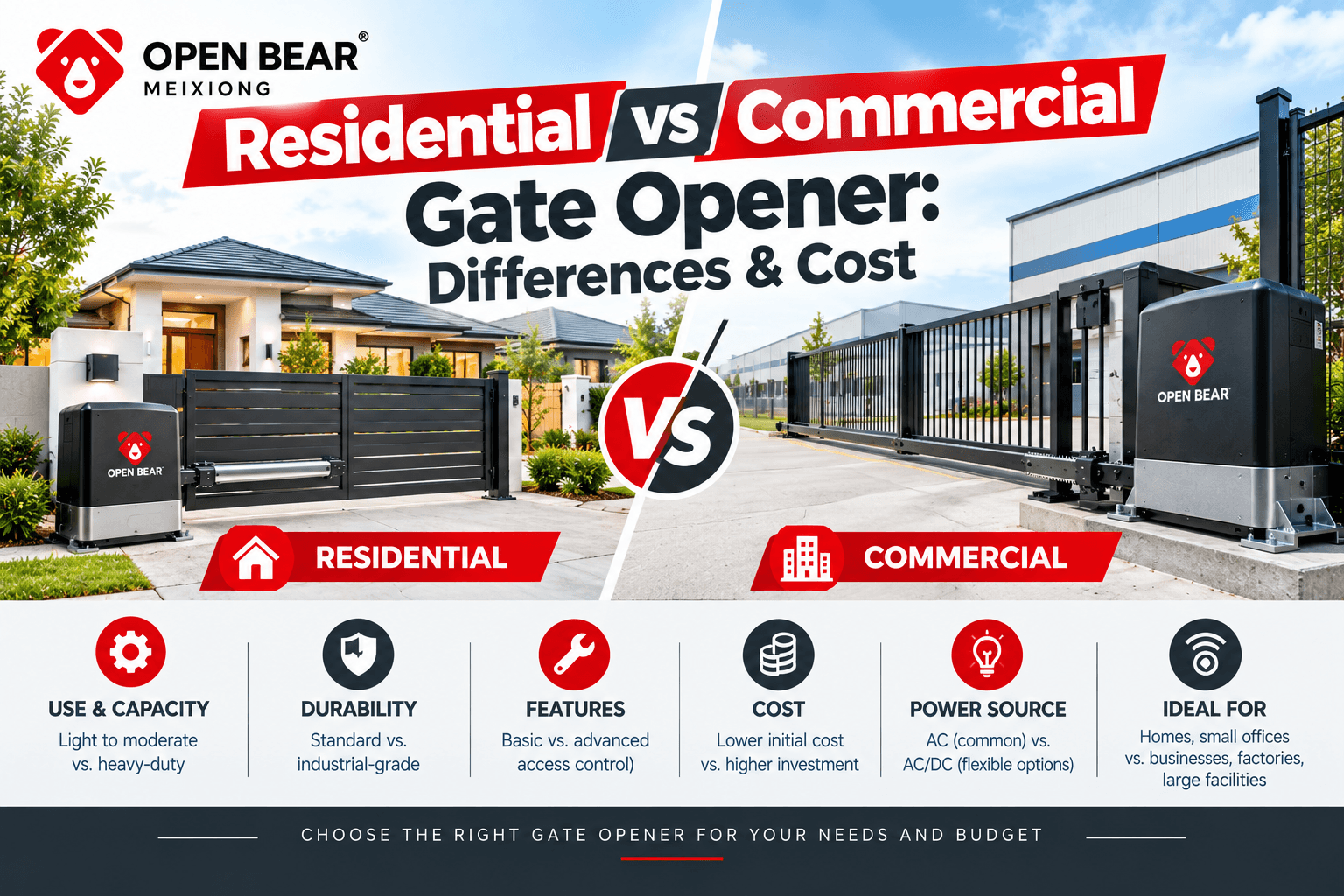
A residential gate opener is built for a home driveway that opens a limited number of times a day. A commercial gate opener is built for heavier gates and near-constant use, with a 24/7 duty rating. The right choice depends on gate weight and daily traffic.
Pick the wrong opener and you pay twice. A home motor on a busy site overheats and fails early, while a heavy commercial unit on a quiet driveway costs more than you need. This residential vs commercial gate opener guide comes from Open Bear, the brand of Gate Opener Factory. We build every gate operator in our ISO 9001 certified factory and test each unit under full load.
How Does a Residential vs Commercial Gate Opener Differ in Daily Use?
The biggest difference is how hard the opener works. A residential gate motor handles a household's daily trips. A commercial gate operator runs on busy sites, all day and night. That changes the duty rating, the motor build and the control features each one needs.
Duty Cycle: How Often the Gate Moves
Duty cycle means how many times an opener can run before it needs a rest. A typical residential gate motor is built for around 15 to 20 cycles a day. That is enough for family cars, visitors and deliveries.
Our commercial models are rated for 24/7 continuous operation. They suit parking lots, offices, hospitals and logistics entries, where the gate may move hundreds of times a day.
Motor Build and Heat Control
Constant use creates heat, and heat is what wears out a motor. Our commercial swing operator uses F-class winding insulation rated to 155°C, so it can keep working without a thermal shutdown.
Both ranges share the same base: a 24V DC permanent magnet synchronous motor that runs at ≤60 dB and works from -35°C to 70°C.
Residential Gate Motor Features for Homes
In a residential vs commercial gate opener comparison, home models focus on convenience. Our side-mounted swing gate opener has Bluetooth and WiFi built in, so you can open the gate from your phone with no extra hardware. Remotes use encrypted signals, and anti-crush speed control slows the gate near closure. For heavier home gates, our top-mounted horizontal swing door opener handles up to 600 kg per leaf.
Control and Safety Features
Every Open Bear opener, home or commercial, includes:
- Obstacle detection that stops and reverses the gate
- A manual release for power outages
- Remote control, with photocell sensors and smart WiFi control as accessories
Commercial sites also get a 10-parameter controller. You can set auto-close time, slow-down position and obstacle sensitivity from the panel. For homes, our automatic driveway gate opener kits include battery backup and remotes in the box.
Every order ships with English manuals, wiring diagrams and parameter tables, so your installer has what they need on day one.
How Do Commercial Gate Openers Handle Heavy Gates?
Commercial gate openers handle heavy gates with higher torque, stronger gearing and motors rated for long run times. Our heavy-duty swing gate operator delivers 650 Nm and moves leaves up to 1,200 kg and 6 m long. Our 400W sliding gate operator moves gates up to 1,800 kg.
Torque and Gate Weight
Torque is the turning force that starts and stops the gate. A heavier or longer leaf needs more torque, especially in wind. If the motor is too small, it strains on every cycle and wears out fast.
That is why a heavy-duty gate opener matters for wide entrances. A home gate rarely needs that much force, but a commercial perimeter gate often does. Gate weight is the clearest line in the residential vs commercial gate opener split.
Commercial Gate Operator Specs at a Glance
Model | Max gate weight | Key spec |
Side-mounted swing gate opener | 200 kg, 1.5 m leaf | 69.7°/s, CE certified |
Heavy-duty swing gate operator | 1,200 kg per leaf, 6 m leaf | 650 Nm torque |
400W sliding gate operator | 1,800 kg | 150 Nm, continuous duty |
Barrier gate | 6 m max arm | 10,000,000 life cycles |
Barrier Gates for Parking and Tolls
For car parks and toll lanes, a barrier gate is often a better fit than a swing or sliding gate. Our barrier gate uses a brushless DC motor and opens in 0.7 to 2.5 seconds per trip. Explore the full range on our commercial gate opener page.
Residential vs Commercial Gate Opener: How Do Costs Compare?
A residential opener costs less up front because it uses a smaller motor and lighter parts. A commercial opener costs more, but it lasts longer under heavy traffic. When you compare residential gate opener vs commercial gate opener cost, look at the price per cycle, not just the price tag.
What Drives the Cost
The cost of any automatic gate motor depends on:
- Gate weight and leaf length, which set the motor size
- Daily cycles, which set the duty rating you need
- Gate type: swing, sliding or barrier
- Accessories such as photocells, WiFi control and access logging
- Installation work, including wiring and foundations
Why Cheap Can Cost More
A home unit on a busy site will fail early, and you pay for repairs, downtime and a second motor. The residential gate opener vs commercial gate opener cost gap often shrinks once you count repairs and downtime. In most residential vs commercial gate opener decisions, matching the duty rating to your traffic is what saves money over time.
Residential vs Commercial Gate Opener Comparison Table
Factor | Residential Gate Opener | Commercial Gate Opener |
Typical site | Homes, villas, driveways | Offices, car parks, hospitals, communities |
Daily use | Around 15–20 cycles | 24/7 continuous duty |
Gate weight | 200 kg side-mounted, 600 kg per leaf top-mounted | Up to 1,200 kg swing, 1,800 kg sliding |
Controller | Simple setup, remotes included | 10 programmable parameters |
Power backup | Battery backup included | Manual release on every model |
Motor | 24V DC, ≤60 dB | 24V DC, ≤60 dB |
Operating temperature | -35°C to 70°C | -35°C to 70°C |
Upfront cost | Lower | Higher |
When Do You Need an Industrial Gate Operator?
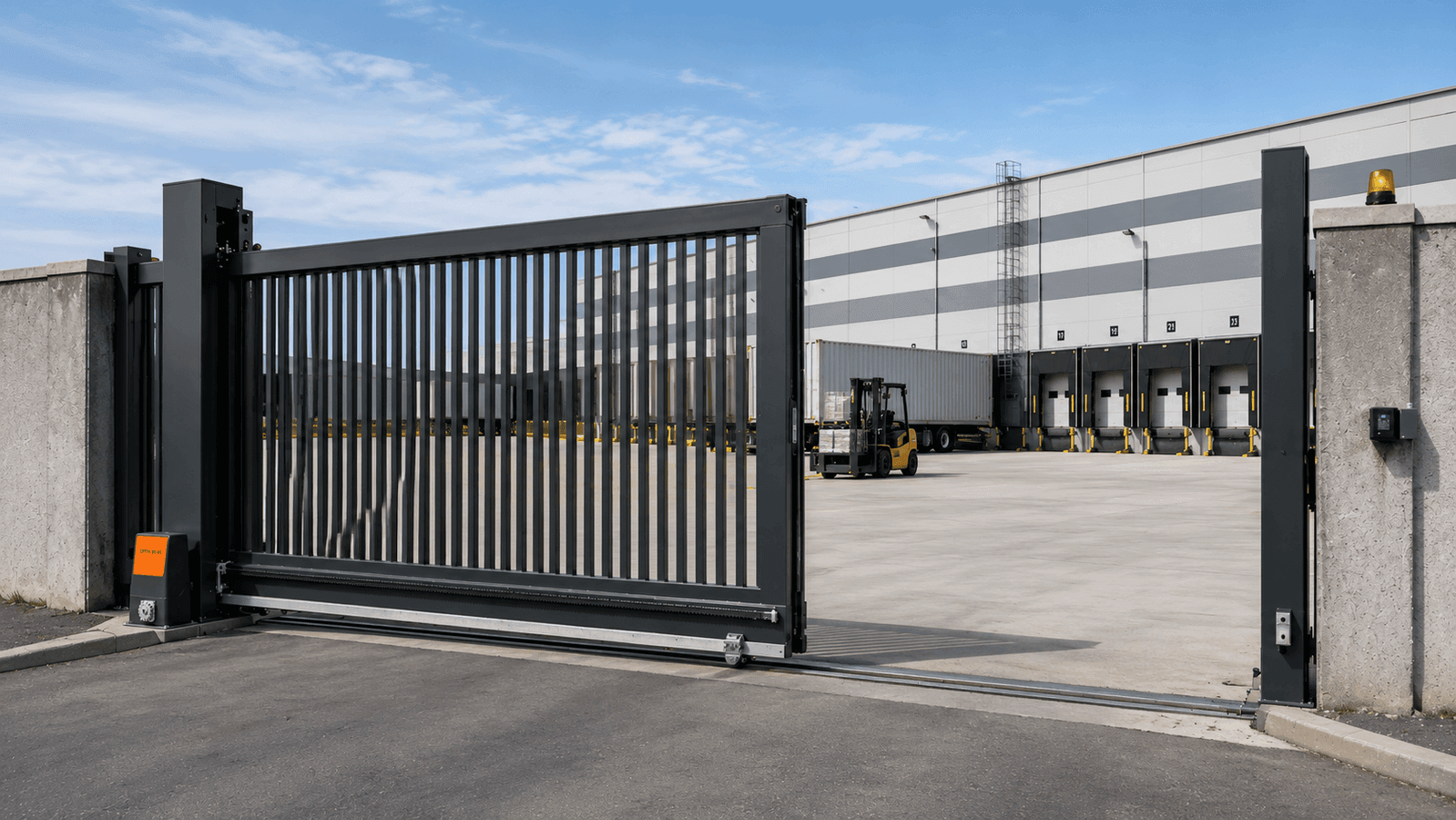
You need an industrial gate operator when the gate is very heavy and runs around the clock. Warehouses, factories, ports and distribution centers fall into this group. Our industrial solutions handle gates up to 3,500 kg, carry a 24/7 continuous duty rating and come with a 2-year warranty.
What Makes an Industrial Gate Operator Different
An industrial gate operator is built for the highest loads and cycle counts. Our industrial motors keep temperature rise within 15°C above ambient under full continuous load, so they hold their rated torque all shift long.
Industrial vs Commercial: Where the Line Sits
The residential vs commercial gate opener question has a third option for the heaviest sites:
- Commercial: offices, schools, hospitals and gated communities with steady daily traffic
- Industrial: freight entries, perimeter fences and construction sites with heavy gates and nonstop use
See the full range on our industrial gate opener page.
How Do You Choose the Right Automatic Gate Motor?
To choose the right automatic gate motor, start with your gate's weight and leaf length. Then count how many times the gate opens each day. Finally, match both numbers to a model's rated capacity and duty rating, and leave some headroom.
Step-by-Step Selection
- Weigh and measure the gate. Note the weight and the length of each leaf. For long or heavy leaves, look at a heavy-duty gate opener.
- Count daily cycles. One cycle is one open and one close.
- Pick the gate type. Choose swing, sliding or barrier based on your space.
- Check the duty rating. For busy or 24/7 sites, choose a commercial or industrial model.
- Add the accessories you need. Consider photocells, WiFi control and battery backup.
Residential Gate Motor or Commercial Model?
Choose a residential gate motor for a private home with light traffic and a gate within its rated weight. Choose a commercial gate operator when several households, a business or the public use the gate. If you are unsure, pick the higher duty rating.
Questions to Ask Before You Buy
Before you settle the residential vs commercial gate opener choice, ask:
- Does the gate need to open during a power cut?
- Do you want phone or WiFi control?
- Will trucks, cars or only people pass through?
- Is the site exposed to strong wind, heat or freezing cold?
Safety note: Gate automation involves electrical wiring and heavy moving parts. Always use a professional installer, and make sure obstacle detection and photocells are set up and tested.
Conclusion
The residential vs commercial gate opener choice comes down to two numbers: gate weight and daily cycles. A residential opener is the smart pick for a home driveway. A commercial or industrial model is the safer pick for busy, heavy or 24/7 gates.
Not sure which model fits your gate? Share its weight, size and daily traffic. Our technical team will recommend the right opener for your site.

Frequently Asked Questions
Key engineering and selection answers regarding this topic
The main difference is workload. A residential opener suits a home gate with around 15 to 20 cycles a day. A commercial opener is built for heavier gates and 24/7 continuous use, with stronger motors and more controller settings. Both can share the same 24V DC motor base.
It is not recommended. A residential opener is not built for the cycle count of a busy business entrance, so it can overheat and wear out early. For offices, car parks or shared communities, choose a commercial gate operator rated for continuous duty and your gate's weight.
Yes. Commercial models use higher torque and larger motors to move heavier gates more often. Our heavy-duty swing gate operator delivers 650 Nm for leaves up to 1,200 kg. Residential models use less force because home gates are usually lighter and open less often.
A residential opener costs less than a commercial one, because it uses a smaller motor and lighter parts. The final price depends on gate weight, gate type, daily cycles, accessories and installation. For an exact figure, send us your gate details and ask for a quote.
Our commercial gate openers are rated for 24/7 continuous operation. That means they can run all day without a forced rest period. Residential motors, by comparison, are built for around 15 to 20 cycles a day, which suits a family home.
Explore Related Automation Systems
Looking for motors, hardware, or installation systems mentioned in this guide? Discover our factory-direct gate opener range:
All Gate Openers
Browse DC24V sliding, swing & barrier operators with full factory warranty.
Explore Products →Residential Gate Operators
Ultra-quiet, solar-ready sliding & swing gate motors for homes and villas.
Residential Solutions →Commercial Gate Systems
Continuous-duty operators for gated communities, business parks & parking.
Commercial Solutions →Industrial Heavy-Duty
High-torque motors engineered for gates up to 4,000 kg and logistics hubs.
Industrial Solutions →