Boom barrier gates for parking use an automatic arm to control which vehicles enter and leave a car park. The best ones combine a fast, adjustable arm, a high cycle rating, vehicle safety loops and support for cards, remotes or plate recognition. The right model depends on lane width and traffic.
A slow or unreliable barrier creates queues at peak times and lets unpaid vehicles slip through. This guide covers the features that matter and how to choose boom barrier gates for parking that keep traffic moving. It comes from Open Bear, the brand of Gate Opener Factory. We build every barrier in our ISO 9001 certified factory and test each unit under full load.
Why Do Car Parks Use Boom Barrier Gates for Parking Access Control?
Car parks use boom barrier gates for parking access control because they open fast and close the lane after each vehicle. That keeps traffic flowing at busy times while blocking unapproved cars. A barrier also takes up little space, so it fits narrow entry and exit lanes.
Faster Entry and Exit
Our barrier lifts its arm in as little as 0.7 seconds with a carbon fiber arm. Quick trips cut queues at shift changes, event finishes and peak shopping hours.
Better Control of Who Enters
The controller opens the arm only on an approved signal. You decide who gets in: account holders, staff, residents or paying visitors.
Common Car Park Problems a Barrier Solves
Well-chosen boom barrier gates for parking fix the most common lane problems:
- Long queues at peak entry and exit times
- Tailgating, where a second car follows the first through the lane
- Unpaid exits at pay-on-exit car parks
- Public drivers entering staff-only or resident-only areas
Where Boom Barrier Gates for Parking Work Best
- Public car park entries and exits
- Office and corporate campus car parks
- Resident and staff car parks
- Staffed booths and pay-on-exit lanes
- Toll and account-holder lanes
What Features Matter Most in a Parking Barrier Gate?
The most important parking barrier gate features are a strong motor, an adjustable arm speed, the right arm length, safety loops and weather protection. Together, these decide how fast the lane moves, how long the barrier lasts and how safely it treats vehicles and drivers.
The Parking Barrier Gate Motor
The motor sets the barrier's speed and lifespan. Our parking barrier gate motor is a 300 W servo motor that runs on 24V DC at 3,000 rpm. A servo motor gives smooth, precise starts and stops, and it can absorb up to three times its rated load without cutting out.
Cycle Rating You Can Trust
Our barrier is rated for at least 10 million cycles, with a mean of at least 2 million cycles between failures. Read both numbers together. At 1,000 vehicles a day, 10 million cycles equals about 27 years of use.
Adjustable Arm Speed
You can set the trip time from 0.7 to 6 seconds with a carbon fiber arm, or from 0.9 to 6 seconds with aluminum. Use a fast setting for busy exits. Use a slower one for long arms or quiet residential car parks.
Arm Length and Style
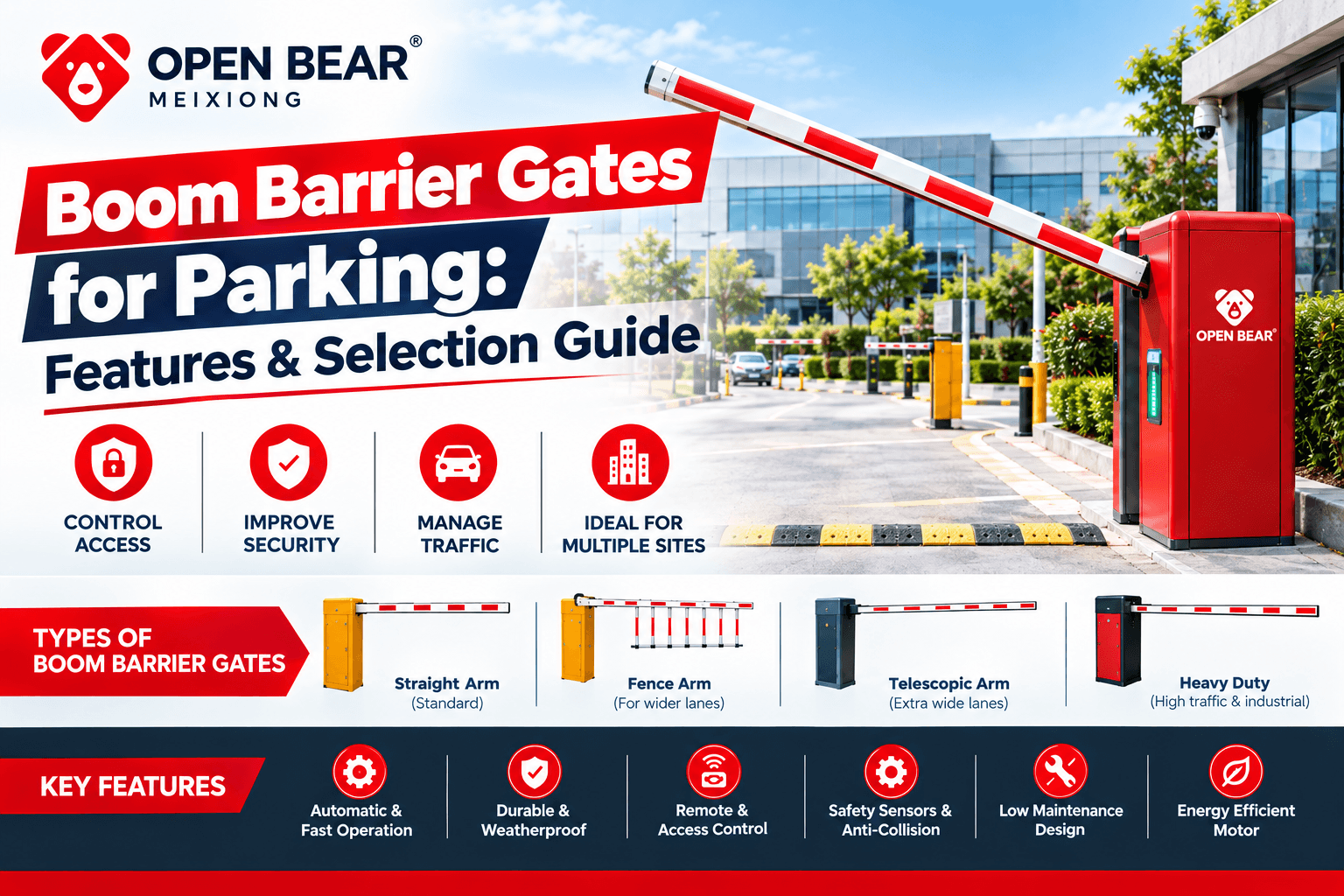
- Straight arm: up to 6 m, for most open lanes
- Fence-style arm: up to 5 m, with a lower skirt that stops people slipping under
Safety and Weather Protection
- A spring mechanism lets the arm fold on impact, which protects the motor
- The barrier works from -35°C to 70°C, in up to 95% humidity (non-condensing)
- Running noise stays at ≤60 dB, which suits car parks next to homes and offices
What Comes in the Box
When you compare boom barrier gates for parking, check what the kit includes. Ours ships with the servo motor unit, spring mechanism rail, arm housing, control board, power supply, 2 RF remotes and an English manual. We test every unit under full load on motor signal equipment before it leaves the factory.
Want the full spec sheet? See motor details, arm options and kit contents on our Barrier Gate Opener page.
Can an Automatic Boom Barrier Connect to Parking Management Systems?
Yes. An automatic boom barrier can work with the access and payment tools a car park already uses. Our controller runs several access methods at once, including cards, remotes and plate recognition cameras. Vehicle loops then handle safety and automatic opening and closing.
Access Methods on One Controller
One controller board supports five access methods, and you can run one or several together:
- Push button for a staffed booth
- IC card for account holders and staff
- Remote control (2 RF remotes come in the kit)
- Microwave sensor for drive-through use
- Face recognition terminal
Vehicle Loops for Unattended Lanes
Loops are sensors cut into the road surface. They make a lane safe and fully automatic:
- Safety loop: stops the arm from lowering onto a vehicle and holds it up until the car clears.
- Arming or exit loop: lifts the arm on its own for free-flow exits.
- Closing loop: drops the arm once the vehicle passes, which helps prevent tailgating.
Plate Recognition and Ticket Systems
License plate recognition (LPR) cameras read a plate and lift the arm for registered vehicles. Ticket-based and pay-on-exit systems can also send an open signal to the barrier when payment is complete.
Fire Alarm Link
The controller accepts a fire alarm signal and holds the barrier open, so vehicles can leave quickly during an evacuation.
How Do Barrier Gate Operators Differ by Parking Site?
Barrier gate operators differ mainly in speed setting, access method and loop setup. A public car park needs fast trips and ticket or plate recognition. A resident car park needs quiet running and cards or remotes. Matching these settings to the site keeps lanes moving without wasted cost.
Parking Site Comparison Table
Site type | Traffic level | Suggested speed | Typical access method | Loops |
Public car park exit | High | Fast (from 0.7 s) | Ticket or LPR | Safety, arming, closing |
Toll or account lane | High | Fast | LPR or IC card | Safety, arming, closing |
Office or campus car park | Medium | Medium | IC card, face recognition | Safety, closing |
Staffed booth | Medium | Medium | Push button | Safety |
Resident or staff car park | Low to medium | Slower, quieter | Remote or IC card | Safety |
Plan for Your Busiest Hour
Size boom barrier gates for parking to your busiest hour, not your daily average. A lane that is quiet at noon may face a long queue at shift change. If one lane cannot clear the peak, add a second lane rather than pushing a single barrier past its comfortable speed.
Choosing Between Arm Materials
Carbon fiber arms support the fastest 0.7-second trip, so they suit busy exits and toll lanes. Aluminum arms reach a 0.9-second fastest trip and work well for everyday car parks.
Running a toll or high-volume lane? Our guide to Boom Barrier Gates for Parking and toll explains speed, loops and cycle ratings for each lane type.
How Do You Choose Boom Barrier Gates for Parking?
To choose boom barrier gates for parking, start with lane width and peak traffic. Then set the speed, check the cycle rating, plan your loops and pick the access methods your site uses. A short checklist keeps the decision simple and avoids costly mismatches.
Selection Checklist
- Measure the lane. Match the arm length to the lane width, up to 6 m straight or 5 m fence-style.
- Count peak traffic. Busy lanes need a fast speed setting and a high cycle rating.
- Read the cycle rating and MCBF together. Look for at least 10 million cycles and 2 million MCBF.
- Pick the motor. Choose a servo motor for heavy, all-day cycling.
- Plan the loops. Add a safety loop, plus arming and closing loops for unattended lanes.
- Choose access methods. Use LPR, cards, remotes or a mix.
Plan the Site Work
Budget for the concrete foundation, power supply and cabling, not just the barrier itself. Leave clearance for the full arc of the arm. Every kit ships with an English manual, wiring diagram and parameter table to guide your installer.
Safety note: Barrier installation involves mains wiring, loop cutting and a fast-moving arm. Always use a professional installer, and test the safety loop and fire alarm link before you open the lane.
Start Picking the Right Barrier for Your Car Park
The right boom barrier gates for parking move traffic fast, block unapproved vehicles and last for years of heavy use. Match the arm length and speed to your lanes, read the cycle rating with the MCBF, and plan your loops and access methods from the start.
Building a full access system? Gate Opener Factory makes barrier, swing and sliding gate operators in one place, so every entrance on your site works together.

Frequently Asked Questions
Key engineering and selection answers regarding this topic
The best boom barrier gate for a parking lot matches your lane width and traffic. Look for an adjustable arm speed, a cycle rating of at least 10 million, safety loops and support for your access method. Our servo-driven barrier lifts in as little as 0.7 seconds
Look for a servo motor, an adjustable trip time, the right arm length, safety loops and impact protection. Weather rating matters too. Our barrier works from -35°C to 70°C and runs at ≤60 dB, so it suits outdoor car parks near homes and offices.
Yes. Automatic boom barrier gates suit commercial parking lots because they open fast, close after each vehicle and handle heavy daily traffic. A 10 million cycle rating supports about 27 years of use at 1,000 vehicles a day. They also connect to cards, remotes and plate recognition.
Measure the lane width to set the arm length. Then count peak traffic to pick the speed setting and cycle rating. Plan safety, arming and closing loops, and choose access methods such as cards, remotes or plate recognition. Finally, budget for the foundation, power and cabling.
Yes. Boom barrier gates can work with parking management tools such as license plate recognition cameras, card readers and ticket or pay-on-exit systems. These send an open signal to the controller. Our controller also accepts a fire alarm signal to hold the arm open during an evacuation.
Explore Related Automation Systems
Looking for motors, hardware, or installation systems mentioned in this guide? Discover our factory-direct gate opener range:
All Gate Openers
Browse DC24V sliding, swing & barrier operators with full factory warranty.
Explore Products →Residential Gate Operators
Ultra-quiet, solar-ready sliding & swing gate motors for homes and villas.
Residential Solutions →Commercial Gate Systems
Continuous-duty operators for gated communities, business parks & parking.
Commercial Solutions →Industrial Heavy-Duty
High-torque motors engineered for gates up to 4,000 kg and logistics hubs.
Industrial Solutions →