
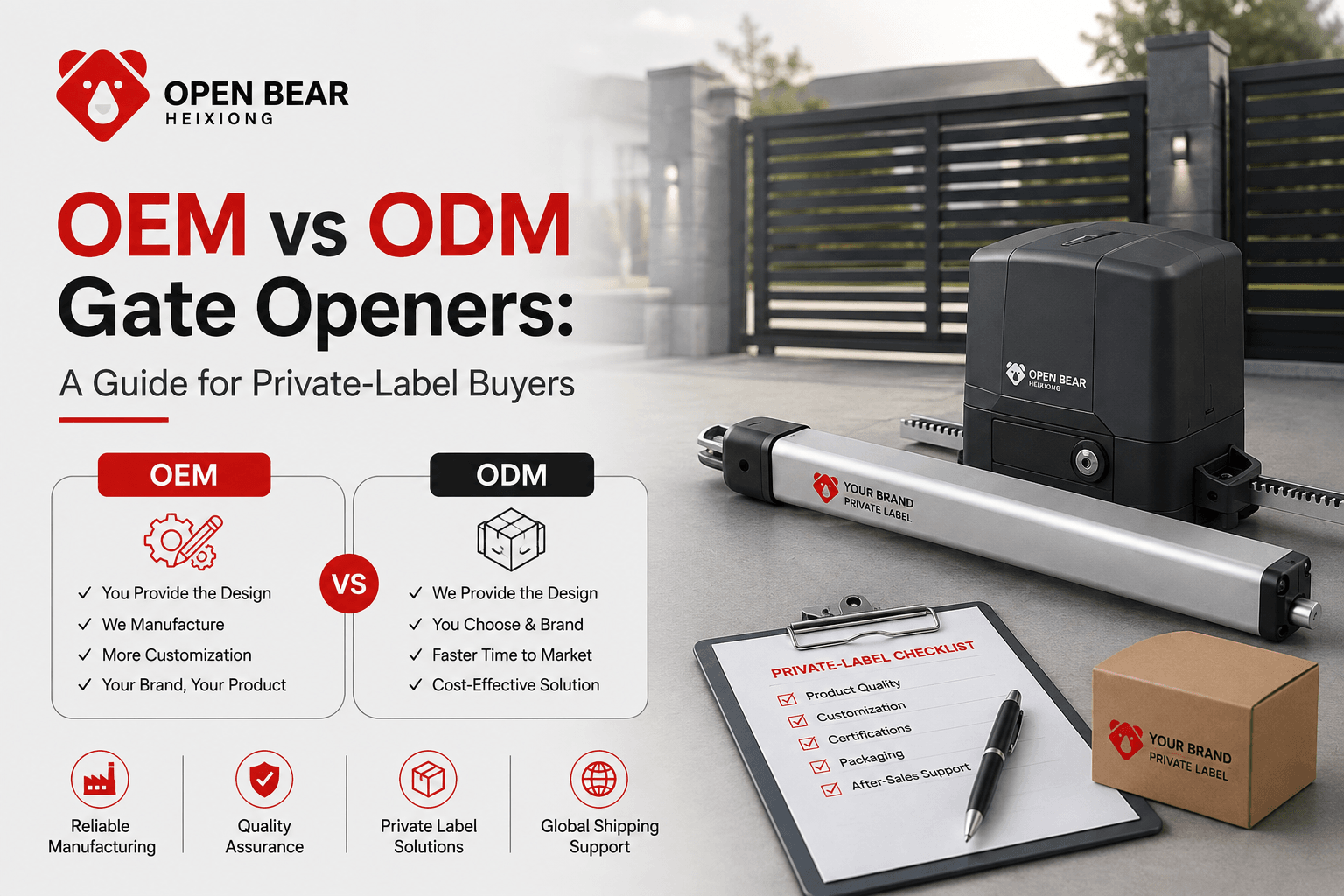
If you want to sell gate openers under your own brand, you will meet two sourcing models early: OEM and ODM. The short version is this. With ODM, you put your brand on a manufacturer's existing product. With OEM, the manufacturer builds to your specification. ODM is faster and cheaper to start. OEM gives you more control, and usually more cost and commitment. Which one fits depends on how different your product needs to be from everything else on the shelf.
Here is how the two models actually differ, and how to decide between them.
OEM and ODM, in plain terms
ODM (original design manufacturer) means the factory already designed the product, and you rebrand it. You choose from what they already build, add your logo and packaging, and sell it as yours. Most "private-label" gate openers start here, because the engineering, tooling and certification already exist. You are buying a proven product and a brand wrapper for it.
OEM (original equipment manufacturer) means the factory builds to your requirements. You bring the specification, and sometimes the design, and they manufacture it under your brand. That can range from changed features on an existing platform to a housing built from a new mould. More of the product is yours, and so is more of the responsibility.
In practice the line blurs. Plenty of real orders sit in between: a manufacturer's proven internals inside a housing you have restyled, with your own remote coding and firmware tweaks. What matters is not the label but two questions. How much of the product is yours, and who owns the design at the end.
What you can actually customize
Customization runs on a ladder from cheap and fast to expensive and slow. Knowing where each change sits stops you from pricing an order wrong.
Branding and packaging
The easiest level. Your logo on the housing and the remote, your colours, your manuals, your trade or retail packaging. This is available on most ODM orders and rarely moves the minimum order much. For a lot of buyers, this is all "private label" needs to mean.
Remotes, firmware and features
The middle level. Custom remote frequencies or rolling codes, so your remotes are not cross-compatible with a competitor's. Firmware changes to speed, soft-start, auto-close timing or safety behaviour. Added features such as app control or a different receiver. These are common on OEM work, and what is possible depends on the manufacturer's platform, so confirm it before you promise a spec sheet to your own customers.
Hardware design and tooling
The deepest and most expensive level. A new housing shape, a different gearbox, a custom control-board layout. Anything that needs a new mould or new tooling carries a one-time cost and a longer lead time, and it usually pushes the MOQ up so the factory can justify the setup. This is full OEM, and it pays off at volume or when the design itself is your selling point.
If you are still settling the underlying spec, our B2B guide to specifying swing operators covers the torque, duty and weight figures you will need to agree on either way.
OEM vs ODM compared
Factor | ODM (rebrand existing) | OEM (build to spec) |
Design origin | Manufacturer's | Yours, or shared |
Customization | Branding, packaging | Up to full hardware |
Tooling cost | None or low | Can be significant |
MOQ | Lower | Higher |
Lead time | Shorter | Longer |
Design ownership | Stays with the factory | Can be yours |
Best for | Fast market entry | A differentiated product |
The numbers behind this vary by manufacturer, product and how much you change, so read the table as direction, not fixed figures. A residential swing kit and a heavy industrial operator will not carry the same MOQ or tooling cost.
Which model fits your business
Choose ODM if you want to reach the market quickly, test a product line, or compete mainly on brand, price and distribution rather than on the hardware itself. You skip tooling cost and long development, and you build on a design that is already certified and proven. The trade is that a competitor can buy the same base product, so your advantage has to come from somewhere other than the unit.
Choose OEM if the product is your differentiator, if you need features or a design a competitor cannot copy off the shelf, or if you are building a range you plan to own for years. You take on higher MOQ, tooling cost and lead time in return for control and, potentially, exclusivity.
Plenty of buyers start with ODM to prove the market, then move to OEM once volume justifies the investment. That is a sensible path, not a failure to plan ahead.
Who owns the design
This is the question private-label buyers skip most often, and it costs them later. On a pure ODM order, the design stays with the factory, and they can sell the same product to anyone, including your competitor next year. On an OEM order with your own tooling, you can usually negotiate ownership or exclusivity of that design, mould or firmware.
If exclusivity matters to your brand, raise it in writing before tooling starts, and be specific about what is exclusive: the housing, the remote coding, the firmware, or the whole unit. Verbal agreements on exclusivity rarely hold up.
Starting an OEM or ODM order
Before you approach a manufacturer, know your answers to a few things:
- The exact product and specification you want branded
- Your realistic first-order quantity
- The level of customization you actually need, from logo to new tooling
- Whether exclusivity matters, and on what
- Your target market and its certification requirements
With those in hand, the conversation moves quickly. You can take your product, quantity and customization goals to Open Bear's team and get a straight answer on what is possible, the MOQ, and the lead time for your case. The same groundwork feeds the wider sourcing decisions in our guide to importing gate openers from China, from samples through to shipping.
The buyers who do well with private labels are the ones who match the model to their real advantage. If your strength is distribution and brand, ODM keeps you lean. If your strength is the product, OEM is worth the extra cost and time.
FAQs
1. What is the difference between OEM and ODM gate openers?
With ODM, you put your brand on a manufacturer's existing product, while with OEM the manufacturer builds to your specification. ODM means the factory already designed and certified the product and you rebrand it, which is faster and cheaper to start. OEM means you bring the specification, and sometimes the design, and the factory manufactures it under your brand, which gives you more control but usually more cost and commitment. Which one fits depends on how different your product needs to be from everything else on the shelf.
2. What does ODM mean for a private-label gate opener?
ODM, which stands for original design manufacturer, means the factory already designed the product and you rebrand it. You choose from what they already build, add your logo and packaging, and sell it as yours. Most private-label gate openers start here because the engineering, tooling, and certification already exist, so you are buying a proven product with a brand wrapper. The trade off is that a competitor can buy the same base product, so your advantage has to come from somewhere other than the unit.
3. What does OEM mean for a private-label gate opener?
OEM, which stands for original equipment manufacturer, means the factory builds to your requirements. You bring the specification, and sometimes the design, and they manufacture it under your brand. This can range from changed features on an existing platform to a housing built from a new mould. More of the product is yours, and so is more of the responsibility. OEM is worth it when the product itself is your differentiator or when you are building a range you plan to own for years.
4. What can I actually customize on a gate opener?
Customization runs on a ladder from cheap and fast to expensive and slow. The easiest level is branding and packaging, meaning your logo, colours, manuals, and packaging, which is available on most ODM orders. The middle level covers remotes, firmware, and features, such as custom remote frequencies, firmware changes to speed or auto close timing, and added features like app control. The deepest level is hardware design and tooling, such as a new housing shape or gearbox, which carries a one time cost and a longer lead time.
5. How does branding and packaging customization work?
Branding and packaging is the easiest and cheapest level of customization. It includes your logo on the housing and the remote, your colours, your manuals, and your trade or retail packaging. This is available on most ODM orders and rarely moves the minimum order much. For many buyers, this is all that private label needs to mean, since it delivers a branded product without the cost of hardware changes.
6. Can I customize remote frequencies and firmware on gate openers?
Yes. Custom remote frequencies or rolling codes can make your remotes incompatible with a competitor's, and firmware changes can adjust speed, soft start, auto close timing, or safety behaviour. Added features such as app control or a different receiver are also possible. These changes are common on OEM work, but what is possible depends on the manufacturer's platform, so confirm it before you promise a spec sheet to your own customers.
7. How do OEM and ODM compare on cost, MOQ, and lead time?
ODM uses the manufacturer's design, limits customization to branding and packaging, carries no or low tooling cost, has a lower minimum order quantity, and offers a shorter lead time, but the design ownership stays with the factory. OEM uses your own or a shared design, allows customization up to full hardware, can carry significant tooling cost, has a higher minimum order quantity and longer lead time, and can let you own the design. ODM is best for fast market entry while OEM is best for a differentiated product. The exact figures vary by manufacturer and product.
8. Should I choose OEM or ODM for my business?
Choose ODM if you want to reach the market quickly, test a product line, or compete mainly on brand, price, and distribution rather than the hardware itself, since you skip tooling cost and long development and build on a proven design. Choose OEM if the product is your differentiator, if you need features a competitor cannot copy off the shelf, or if you are building a range you plan to own for years. Many buyers start with ODM to prove the market, then move to OEM once volume justifies the investment.
9. Who owns the design in an OEM or ODM order?
On a pure ODM order, the design stays with the factory, and they can sell the same product to anyone, including your competitor. On an OEM order with your own tooling, you can usually negotiate ownership or exclusivity of that design, mould, or firmware. This is the question private-label buyers skip most often, and it costs them later. If exclusivity matters, raise it in writing before tooling starts and be specific about what is exclusive, whether that is the housing, the remote coding, the firmware, or the whole unit.
10. What should I prepare before starting an OEM or ODM order?
Before approaching a manufacturer, know the exact product and specification you want branded, your realistic first order quantity, and the level of customization you actually need, from logo to new tooling. Also decide whether exclusivity matters and on what, and confirm your target market and its certification requirements. With those answers in hand, the conversation moves quickly, and you can get a straight answer on what is possible, the minimum order quantity, and the lead time for your case.

Explore Related Automation Systems
Looking for motors, hardware, or installation systems mentioned in this guide? Discover our factory-direct gate opener range:
All Gate Openers
Browse DC24V sliding, swing & barrier operators with full factory warranty.
Explore Products →Residential Gate Operators
Ultra-quiet, solar-ready sliding & swing gate motors for homes and villas.
Residential Solutions →Commercial Gate Systems
Continuous-duty operators for gated communities, business parks & parking.
Commercial Solutions →Industrial Heavy-Duty
High-torque motors engineered for gates up to 4,000 kg and logistics hubs.
Industrial Solutions →