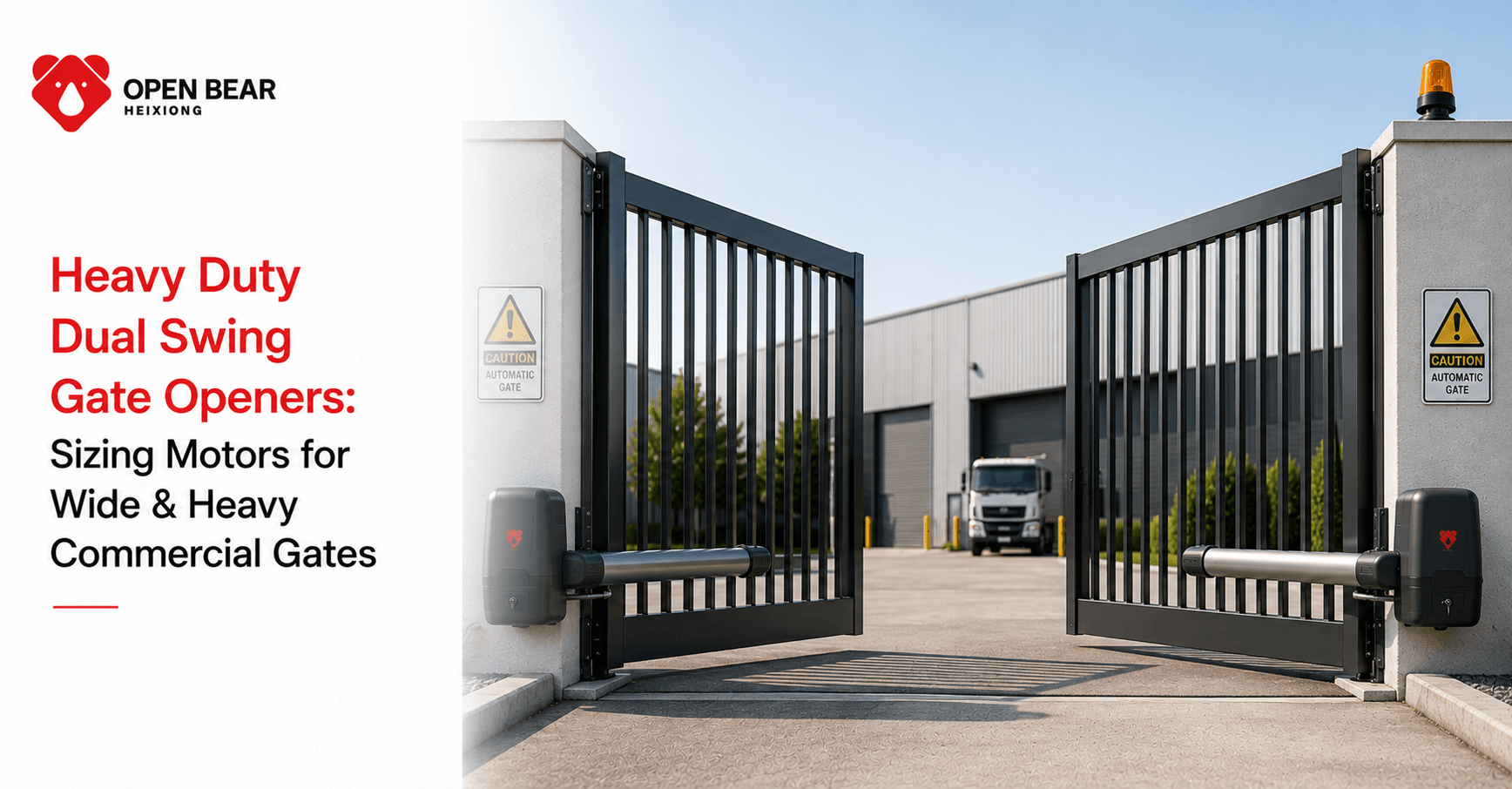
A double gate is where cheap automation gets found out. On a single leaf you can oversize the motor and paper over a lot of small mistakes. On a wide dual gate you can't. The two leaves have to meet in the middle within a few millimetres, in the right order, cycle after cycle after cycle. A motor that's merely 'strong enough' won't hold that tolerance once wind and a bit of wear turn up.
So this guide is about speccing a heavy duty dual swing gate opener that keeps two heavy leaves lined up through a decade of commercial traffic. It takes the four operator families and the three sizing numbers from the swing operator buyer's guide as read. Here we go deeper on the parts that only matter once there are two leaves in play: torque under load, sequencing, and duty.
Why two leaves isn't two problems
The instinct is to treat a dual gate as two single gates and just buy two kits. Resist it. A proper dual system drives both motors from one controller that staggers the leaves, so the second one closes a beat behind the first and they overlap and latch instead of clashing at the mid-stop. Two separate single kits share no clock. They drift, they meet early, and eventually they either jam or leave a gap you could post a letter through. Every heavy dual job should be a matched pair on a sequencing controller. No exceptions worth making.
Torque, not wattage, sizes a wide leaf
A wider leaf multiplies the load at the hinge. The force the motor feels isn't just the leaf's weight, it's that weight acting through the leaf's length like a lever. Roughly double the length and you roughly double the torque needed to start and stop it smoothly. Which is why a 3-metre leaf at 300 kg can actually be harder on a motor than a 2-metre leaf at 400 kg. Width matters more than people expect.
Our heavy-duty swing operator is built for exactly this envelope. 650 Nm of torque, single leaves up to 1,200 kg and 6 metres, running on a 24V DC / 400W motor with a crank connecting-rod drive that keeps the motion smooth, no jerk at the start, no slam at the end. For a dual gate you spec two of that class, one per leaf, and let the shared controller sequence them. The full torque and duty figures live on the 650 Nm / 1,200 kg model page.
Here is Table 1 converted into a clean, layout-safe text format:
Dual Swing Sizing Specifications (Per-Leaf Figures)
Light Duty: Up to 2.5 m / 250 kg
For smaller, lighter gate leaves, a light ram or articulated arm operator provides sufficient torque for standard daily residential use.
- Leaf Dimensions: Width $\le$ 2.5 m | Weight $\le$ 250 kg
- Torque Class Needed: ~180–250 Nm
- Drive Type: Articulated arm or light ram
- Duty Rating: Standard duty
Heavy Duty: 2.5 m – 3.5 m / 250 kg – 500 kg
Mid-sized gates require a step up in torque to ensure steady operation and resistance to wind loads, making linear ram drives the standard choice.
- Leaf Dimensions: Width 2.5–3.5 m | Weight 250–500 kg
- Torque Class Needed: ~300–450 Nm
- Drive Type: Linear ram
- Duty Rating: Heavy duty
Continuous Duty: 3.5 m – 5 m / 500 kg – 800 kg
Larger commercial or heavy residential gate leaves need high-torque hydraulic or heavy ram operators designed to handle regular, uninterrupted operation.
- Leaf Dimensions: Width 3.5–5 m | Weight 500–800 kg
- Torque Class Needed: ~450–650 Nm
- Drive Type: Hydraulic or heavy ram
- Duty Rating: Continuous duty
24/7 Continuous Duty: 5 m – 6 m / up to 1,200 kg
Massive industrial gate leaves demand maximum torque capacity to maintain continuous round-the-clock cycling without straining the drive mechanism.
- Leaf Dimensions: Width 5–6 m | Weight up to 1,200 kg
- Torque Class Needed: 650 Nm class
- Drive Type: Crank or hydraulic
- Duty Rating: 24/7 continuous duty
Duty cycle: the number commercial buyers underestimate
A logistics yard gate can cycle three to five hundred times a day. Put a residential-duty motor under that and the thermal cut-out trips, the gate parks itself open, and the site sits exposed until the motor cools down. Commercial and industrial gates need a continuous or high-duty rating, and that's a genuinely different motor and gearbox build, not just a beefier version of the residential unit. Our industrial operators are rated for 24/7 running and ship with a 2-year warranty. The property-type breakdown is on the industrial gate operator and commercial gate operator pages if you want to check yourself against it.
Pillar geometry: where dual installs actually come undone
Heavy dual gates fail at the pillars more often than at the motor. Two things drive that:
1. Hinge-to-motor geometry. A linear ram needs a specific distance between the hinge pivot and its mounting point. Get it wrong and the gate either won't reach full open or strains at both ends of travel. Pull the operator's install chart and set the bracket to those pivot distances before you weld anything.
2. Pillar mass. A 600 kg leaf throws real force into its post. Brick piers on shallow footings crack, sometimes within the first year. Heavy dual jobs want substantial pillars or steel posts on proper foundations, so spec the civil works, don't just assume the existing piers will cope.
If the pillars genuinely can't take a side-mounted ram, an underground / floor operator drops the drive into a foundation vault and off the post entirely. It's more work to install, but it takes the pillar-stress problem off the table and hides the hardware while it's at it. The trade-offs are laid out in the arm types guide.
Safety isn't optional on heavy gates
A 600 kg leaf swinging shut on a vehicle or a person is a serious hazard, and on a commercial site it's a liability question the moment something goes wrong. Any heavy dual install wants three things as a baseline:
· Photocell safety beams across the opening, to reverse the gate the instant something breaks the plane.
· Anti-crushing detection in the controller, sensing an obstruction by motor load and stopping or reversing. Ours include this as standard.
· A manual release so the gate opens by hand in a power cut, without needing tools.
Hydraulic or mechanical for the heaviest leaves?
Once you're past roughly 500 kg per leaf on a high-cycle site, the ram question becomes the decision. Hydraulic rams take continuous duty and heavy mass more gracefully. Mechanical (screw) rams are simpler to service and cheaper to hold in stock. It's worth its own read, so look at hydraulic vs. mechanical swing gate operators before you commit a heavy dual site to either one.
Here is Table 2 converted into a clean, text-based format for your blog post:
Duty Rating vs. Daily Cycles
Standard Duty (Up to ~20 Cycles/Day)
Ideal for low-traffic residential or small office setups where the gate is operated only a few times throughout the day.
- Daily Cycles: Up to ~20
- Motor Build: Residential-grade
- Example Site: Villa, small office
Heavy Duty (20–100 Cycles/Day)
Built for moderate daily usage, these operators feature stronger gearboxes to handle regular residential community or commercial entry traffic.
- Daily Cycles: 20–100
- Motor Build: Reinforced gearbox
- Example Site: Gated community, commercial forecourt
High Duty (100–300 Cycles/Day)
Designed for busy locations requiring constant movement without thermal overload, utilizing motors rated for continuous operation.
- Daily Cycles: 100–300
- Motor Build: Continuous-capable
- Example Site: Business park, commercial car park
Continuous / 24/7 Duty (300+ Cycles/Day)
Engineered for intense, non-stop usage in industrial environments, featuring thermal-managed drive systems to prevent overheating.
- Daily Cycles: 300+
- Motor Build: Industrial, thermal-managed
- Example Site: Logistics yard, factory
People also ask
Can I use two single swing openers on a double gate?
Not reliably, no. Two independent kits share no timing, so the leaves drift out of sequence and eventually either collide or leave a gap at the mid-stop. Use a matched pair on a single sequencing controller instead, so one leaf closes a beat behind the other and they latch cleanly every time.
What torque do I need for a 500 kg commercial leaf?
As a rough per-leaf guide, a 500 kg leaf around 3 to 3.5 m wide sits in the ~450 Nm class. Push past 4 m and you're heading toward the 650 Nm class, because the extra width multiplies the load. Always read the model's weight and width ratings together, and leave yourself headroom rather than running the motor flat out.
Do heavy dual gates need a separate safety system?
Yes. Any heavy leaf wants photocell beams across the opening, anti-crushing load detection in the controller, and a manual release for power failures. On commercial sites that isn't just good practice, it's a liability requirement you don't want to be caught without.
A distributor's checklist for heavy dual kits
· Sequencing controller included. Confirm it's a true dual controller, not two single boards in one box.
· Matched pair. Both motors the same model, same firmware.
· Torque and duty stated per leaf. Against the site's widest, heaviest leaf, not the average one.
· Certification on the exact model. CE or UL tied to the SKU, downloadable from the downloads page.
· Spare control boards in the pipeline. Heavy gates run for years, so parts availability is what protects the account down the line.
Spec a heavy dual gate the way it actually loads. Torque against the widest leaf, duty against the daily cycle count, and one controller sequencing both sides. Do that and the two leaves will still be meeting cleanly in the middle long after the warranty's run out. To match a matched pair to a specific opening, start with the product range or talk it through with the technical team.
About the Author
Daniel Okafor is a senior gate automation engineer who specialises in heavy commercial and industrial swing systems. He's commissioned dual-leaf gates on logistics yards, factories and gated communities, and works with the Open Bear team in Shenzhen on high-torque, continuous-duty operators. He writes for the installers and distributors who carry the callback risk when a heavy gate gets under-specced. Reach the technical team via the contact page.

Frequently Asked Questions
Key engineering and selection answers regarding this topic
Once you're past roughly 500 kg per leaf on a high-cycle site, the ram question becomes the decision. Hydraulic rams take continuous duty and heavy mass more gracefully. Mechanical (screw) rams are simpler to service and cheaper to hold in stock. It's worth its own read, so look at before you commit a heavy dual site to either one.
Explore Related Automation Systems
Looking for motors, hardware, or installation systems mentioned in this guide? Discover our factory-direct gate opener range:
All Gate Openers
Browse DC24V sliding, swing & barrier operators with full factory warranty.
Explore Products →Residential Gate Operators
Ultra-quiet, solar-ready sliding & swing gate motors for homes and villas.
Residential Solutions →Commercial Gate Systems
Continuous-duty operators for gated communities, business parks & parking.
Commercial Solutions →Industrial Heavy-Duty
High-torque motors engineered for gates up to 4,000 kg and logistics hubs.
Industrial Solutions →