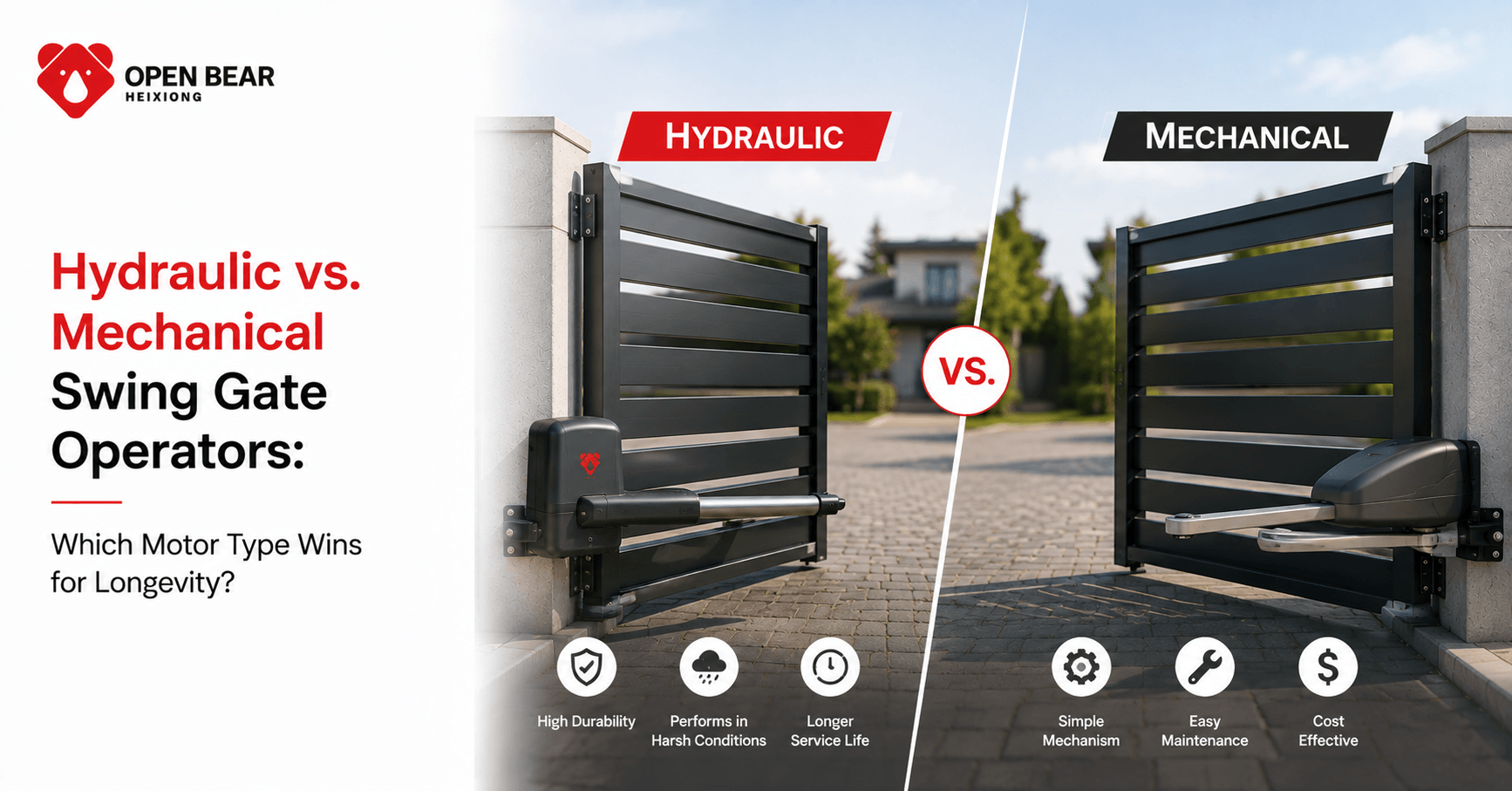
Ask two installers whether hydraulic or mechanical swing operators last longer and you'll get an argument, not an answer. Usually because each one is defending whatever they've always fitted. The truthful version is less satisfying: they fail in different ways, and which one lasts longer depends entirely on how hard the gate has to work. This guide gives you the real trade-off, so you can match the drive to the site instead of to habit. Framed simply, the hydraulic vs mechanical swing gate opener decision is a duty question, not a quality one.
If you haven't nailed down leaf weight, wind and duty yet, do that first over in the swing operator buyer's guide. Those three numbers settle most of this before drive type even comes up.
How each drive actually moves the gate
Mechanical (screw / worm) rams
A mechanical linear ram spins a motor through a screw thread that extends or pulls back a rod, and that rod pushes the leaf. It's a direct, positive drive. The gate is wherever the screw says it is, full stop. That makes it self-locking, the leaf can't be forced open by hand, which is a real security plus, and dead simple to diagnose, because there's no fluid, no seals, nothing under pressure to lose. When it wears, it wears mechanically and visibly. Thread, bushings, end-stops. You can see the problem.
Hydraulic rams
A hydraulic operator runs an electric pump that moves oil, and the oil pressure drives the ram. The gate effectively floats on a cushion of fluid, which is why hydraulics feel so smooth on heavy leaves and barely notice constant cycling. There's no metal thread taking the full shock of every start and stop. The price you pay is complexity. Seals age, the oil wants occasional attention, and a leak turns into a service call rather than a five-minute swap.
The longevity question, answered honestly
Neither drive is 'more durable' in the abstract. What matters is whether the duty and the drive are matched:
· On a low-to-medium cycle gate, say a villa or a small commercial forecourt, a mechanical ram will outlast the owner's interest in the gate. The screw simply isn't worked hard enough to wear in any meaningful way.
· On a heavy, high-cycle gate, like an industrial yard running hundreds of cycles a day, hydraulics pull ahead. The fluid cushion soaks up the repeated shock that would slowly grind down a screw thread, and hydraulic units are built for continuous duty from the outset.
So the honest headline is this. Mechanical wins on simplicity and low service. Hydraulic wins on heavy, continuous work. The failure that actually ends a gate's life is almost always a duty mismatch, not the drive principle itself.
Here is Table 1 converted into a clean, layout-safe text format:
Hydraulic vs. Mechanical Gate Operators at a Glance
Mechanical Operators (Screw Ram)
Mechanical screw rams are a cost-effective, low-maintenance option best suited for low to medium daily cycling.
- Best Duty: Low–medium cycle
- Heavy-Leaf Smoothness: Good
- Self-Locking / Security: Yes, inherently self-locking
- Service Needs: Minimal (no fluid to manage)
- Diagnosis: Simple, visual troubleshooting
- Unit Cost: Lower
- Cold-Weather Behavior: Stable performance in low temperatures
Hydraulic Ram Operators
Hydraulic rams are built for demanding, high-frequency entry points where continuous performance and ultra-smooth leaf movement are paramount.
- Best Duty: High / continuous cycle
- Heavy-Leaf Smoothness: Excellent (utilizes a fluid cushion)
- Self-Locking / Security: Requires a dedicated hydraulic lock valve
- Service Needs: Periodic seal and oil maintenance required
- Diagnosis: Requires pressure and leak testing
- Unit Cost: Higher initial investment
- Cold-Weather Behavior: Sensitive to temperature (oil viscosity matters)
Where 24V DC upends the old assumptions
A lot of the 'hydraulics are just tougher' folklore comes from the 230V AC era, when mechanical units ran hot and hard and didn't last. Our range is 24V DC across both approaches now, and the heavy mechanical models use a crank connecting-rod drive that delivers the same smoothness people used to buy hydraulics for.
The 650 Nm heavy-duty operator handles 1,200 kg leaves on a screw-type drive precisely because the DC control eases the start and the stop. So the modern gap between the two is a good deal narrower than the old wisdom suggests, especially across the residential and light-commercial range.
Cold, heat and the environment
Hydraulic performance leans on oil viscosity, and viscosity changes with temperature. In genuinely cold weather the fluid stiffens and the gate slows down until it warms through. Our operators are rated from -35°C to 70°C, but in extreme cold a mechanical drive stays more predictable, because there's no fluid to thicken in the first place. Flip it around, though, and in a dusty or corrosive spot a sealed hydraulic unit will shrug off the kind of contamination that fouls an exposed screw. Read the site, not just the spec sheet.
Here is Table 2 converted into a clean, text-based format for your blog post:
Choosing the Right Drive by Site Scenario
Suburban Villa (Low Usage)
For residential properties averaging 10 or fewer daily cycles, a mechanical ram offers a hassle-free, cost-effective solution.
- Recommended Drive: Mechanical ram
- Why: Provides maximum simplicity, requires no fluid servicing, and is inherently self-locking for everyday security.
Gated Community Entrance (Medium Duty)
Shared entry points require a balance of security and reliable performance under regular daily traffic.
- Recommended Drive: Mechanical or light hydraulic ram
- Why: Handles medium-duty cycling effectively while maintaining site security.
Industrial Yard (High Duty)
Heavy-traffic commercial facilities operating 300+ cycles per day require an industrial-grade drive system designed for non-stop performance.
- Recommended Drive: Hydraulic ram
- Why: Rated for continuous 24/7 duty and built with fluid cushioning for natural shock absorption under heavy loads.
Very Cold Climates
Regions subject to freezing temperatures demand drive systems that remain unaffected by cold-weather dynamics.
- Recommended Drive: Mechanical ram
- Why: Operates reliably without the risk of oil-viscosity slowdown or stiff fluid dynamics.
Dusty or Corrosive Sites
Environments exposed to heavy dust, debris, or salt spray require extra protection against internal wear.
- Recommended Drive: Sealed hydraulic operator
- Why: High contamination resistance keeps environmental grit out of sensitive moving parts.
Aesthetic-Led Sites (Hidden Hardware)
For high-end residential or heritage sites where visible machinery detracts from architectural design.
- Recommended Drive: Hydraulic floor operator
- Why: Vault-mounted under the driveway to keep the hardware entirely invisible while maintaining smooth operation.
That last row hints at a third option people forget. Where the hardware simply can't be seen, the hydraulic floor-spring operator puts a hydraulic drive underground and out of sight. And for the mechanics of arm and ram geometry in general, the arm types guide covers how each one mounts.
Serviceability: who fixes it, and how often
Longevity is only half the ownership story. The other half is what happens when something does need attention. A mechanical ram can be diagnosed by eye, a worn thread, a failed end-stop, a tired bushing, and put right with basic parts and no special kit. A hydraulic unit needs someone who can pressure-test and bleed a system, and a leaking seal is a workshop job. On remote sites, or where the maintaining contractor is a general electrician rather than a gate specialist, that gap matters more than raw lifespan does. Spec the drive the site's support chain can actually service, not just the one that lasts longest on paper.
Total cost of ownership, not sticker price
Installers quoting hard against each other fixate on unit cost, where mechanical wins outright. But on a high-cycle commercial gate, a mechanical ram worked past its duty will be up for replacement while a correctly specced hydraulic is still barely mid-life. Cost the decade, not the invoice. On a heavy dual gate especially, and there's more on that in heavy-duty dual swing openers guide, the right drive choice is the difference between one install and two.
People also ask
Do hydraulic gate operators last longer than mechanical ones?
Only on heavy, high-cycle gates. The hydraulic fluid cushion absorbs the repeated shock of constant cycling that would wear out a screw thread, so on an industrial gate running hundreds of cycles a day, hydraulics generally outlast mechanical. On a residential gate the mechanical ram is barely working, and it'll outlast the owner's interest in it.
Are hydraulic swing operators harder to maintain?
They ask more of you than mechanical units do. Seals age, oil wants checking now and then, and a leak is a service call rather than a part swap. Mechanical rams have no fluid and no seals, so maintenance is minimal and faults tend to be visible. On sites with limited service access, that simplicity is a genuine advantage.
Which is better for cold climates?
Mechanical, as a rule. Hydraulic fluid thickens as it cools, so a hydraulic gate slows in hard frost until it warms up. A mechanical screw drive has no fluid to stiffen and behaves predictably right down to the operator's rated -35°C.
The bottom line
Go mechanical when the gate is residential-to-medium duty, when service access is awkward, or when the climate is genuinely cold. You get simplicity, self-locking security, and next to no maintenance. Go hydraulic when the gate is heavy and cycling constantly, or when the environment is dusty or corrosive. You get the fluid cushion and the continuous-duty stamina. Either way, match the operator to the property type, confirm the duty rating for commercial use, and check the exact model's certification in the downloads library. Once you've narrowed it down, the technical team can confirm the right drive for your leaf and cycle count.
About the Author
Daniel Okafor is a senior gate automation engineer who has installed and serviced both hydraulic and mechanical swing operators for over a decade, across residential, commercial and industrial sites. He works with the Open Bear engineering team in Shenzhen on 24V DC drive design and duty-cycle testing. He writes to help installers choose by evidence rather than habit. Reach the technical team through the Gate Opener Factory contact page.

Explore Related Automation Systems
Looking for motors, hardware, or installation systems mentioned in this guide? Discover our factory-direct gate opener range:
All Gate Openers
Browse DC24V sliding, swing & barrier operators with full factory warranty.
Explore Products →Residential Gate Operators
Ultra-quiet, solar-ready sliding & swing gate motors for homes and villas.
Residential Solutions →Commercial Gate Systems
Continuous-duty operators for gated communities, business parks & parking.
Commercial Solutions →Industrial Heavy-Duty
High-torque motors engineered for gates up to 4,000 kg and logistics hubs.
Industrial Solutions →