The arm is the part of a swing operator that decides whether the install takes two hours or the whole day. Motor torque gets all the attention, but the arm geometry, how the drive physically links the post to the leaf, is what sets the mounting, the look, and honestly half the things that go wrong later on. Fit the wrong arm to a pillar and no amount of torque will save you. So this guide compares the three arm families, so you match the mechanism to the opening the first time round.
It assumes you've already sized the motor using the swing operator buyer's guide. What's left here is purely mechanical: how the drive actually reaches the leaf.
Articulated arm operators
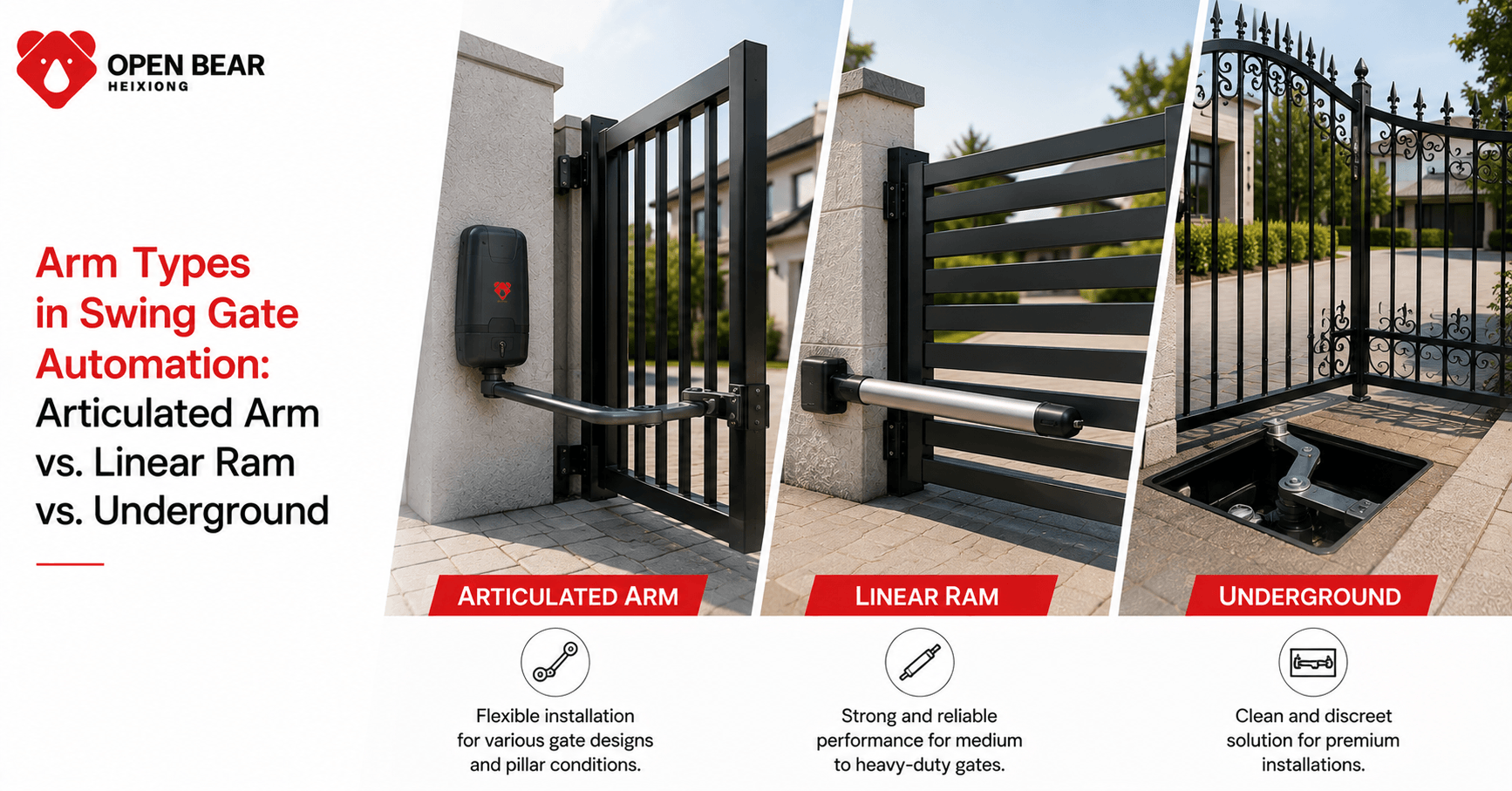
An articulated arm works like a jointed elbow. There's a driven segment and a hinged forearm that fold and unfold to swing the leaf. Because the arm reaches out from the post, it copes with the one situation that defeats other operators: a wide pillar, where the hinge sits a long way back from the face of the leaf. When that distance is large, an articulated arm gate opener is often the only thing that'll fit without you cutting into the pier.
· Best for: wide pillars, residential and light-commercial gates, retrofits where the hinge can't move.
· Strength: forgiving geometry, easily the simplest to mount on an awkward post.
· Watch-out: the jointed arm is the most visible hardware of the three, and the extra linkage gives you a little more to maintain.
Linear ram operators
A linear ram is a straight actuator, a screw or worm drive inside a tube that extends and retracts to push the leaf directly. It's the workhorse of commercial swing automation. Compact, strong, and self-locking, because the screw holds the leaf wherever it stops. That self-locking behaviour is a real security feature, the gate can't just be shoved open by hand. Our side-mounted swing operator is a compact ram-style unit built for exactly this, and the side-mounted design guide walks through its footprint if you want the detail.
· Best for: commercial and security-led sites, standard pillar geometry, heavier leaves.
· Strength: strong, tamper-resistant, tidy on the eye, and straightforward to diagnose.
· Watch-out: unforgiving on geometry. The hinge-to-mount distance has to match the ram's stroke chart, or the gate won't reach full open, or it'll strain at both ends.
That geometry sensitivity is the number-one linear-ram install mistake, and it's an avoidable one. Pull the operator's mounting chart and set the bracket to the specified pivot distances before you weld a thing.
Underground / floor operators
An underground operator buries the drive in a foundation vault at the base of the post, connected to the leaf by a below-ground arm. From the street there's no hardware to see at all. The gate just moves. That invisibility is the entire point, which is why you find them on heritage properties, architect-led homes, and prestige commercial entrances where a visible arm would spoil the whole look. Our hydraulic floor-spring operator is the underground option in the range, and the invisible floor-operator guide covers the vault prep.
· Best for: aesthetic-critical sites, heritage gates, anywhere the hardware has to disappear.
· Strength: invisible, no load hanging off the pillar, and it doesn't eat into pedestrian clearance.
· Watch-out: the install is the hard part. The vault has to drain, or the operator ends up sitting in water. Drainage and waterproofing aren't negotiable, and retrofitting one into an existing gate is a civil-works job, not an afternoon.
Retrofit vs new-build: the arm decision shifts
On a new build you can influence the pillar and hinge positions before anything's set, which throws every option open. You can design the geometry around a linear ram, or pour a vault for an underground unit while the ground's already dug. Retrofits are the opposite story. The pillars exist, the hinges are fixed, and you fit the arm that tolerates whatever's already there. That's exactly why articulated arms dominate retrofit work, they absorb the awkward pillar-to-hinge distances a linear ram simply can't. So if you're specifying at design stage, settle the arm before the civils go in. Retrofitting an underground operator later means breaking up a finished driveway, and nobody enjoys that conversation.
Here is Table 1 converted into a clean, text-based format with clear headings and bullet points:
Comparing Swing Arm Types
Articulated Arm
Articulated arms offer a forgiving installation process, making them an excellent choice for retrofitting onto existing structures with wide posts.
- Install Effort: Low–medium
- Pillar Geometry: Easily handles wide pillars
- Visibility: Most visible of the three options
- Best Fit: Retrofits and wide piers
Linear Ram
Linear rams provide a sleek, low-profile look along the gate leaf, ideal for commercial sites that require strong holding force.
- Install Effort: Medium
- Pillar Geometry: Requires correct pillar-to-hinge geometry
- Visibility: Slim and side-mounted
- Best Fit: Commercial and security-led applications
Underground / Floor
Underground operators require extensive ground preparation but deliver a completely hidden installation that preserves architectural beauty.
- Install Effort: High (requires civil/ground works)
- Pillar Geometry: Works with any pillar geometry
- Visibility: Completely invisible
- Best Fit: Aesthetic-led designs and heritage sites
The decision, boiled down
Three quick questions settle most jobs:
1. Can you see the hardware, and does anyone care? If looks are critical, go underground. If not, read on.
2. How far is the hinge from the pillar face? Large distance points to an articulated arm. Standard distance points to a linear ram.
3. Is security a priority? A linear ram's self-locking screw resists forced entry better than a jointed arm does.
Here is Table 2 converted into a clean, layout-safe text format:
Choosing an Arm Type by Scenario
Retrofit Onto Wide Brick Piers
When upgrading existing gates with deep or wide brick pillars, installing standard linear rams can require cutting into the masonry.
- Arm Choice: Articulated arm
- Reason: Reaches around and across wide pillars without needing to cut into the masonry.
New-Build Commercial Entrance
For modern commercial entrances built to standard architectural specifications, strong structural hold and security are paramount.
- Arm Choice: Linear ram
- Reason: Delivers strong, self-locking operation that integrates smoothly with standard pillar geometry.
Heritage or Architect-Designed Home
When preserving original gate aesthetics or high-end architectural lines is the top priority.
- Arm Choice: Underground operator
- Reason: Complete concealment with zero visible hardware on the gate leaf.
Coastal or Dusty Exposed Site
Environments exposed to heavy salt air, sand, or airborne debris require simplified drive mechanisms that resist wear.
- Arm Choice: Linear ram (sealed)
- Reason: Has fewer exposed joints and linkages that could foul, jam, or corrode over time.
High-Security Perimeter
For entryways requiring high physical resistance against forced entry or mechanical tampering.
- Arm Choice: Linear ram
- Reason: The internal screw drive mechanism offers inherent tamper resistance and strong holding power against forced movement.
People also ask
What's the difference between an articulated arm and a linear ram gate opener?
An articulated arm is a jointed 'elbow' that folds and unfolds, reaching out from the post, which is ideal when the hinge sits well back from a wide pillar. A linear ram is a straight actuator that extends and retracts to push the leaf directly. It's more compact and self-locking for security, but fussy about the hinge-to-mount geometry. Wide pillar or a retrofit favours the articulated arm. Standard geometry and a security brief favour the ram.
Are underground gate operators worth the extra install cost?
On aesthetic-critical sites, yes. They hide the hardware completely and take the load off the pillar. But the vault has to be prepped with proper drainage and waterproofing, or the operator ends up sitting in water. Budget for the civil works, because that, not the motor, is where the cost and the risk actually sit.
Which arm type is the most secure?
The linear ram. Its screw drive is self-locking, so the leaf can't be forced open by hand, which is a genuine edge on a high-security perimeter compared with a jointed articulated arm.
Where the arm meets the rest of the spec
Arm type doesn't sit in isolation, it interacts with two other calls. First, the drive principle: an underground operator is usually hydraulic, which loops you straight back to the hydraulic vs. mechanical comparison. Second, load: a heavy dual gate narrows your arm options, because the geometry and the torque both tighten at once, and there's more on that in heavy-duty dual swing openers guide. Whatever arm you land on, the leaf's weight and wind exposure still set the torque, which is the weight and wind-load calculation.
Pick the arm for the pillar and the look, size the motor for the leaf, and confirm the mounting chart before the bracket goes anywhere near the post. Browse the swing operators in the full product range, check them against your residential or commercial site type, and the technical team can confirm the right arm for an awkward opening.
About the Author
Daniel Okafor is a senior gate automation engineer whose specialism is retrofits and awkward installs, the wide pillars, tight clearances and heritage sites where arm choice makes or breaks the job. He works with the Open Bear team in Shenzhen across the articulated, linear and underground operator ranges. He writes to help installers dodge the geometry mistakes that turn a morning job into a full day. Reach the technical team via the contact page.

Explore Related Automation Systems
Looking for motors, hardware, or installation systems mentioned in this guide? Discover our factory-direct gate opener range:
All Gate Openers
Browse DC24V sliding, swing & barrier operators with full factory warranty.
Explore Products →Residential Gate Operators
Ultra-quiet, solar-ready sliding & swing gate motors for homes and villas.
Residential Solutions →Commercial Gate Systems
Continuous-duty operators for gated communities, business parks & parking.
Commercial Solutions →Industrial Heavy-Duty
High-torque motors engineered for gates up to 4,000 kg and logistics hubs.
Industrial Solutions →