
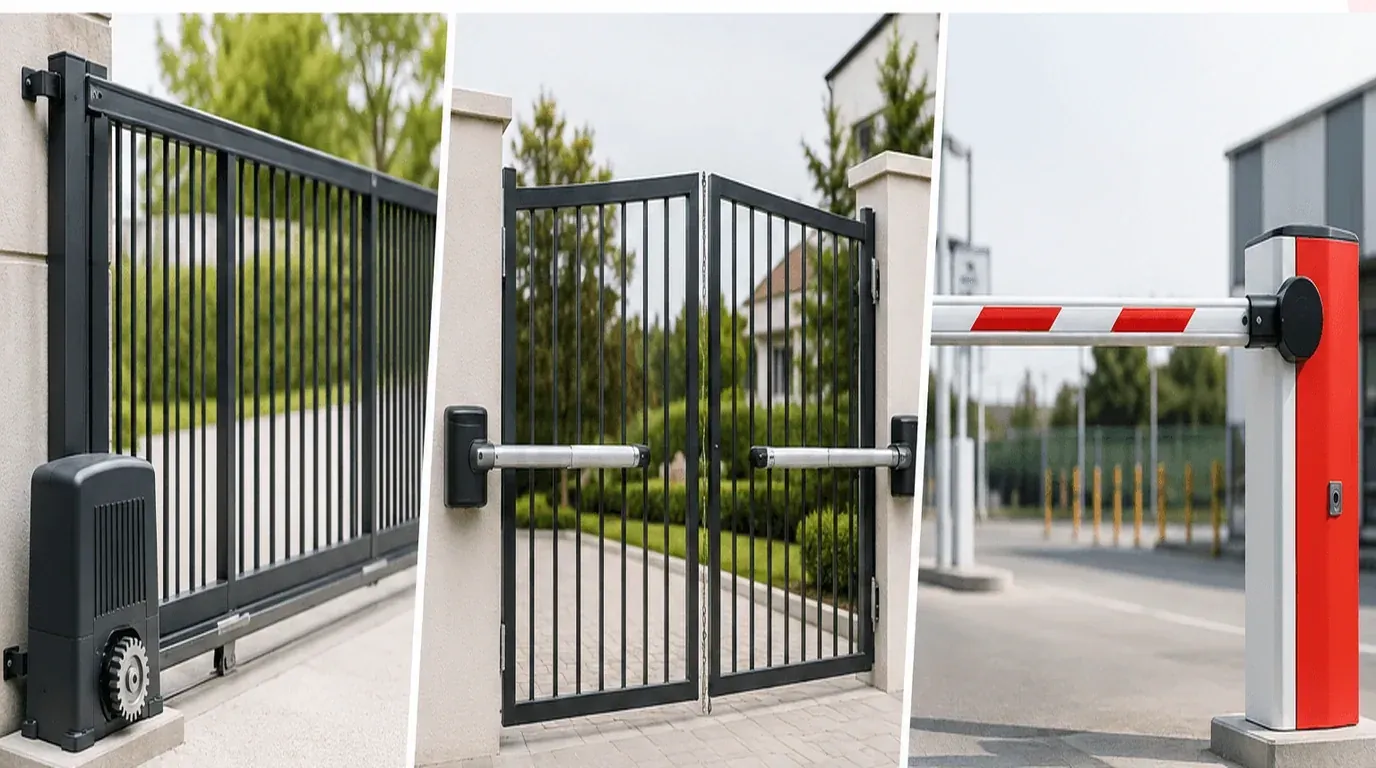
Knowing how to open an electric gate manually is the one piece of gate maintenance every owner should learn. Every automatic gate can be opened by hand. The opener holds the gate through a gearbox, and a manual release gate opener mechanism disconnects that drive so the gate moves freely. The trouble is that most people first look for the release in the dark, in the rain, with a car blocking the drive.
This guide explains how to open an electric gate manually on swing, sliding, and barrier systems, what to watch out for, and how to put everything back afterward.
Find the Release Before You Need It
Do this on a dry afternoon rather than during an outage.
- Locate the release point on each opener.
- Find the gate manual release key and test that it turns.
- Practice one full release and re-engage.
- Show everyone in the household or on staff how it works.
- Keep a spare key somewhere you can reach from outside the gate.
That last point matters. If the only key is inside a garage behind the gate, it will not help you during an electric gate power cut.
Safety First
A released gate is a heavy object with nothing holding it.
- Switch off power at the isolator before releasing, if you can reach it safely.
- On a sloping driveway, a released sliding gate can roll on its own. Stand to the side, never in its path.
- On barrier gates, the boom is spring balanced and can swing upward quickly when released.
- Keep children and pets well clear.
- Never put fingers near the gear, rack, or hinge area.
If a vehicle is trapped between the gate leaves or under a boom, move people clear before moving the gate.
How the Manual Release Works
Inside the opener, a clutch or lever connects the motor and gearbox to the drive. Releasing it disconnects that link. The motor stays where it is, and the gate becomes free to push.
Most releases are one of three types:
- Key-operated cover. A small keyed cover on the housing, usually on the side or front.
- Lever under a cap. A plastic cap that lifts off to reveal a lever.
- Keyed lever combination. The key opens a flap and the lever underneath does the releasing.
Releasing by Gate Type
Sliding Gates
- Switch off the power if you can.
- Find the release door on the side of the motor housing.
- Insert the gate manual release key and turn it, usually a quarter turn.
- Open the flap and pull the lever down or outward, following the arrow marked on the casting.
- Push the gate along the track by hand, from the side, not from in front.
- Stop before the physical end stops.
If the gate will not move after releasing, the lever may not be fully engaged in the release position. Check that it has traveled its full range. If it still will not move, the gate itself is jammed, not the opener.
Swing Gates
The method depends on the type of operator.
Arm and ram operators: lift the cap or open the cover at the outer end of the arm or on the body of the ram. Turn the key or pull the lever, then push the leaf open. Move each leaf separately.
Underground operators: the release sits under a cover plate in the ground box beside the hinge. Lift the cover, insert the key, and turn until the lever frees. Underground boxes collect water and leaves, so clear the box before you look for the release.
Push swing leaves near the outer edge, not near the hinge, and be ready for the leaf to keep moving if the ground slopes or the wind catches it.
Barrier Gates
Barrier booms are balanced by a spring, so the boom has stored energy in it.
- Open the cabinet door with the cabinet key.
- Hold the boom with one hand before releasing.
- Turn the release lever or key inside the cabinet.
- Raise the boom slowly to the vertical position.
- Secure it so wind cannot drop it back down.
Never let go of the boom during release. A balanced boom can rise sharply on its own. For more on these systems, see our guide to boom barrier gates for parking and toll lanes.
What Happens During an Outage
Openers behave differently when the power drops.
- With battery backup, a DC opener keeps working for a number of cycles, so you may not need the release at all.
- Without backup, the gate stops where it is. It may be fully open, fully closed, or halfway.
- When power returns, most boards wait for a command rather than moving on their own. Some run a slow relearn cycle on the first press.
If the gate stopped partway and a vehicle is under it or between the leaves, release the drive and move the gate clear before doing anything else. Do not reconnect power while someone is in the opening.
Mistakes to Avoid
- Forcing the gate before the lever is fully in the release position, which damages the gear and rack
- Standing downhill of a released sliding gate
- Letting go of a barrier boom during release
- Leaving the opener released and powered, so the board tries to drive a disconnected gearbox
- Storing the only release key behind the gate
What to Do When Power Returns
Leaving the opener released is a security risk, because anyone can push the gate open by hand.
- Move the gate back to the fully closed position by hand.
- Return the lever to the drive position and lock the cover.
- Restore power at the isolator.
- Run one full cycle on the remote and watch it.
- Confirm the gate stops in the right places at both ends.
Some boards relearn their limit positions after a power interruption. If the gate behaves oddly on the first cycle, check the manual for the relearn procedure rather than forcing it.
Avoiding the Problem Next Time
Manual release is a backup, not a plan. Knowing how to open an electric gate manually matters, but it is better not to need it. If your gate is the only way in or out, add a way to keep it running.
- Battery backup lets a DC opener finish a number of cycles during an outage. Open Bear openers run on 24V DC, which suits battery backup well.
- Solar power works for remote entrances and farm gates with no mains supply.
- A pedestrian gate beside the main gate means people can still get in and out during an electric gate power cut.
- A keypad or app gives a second control route if a remote fails.
Our gate access control guide explains the control options, and our gate accessories range includes smart control and safety devices.
Quick Reference by Gate Type
Gate type | Where the release is | Watch out for |
|---|---|---|
Sliding | Keyed flap on the side of the motor | Gate rolling on a slope, end stops |
Swing, arm or ram | Cap or keyed cover on the arm or ram body | Wind catching the leaf, sloping ground |
Swing, underground | Cover plate in the ground box by the hinge | Water and debris in the box |
Barrier | Lever inside the cabinet | Spring-loaded boom rising fast |
Keys, Labels, and Handover
Treat the release key like a fire exit key.
- Label it clearly and keep it with the car keys or at the entrance.
- Give a copy to anyone who regularly uses the gate.
- On commercial sites, keep one in the key cabinet and note the location in the site induction.
- Replace lost keys promptly. Most manufacturers can supply another.
If you are not sure which release your opener has, check the manual. Every kit from Gate Opener Factory ships with English manuals and diagrams that show the release point, and you can also download documents from our downloads page.

Frequently Asked Questions
Key engineering and selection answers regarding this topic
A: Yes. Every powered gate has a manual release, so people can open the gate during a power outage or a fault. The release point and method vary by opener type, so check your manual.
A: Contact the manufacturer or installer for a replacement, since many use standard keys for a given model. Do not force the cover, because a damaged release can leave you unable to free the gate later.
A: Yes, once you return the lever to the drive position and lock the cover. Run one full cycle afterward and check the stopping points, as some boards relearn limits after a power interruption.
A: It is safer for access but weaker for security, since anyone can push the gate open. If you must leave it released, close it fully and secure it with a padlock or chain until the opener is working again.
A: It depends on the battery size, the gate weight, and how many cycles you run. Backup is sized in cycles rather than hours, so keep the release key accessible even on a gate with a battery fitted.
Explore Related Automation Systems
Looking for motors, hardware, or installation systems mentioned in this guide? Discover our factory-direct gate opener range:
All Gate Openers
Browse DC24V sliding, swing & barrier operators with full factory warranty.
Explore Products →Residential Gate Operators
Ultra-quiet, solar-ready sliding & swing gate motors for homes and villas.
Residential Solutions →Commercial Gate Systems
Continuous-duty operators for gated communities, business parks & parking.
Commercial Solutions →Industrial Heavy-Duty
High-torque motors engineered for gates up to 4,000 kg and logistics hubs.
Industrial Solutions →