Most gates don't die suddenly. They get a little slower, a little noisier, and then one wet Monday morning the gate stops halfway and blocks the driveway. By then the problem has usually been building for months. A dry hinge. A sensor caked in dust. A bolt that worked itself loose.
Gate opener maintenance is mostly about catching those small things early. The routine below takes about ten minutes a month, an hour or so twice a year, and a bit longer once a year. It works for both swing and sliding gates.
The short version
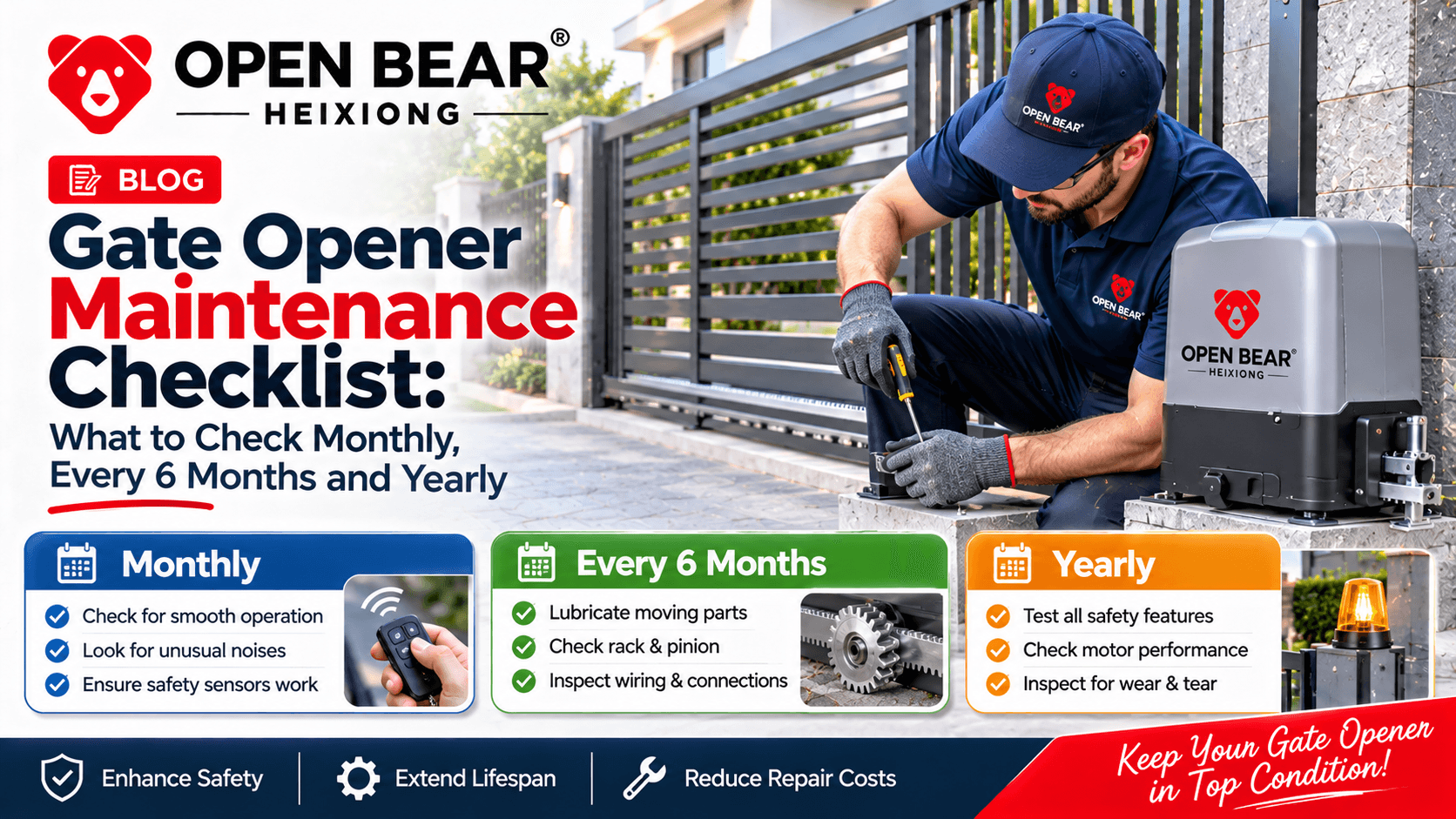
- Every month: wipe the sensors, test the remote, try the manual release, push the gate by hand.
- Every 6 months: grease the moving parts, tighten bolts, clear the track, check the limits.
- Once a year: test the battery, inspect wiring and seals, review the force settings.
Busy commercial gates, dusty yards and coastal sites need these checks more often. And if your manual says something different, the manual wins.
Before you start: switch the power off
Turn off the power and disconnect the battery before you go near wiring, the control board or anything that moves. Keep kids, pets and cars well away from the gate. It can start moving the moment power comes back.
Open Bear motors run on 24V DC, which is far gentler than mains voltage. The supply feeding the power unit is still mains, though, so anything involving that wiring is a job for a qualified electrician.
Monthly: the ten-minute check
Start with the photocells. Wipe each lens with a soft, damp cloth. One cobweb across the beam is enough to stop a gate closing, and people blame the motor for it all the time. While you're there, make sure the two sensors still face each other. A knock from a car or a lawnmower can nudge them out of line.
Next, test obstacle detection. Close the gate and put a cardboard box in its path. The gate should stop or reverse when it touches the box. If it shoves straight through, stop using auto mode and get the force settings looked at. Don't just live with it.
Try every remote from where you normally use it, say the driver's seat of the car. If the range has dropped, swap the remote battery before anything else. Our guide to gate remote range problems covers the other causes.
Then the manual release. This is the check people skip, and it's the one you'll need on the worst possible day. Turn the key, move the gate by hand, lock it again. If you've never done it, read how to open an electric gate manually in a power cut now, not during the power cut.
Last, release the motor and push the gate by hand. It should move freely with light pressure. If it drags, scrapes or catches in one spot, the problem is the gate, not the motor. A bent track or a seized hinge makes even a strong opener work harder on every cycle, and it will wear out sooner because of it.
And listen. A new grinding, clicking or beeping sound is the gate telling you something. If you hear one, our fault-finding guide on a humming, clicking or beeping gate motor is the next stop.
Every six months: grease, bolts and alignment
Twice a year, get your hands a little dirty.
Start with lubrication, using whatever your manual recommends. On a swing gate that means the hinges and the pivot points of the arm or actuator. On a sliding gate it means the wheels, the guide rollers and the rack. Wipe off the old grease and grit first. Gritty grease does more harm than none at all.
Then bolts. Vibration loosens everything eventually, so check the motor mounting, the brackets on the post and the gate, and the fixings holding the rack. A loose bracket is behind a surprising number of noisy-motor complaints.
Look at the structure too: rust on hinges, cracks near welds, a post that has started to lean. On a sliding gate, clear stones and leaves out of the track and spin the wheels by hand.
If you have a rack-and-pinion drive, check that the pinion meshes evenly along the whole run. Worn teeth, a bent section of rack, or a gap that's too loose or too tight will all show up as rough movement.
Finally, check the limits. The gate should stop cleanly at fully open and fully closed without slamming into the end stops. If it overshoots or stops early, reset the limits as described in the manual.
Once a year: the full service
Put this one in the calendar. It's also the point where paying a technician starts to make sense, if you'd rather not do it yourself.
Battery. If you have backup power, look at the terminals for corrosion and count how many cycles the gate manages on battery alone. A weak battery looks fine right up until the power goes out, so replace it when its capacity drops, not when it fails.
Wiring and seals. Look for cracked cable insulation, loose terminals and any sign of water or condensation inside the control box. Check that the lid seals and cable entries are still doing their job.
Settings. Review force, speed and auto-close. Open Bear sliding gate controllers have 10 programmable settings, so make sure they still suit how the gate is used. One rule: never turn the force up to cover a mechanical fault. Fix the fault.
Motor and drive. Check the housing for moisture and cracks, then listen to the motor under load. Hesitation at the start of a move is worth noting.
Safety devices. Retest the photocells, safety edges and warning lights, and replace anything damaged or failing.
Then write it all down. A simple log with dates helps with warranty claims and tells you when something was last touched.
Swing vs sliding: where the wear is
Area | Swing gate opener | Sliding gate opener |
|---|---|---|
Main wear points | Hinges, arm or actuator pivots | Wheels, track, rack and pinion |
Key check | Hinge movement, bracket tightness | Track clearance, rack alignment |
Typical problem | Sagging gate, loose brackets | Debris in the track, worn wheels |
Wind | Wide leaves catch it like a sail | Much less affected |
Lubrication focus | Hinges and arm joints | Wheels, rollers and rack |
Still deciding between the two styles? Our sliding vs swing gate guide breaks down the differences.
Hot, cold, dusty and coastal sites
Climate changes how often you need to look. Heat and strong sun dry out grease and crack cable insulation, so check both more often. In cold areas, ice in a track or on a hinge can jam the gate. Clear it and don't force it. Dust and sand clog tracks and sensors, so clean both every two to four weeks. Near the coast, salt air eats brackets, bolts and hinges.
Open Bear openers are rated for -35°C to 70°C, so the motor itself copes with extremes. The gate, track and hinges around it still need the attention.
DIY or call someone?
You can safely do the cleaning, remote testing, release check, greasing, track clearing and tightening of visible bolts yourself. Leave mains wiring, control board repairs, motor or gearbox faults, a gate that has gone out of alignment and repeated obstacle-detection failures to a professional. So is anything you aren't sure about.
Looking after several gates, a residential community or a business site? An annual maintenance contract saves a lot of chasing. Scheduled visits and priority call-outs mean small faults get fixed before they stop the site. Our FAQ explains the maintenance contracts we offer.
Printable checklist
When | Task | Done |
|---|---|---|
Monthly | Clean photocell lenses and check alignment | ☐ |
Monthly | Test obstacle detection | ☐ |
Monthly | Test remotes and keypad | ☐ |
Monthly | Test the manual release | ☐ |
Monthly | Move the gate by hand and feel for resistance | ☐ |
6 months | Lubricate hinges, wheels, rollers and rack | ☐ |
6 months | Tighten bolts and brackets | ☐ |
6 months | Clear the track and check wheels | ☐ |
6 months | Check rack and pinion mesh | ☐ |
6 months | Confirm limit settings | ☐ |
Yearly | Test battery and check terminals | ☐ |
Yearly | Inspect wiring and waterproofing | ☐ |
Yearly | Review force and speed settings | ☐ |
Yearly | Inspect motor and drive | ☐ |
Yearly | Test all safety devices | ☐ |
Yearly | Update the service log | ☐ |
Don't wait for the schedule if...
- The gate is slower than it used to be, or hesitates when it starts.
- The motor hums or clicks but the gate doesn't move.
- The gate stops or reverses for no obvious reason.
- The gate opens or closes on its own. Our guide to a gate opening or closing by itself lists the usual causes.
- Remote range keeps getting shorter.
- Battery backup runs out far sooner than it used to.
Where to go from here
Whether you run a sliding gate motor or a heavy-duty swing gate opener, the routine is the same: keep it clean, keep it greased, keep it aligned and test the safety devices.
Not sure your motor suits your gate in the first place? Try our gate opener sizing guide, or contact our team with your gate weight, length and power situation and we'll point you to a suitable setup.

Frequently Asked Questions
Key engineering and selection answers regarding this topic
Quick checks monthly, a mechanical check every six months, and a full service once a year. A busy commercial gate may need a service every three to six months.
Whatever your manual recommends. Put it on hinges, wheels, rollers and the rack, and wipe the old grease off first. Avoid anything that attracts dust unless the manual allows it.
That depends on the model, how often the gate runs and the climate. Regular cleaning, lubrication and sensible settings cut wear, and that's what helps the motor and drive last.
Usually a dry hinge or wheel, a loose bracket, debris in the track or a misaligned rack. Check those before you suspect the motor.
A dated service log helps if you ever need to claim. Check your warranty terms for any maintenance conditions.
Yes for cleaning, testing and basic lubrication. Mains wiring, control board work and motor repairs belong to a qualified technician.
Explore Related Automation Systems
Looking for motors, hardware, or installation systems mentioned in this guide? Discover our factory-direct gate opener range:
All Gate Openers
Browse DC24V sliding, swing & barrier operators with full factory warranty.
Explore Products →Residential Gate Operators
Ultra-quiet, solar-ready sliding & swing gate motors for homes and villas.
Residential Solutions →Commercial Gate Systems
Continuous-duty operators for gated communities, business parks & parking.
Commercial Solutions →Industrial Heavy-Duty
High-torque motors engineered for gates up to 4,000 kg and logistics hubs.
Industrial Solutions →